Monday, September 29, 2014

Why and how we care about inequality

Note: These are remarks I gave in a concluding panel at the Conference on Inequality in Memory of Gary Becker, Hoover Institution, September 26 2014. The conference program here, and John Taylor's summary here, where you can see the great papers I allude to. I'll probably rework this to a more general essay, so I reserve the right to recycle some points later.

Why and How We Care About Inequality

Wrapping up a wonderful conference about facts, our panel is supposed to talk about “solutions” to the “problem” of inequality.

We have before us one “solution,” the demand from the left for confiscatory income and wealth taxation, and a substantial enlargement of the control of economic activity by the State.

Note I don’t say “redistribution” though some academics dream about it. We all know there isn’t enough money, especially to address real global poverty, and the sad fact is that government checks don’t cure poverty. President Obama was refreshingly clear, calling for confiscatory taxation even if it raised no income. “Off with their heads” solves inequality, in a French-Revolution sort of way, and not by using the hair to make wigs for the poor. The agenda includes a big expansion of spending on government programs, minimum wages, “living wages,” government control of wages, especially by minutely divided groups, CEO pay regulation, unions, “regulation” of banks, central direction of all finance, and so on. The logic is inescapable. To “solve inequality,” don’t just take money from the rich. Stop people, and especially the “wrong” people, from getting rich in the first place.

In this context, I think it is a mistake to accept the premise that inequality, per se, is a “problem” needing to be “solved,” and to craft “alternative solutions.”

Just why is inequality, per se, a problem?

Suppose a sack of money blows in the room. Some of you get $100, some get $10. Are we collectively better off? If you think “inequality” is a problem, no. We should decline the gift. We should, in fact, take something from people who got nothing, to keep the lucky ones from their $100. This is a hard case to make.

One sensible response is to acknowledge that inequality, by itself, is not a problem. Inequality is a symptom of other problems. I think this is exactly the constructive tone that this conference has taken.

But there are lots of different kinds of inequality, and an enormous variety of different mechanisms at work. Lumping them all together, and attacking the symptom, “inequality,” without attacking the problems is a mistake. It’s like saying “fever is a problem. So medicine shall consist of reducing fevers.”


Yes, the reported, pre-tax income and wealth of the top 1% in the U.S. and many other countries has grown. We have an interesting debate whether this is “good” or “market” inequality – Steve Jobs starts a company that invents the iphone, takes home 1/10 of 1% of the welfare (consumer surplus) the iphone created, and lives in a nice house and flies in a private jet – or “bad,” “rent-seeking” inequality, cronyism, exploiting favors from the government. Josh Rauh made a good case for “market.” It’s interesting how we even use different language. Emmanuel Saez spoke of how much income the 1% “get,” and Josh how much the 1% “earn.”

In middle incomes, as Kevin Murphy told us, the “returns to skill” have increased. This has nothing to do with top-end cronyism. As Kevin so nicely reminds us, wages go up when demand for skill goes up and supply does not. He locates the supply restriction in awful public schools, taken over by teacher’s unions. Limits on high –skill immigration also restrict supply and drive up the skill premium. There’s a problem we know how to fix. Confiscatory taxation isn’t going to help!

More “education” is one obvious “solution.” But we need to be careful here, and not too quickly join the chorus asking that our industry be further subsidized. The returns to education chosen and worked hard for are not necessarily replicated in education subsidized or forced. Free tuition for all majors draws people into art history too. Forgiving student loans for people who go to non-profits or government work, or a large increase in wealth and income taxation, remove the market signal to study computer programming rather than art history, which raises the skill premium even more. Saudi Arabia spends a lot on “education” in Madrases around the world. In a Becker memorial conference remember three rules: Supply matters, not just demand; don’t redistribute income by distorting prices; and human capital investments respond to incentives. (By the way, I’m all for art history. Just don’t pretend that the measured economic returns to education will apply.)

America has a real problem on the lower income end, epitomized by Charles’ Murray’s “Fishtown.” A segment of America is stuck in widespread single motherhood, leading to terrible early-child experiences, awful education, substance abuse, and criminality. 70% of male black high school dropouts will end up in prison, hence essentially unemployable and poor marriage prospects. Less than half are even looking for legal work.

This is a social and economic disaster. And it has nothing to do with whether hedge fund managers fly private or commercial. It is immune to floods of Government cash, and, as Casey Mulligan reminded us, Government programs are arguably as much of the problem as the solution. So are drug laws, as much of the earlier discussion reminded us.

Around the world, about a billion people still live on $2 a day, have no electricity, drinking water, or even latrines. If you care about “inequality,” minimum wage earners in the US should be paying Piketty taxes.

These cases all represent completely different problems. Where there are problems, we should fix them, but to fix them, not to “reduce inequality.”

Kinds of inequality

More puzzling, why are critics on the left so focused on the 1% in the US, when by many measures we live in an era of great leveling?

Earnings inequality between men and women has narrowed drastically, as Kevin Murphy reminded us. Inequality across countries, and thus across people around the globe, has also been shrinking dramatically even as income inequality within advanced countries has risen. One billion Chinese were rescued from totalitarian misery, and a billion Indians sort-of-rescued from British-style license-Raj socialism. These are wonderful events for human progress as well as, incidentally, for global inequality. Sure, these countries have many political and economic problems left, but the “its’ all getting worse” story just aint’ so. China and India did not start growing by confiscatory taxation of income and wealth, and increasing state intervention in markets. Exactly the opposite. And the parts of the world left or falling behind – parts of the Middle East, Latin Amirica (think Venezuela), parts of Africa – have just nothing to do with the private-jet purchases of US hedge fund billionaires.

“Inequality” is about more than income or wealth, reported to tax authorities. Consumption is much flatter than income. Rich people mostly give away or reinvest their wealth. It’s hard to see just how this is a problem.

Political, social, cultural inequality, inequality of lifespan, of health, of social status, even of schooling are all much flatter than they used to be (Nick Eberstat recently summarized these in a nice Wall Street Journal Oped.) Mark Zuckerberg wears a hoody, not a top hat.

Look at Versailles. Nobody, not even Bill Gates, lives like Marie Antoinette. And nobody in the US lives like her peasants. In 1960, Mao Tse-Tung waved his hand and 20 millions died. In 1935, Joseph Stalin did the same. Neither reported a lot of income to tax authorities for economists to measure “inequality.” It is preposterous to claim that, even the citizens of Ferguson Mo., with all their problems and injustices, are less equal now than they were in 1950. Or 1850.

Why does it matter at all to a vegetable picker in Fresno, or an unemployed teenager on the south side of Chicago, whether 10 or 100 hedge fund managers in Greenwich have private jets? How do they even know how many hedge fund managers fly private? They have hard lives, and a lot of problems. But just what problem does top 1% inequality really represent to them?

I’ve been reading Piketty, Saez, Krugman, Stiglitz, the New York Times editorial pages to find the answers. They all recognize that inequality per se is not a persuasive problem, so they must convince us that inequality causes some other social or economic ill.

Here’s one. Standard and Poors economists wrote a recent summary report on inequality, (earlier post here) perhaps as penance for downgrading the US debt, and wrote
As income inequality increased before the crisis, less affluent households took on more and more debt to keep up--or, in this case, catch up--with the Joneses....
In Vanity Fair, Joe Stiglitz wrote similarly that inequality is a problem because it causes
a well-documented lifestyle effect—people outside the top 1 percent increasingly live beyond their means….trickle-down behaviorism
Aha! Our vegetable picker in Fresno hears that the number of hedge fund managers in Greenwich with private jets has doubled. So, he goes out and buys a pickup truck he can’t afford. Therefore, Stiglitz is telling us, we must quash inequality with confiscatory wealth taxation… in order to encourage thrift in the lower classes?

If this argument held any water, wouldn’t banning “Keeping up with the Kardashians” be far more effective? (Or, better, rap music videos!) If the problem is truly overspending by low income Americans, can we not think of more directed solutions? For example, might we not want to remove the enormous taxation of savings that they face through social programs?

Another example. The S&P report moved on to a new story: Inequality is a problem because rich people save too much of their money, and poor people don’t. So, by transferring money from rich to poor, we can increase overall consumption and escape “secular stagnation.”

I see. Now the problem is too much saving, not too much consumption. We need to forcibly transfer wealth from the rich to the poor in order to overcome our deep problem of national thriftiness.

I may be bludgeoning the obvious, but let’s point out just a few ways this is incoherent. If Keynesian “spending” and “aggregate demand” are the problems behind low long-run growth rates – and that’s a big if - standard Keynesian answers are a lot easier solutions than confiscatory wealth taxation and redistribution. Which is why standard Keynesians argued for monetary and fiscal policies, not confiscatory anti-inequality taxation, until the latter became politically popular.

In a series of recent blog posts, (see coverage here) Paul Krugman offers evidence that people vastly underestimate how wealthy the rich are, bemoans how they live separate lives -- my fry cook has, in fact, no idea of their lifestyle -- and argues for confiscatory taxation to eliminate the "externality" of their excessive consumption.  Well, I'm glad logical consistency isn't holding back these arguments.

The most common argument is that we have to reduce income inequality to avoid political instability. If we don’t redistribute the wealth, the poor will rise up and take it. As a cause-and effect claim about human affairs, this is dubious amateur political science, one that would look especially amateurish to the political scientists and historians at this Hoover Institution on War, Revolution and Peace. Maybe the poor should rise up and overthrow the rich, but they never have. Inequality was pretty bad on Thomas Jefferson’s farm. But he started a revolution, not his slaves.

These are just three examples, and I won’t go on since time is short. But there are some interesting patterns. The answer is always the same – confiscatory wealth taxation and expansion of the state. The question, the “problem” this answer is supposed to solve keeps changing. When an actual economic problem is adduced – excessive spending by the poor, inadequate spending by the rich, political instability -- they don’t advocate the problem’s natural solution. These “problems” are being thought up afterwards to justify the desired answer. And amazing, novel and undocumented cause-and-effect assertions about public policy are dreamed up and passed around like internet cat videos.

Politics and Money

But these are serious people. Let’s recognize this is all the balderdash and distraction that it seems, and that we are circling around the elephant in the room. Let’s try to find the core issue that they are really talking about. Let’s find a common ground, a resolvable difference, so we can stop talking past each other.

In the end, most of these authors are pretty clear the real problem they see: money and politics. They worry that too much money is corrupting politics, and they want to take away the money to purify the politics.

That explains the obsessive focus on the income and wealth of the top 1%. Consumption may be flatter, but income and wealth buy political connections. And all of our concern about the status of the poor, the returns to skill, awful education, the effects of widespread incarceration, all this is irrelevant to the money and politics nexus.

Now, the critique of an increasingly rent-seeking society echoes from both the left and the libertarians. Rent-seeking is a big problem. Cronyism is a big problem. Stigler finds a lot to agree with in Stiglitz. As do Friedman, Buchanan, and so forth.

But now comes the most astounding lack of logic of all. If the central problem is rent-seeking, abuse of the power of the state, to deliver economic goods to the wealthy and politically powerful, how in the world is more government the answer?

If we increase the statutory maximum Federal income tax rate 70% , on top of state and local taxes, estate taxes, payroll taxes, corporate taxes, sales taxes and on and on -- at a Becker conference, always add up all the taxes, not just the one you want to raise and pretend the others are zero -– will that not simply dramatically increase the demand for tax lawyers, lobbyists and loopholes?

If you believe cronyism is the problem, why is the first item on your agenda not to repeal the Dodd Frank act and Obamacare, surely two of the biggest invitations to cronyism of our lifetimes? And move on to the rotten energy section of the corporate tax code.

They don’t, and here I think lies the important and resolvable difference. Stiglitz wrote that “wealth is a main determinant of power.” Stigler might answer, no, power is a main determinant of wealth. To Stiglitz, if the state grabs all the wealth, even if that wealth is fairly won, then the state can ignore rent-seeking and benevolently exercise its power on behalf of the common man. Stigler would say that government power inevitably invites rent-seeking. His solution to cronyism is to limit the government’s ability to hand out goodies in the first place. We want a simple, transparent, fair, flat and low tax system.

Here is where I think Josh Rauh’s masterful collection of data that the upper 1% in the U.S. are making their money fairly, falls flat to left ears. They think even fairly gotten money will pervert politics.

Now we have boiled the argument down to a simple question of cause and effect. They believe that raising tax rates and a large increase in state direction of economic activity will reduce rent-seeking and cronyism. I assert the opposite, which is the rather traditional conclusion of the vast literature on public choice as well as obvious experience. If I were trying to be polite, I might say it’s an interesting new theory to be debated and investigated. But I’m not, and it isn’t. It is the cream on the cake of amateur ad-hoc assertions of cause-and-effect relationships in human affairs, changing the sign of everything we know.

As we look around the world, cronyism, rent-seeking, using the power of the state to deliver riches to yourself and privilege to your family is a huge problem, not just driving inequality, but driving most of poverty, lack of growth, and human misery throughout the world. But Egypt, say, does not suffer because it is not good enough at grabbing wealth, stifling markets and blocking the rise of entrepreneurs. Quite the opposite.

Politics and the agenda.

But let’s go with their argument. At least now the argument makes sense, in a way hat limiting envy-induced spendthrifery does not. But looked at in the light of day, the argument is truly scary. They are saying that the government must confiscate individual wealth so that individual wealth cannot influence politics in directions they don’t like. Koch brothers, no. Public employee unions, yes.

We finally agree on a cause-and-effect proposition. Yes, expanding the power of the state to direct economic activity and strip people of wealth is well-proven way to cement the power of the state and quash dissent.

So now you see why I rebel at the presumption that “inequality” is a problem, and why I rebel at the task of articulating an alternative “solution.” “Inequality” has become a meaningless buzzword, or code word for “on our team,” like “sustainability,” or “social justice.” Should we discuss “free-market solutions” to address “social justice?”

“Inequality” has become a code word for endless, thoughtless, and counterproductive intrusions into economic activity. Minimum wages, stronger teachers unions, even prison guard unions, are all advocated on the grounds of “providing middle class jobs” to “reduce inequality,” though they do the opposite. Mayor Bill de Blasio has already reduced it to farce: As reported in the New York times, the latest energy efficiency standards for fancy New York high rises are bing put in place. Why? To cool the planet by a billionth of a degree? To stem the rise of the oceans by a nanometer? No, first on the list… to reduce inequality. Poor people pay more of their incomes in heating bills, you see.

Finally, why is “inequality” so strongly on the political agenda right now? Here I am not referring to academics. Kevin has been studying the skill premium for 30 years. Emmanuel likewise has devoted his career to important measurement questions, and will do so whether or not the New York Times editorial page cheers. All of economics has been studying various poverty traps for a generation, as represented well by the other authors at this conference. Why is there a big political debate just now? Why is the Administration and its allies in the punditry, such as Paul Krugman and Joe Stiglitz, all a-twitter about “inequality?” Why are otherwise generally sensible institutions like the IMF, the S&P, and even the IPCC jumping on the “inequality” bandwagon?

That answer seems pretty clear. Because they don’t want to talk about Obamacare, Dodd-Frank, bailouts, debt, the stimulus, the rotten cronyism of energy policy, denial of education to poor and minorities, the abject failure of their policies to help poor and middle class people, and especially sclerotic growth. Restarting a centuries-old fight about “inequality” and “tax the rich,” class envy resurrected from a Huey Long speech in the 1930s, is like throwing a puppy into a third grade math class that isn’t going well. You know you will make it to the bell.

That observation, together with the obvious incoherence of ideas the political inequality writers bring us leads me to a happy thought that this too will pass, and once a new set of talking points emerges we can go on to something else.

But if that is our circumstance, clearly we should not fall for the trap. Don’t surrender the agenda. State our own agenda. We care about prosperity. We care about fixing the real, serious, economic problems our country faces and especially that people on the bottom of society face. Globally, we care about the billion on $2 a day, that no amount of tax and transfer will help.

The “solutions,” the secrets of prosperity, are simple and old-fashioned: property rights, rule of law, honest government, economic and political freedom. A decent government, yes, providing decent roads, schools, and laws necessary for the common good. Confiscatory taxation and extensive government direction of economic activity are simply not on the list.

Monday, September 22, 2014

A few things the Fed has done right -- the oped

Now that 30 days have passed, I can post the whole oped from the Wall Street Journal. See previous post for additional commentary

A Few Things the Fed Has Done Right

The Fed's plan to maintain a large balance sheet and pay interest on bank reserves is good for financial stability.

As Federal Reserve officials lay the groundwork for raising interest rates, they are doing a few things right. They need a little cheering, and a bit more courage of their convictions.

The Fed now has a huge balance sheet. It owns about $4 trillion of Treasury bonds and mortgage-backed securities. It owes about $2.7 trillion of reserves (accounts banks have at the Fed), and $1.3 trillion of currency. When it is time to raise interest rates, the Fed will simply raise the interest it pays on reserves. It does not need to soak up those trillions of dollars of reserves by selling trillions of dollars of assets.

The Fed's plan to maintain a large balance sheet and pay interest on bank reserves, begun under former Chairman Ben Bernanke and continued under current Chair Janet Yellen, is highly desirable for a number of reasons—the most important of which is financial stability. Short version: Banks holding lots of reserves don't go under.

This policy is new and controversial. However, many arguments against it are based on fallacies.


People forget that when the Fed creates a dollar of reserves, it buys a dollar of Treasurys or government-guaranteed mortgage-backed securities. A bank gives the Fed a $1 Treasury, the Fed flips a switch and increases the bank's reserve account by $1. From this simple fact, it follows that:

• Reserves that pay market interest are not inflationary. Period. Now that banks have trillions more reserves than they need to satisfy regulations or service their deposits, banks don't care if they hold another dollar of interest-paying reserves or another dollar of Treasurys. They are perfect substitutes at the margin. Exchanging red M&Ms for green M&Ms does not help your diet. Commenters have seen the astonishing rise in reserves—from $50 billion in 2007 to $2.7 trillion today—and warned of hyperinflation to come. This is simply wrong as long as reserves pay market interest.

• Large reserves also aren't deflationary. Reserves are not "soaking up money that could be lent." The Fed is not "paying banks not to lend out the money" and therefore "starving the economy of investment." Every dollar invested in reserves is a dollar that used to be invested in a Treasury bill. A large Fed balance sheet has no effect on funds available for investment.

• The Fed is not "subsidizing banks" by paying interest on reserves. The interest that the Fed will pay on reserves will come from the interest it receives on its Treasury securities. If the Fed sold its government securities to banks, those banks would be getting the same interest directly from the Treasury.

The Fed has started a "reverse repurchase" program that will allow nonbank financial institutions effectively to have interest-paying reserves. This program was instituted to allow higher interest rates to spread more quickly through the economy.

Again, I see a larger benefit in financial stability. The demand for safe, interest-paying money expressed so far in overnight repurchase agreements, short-term commercial paper, auction-rate securities and other vehicles that exploded in the financial crisis can all be met by interest-paying reserves. Encouraging this switch is the keystone to avoiding another crisis. The Treasury should also offer fixed-value floating-rate electronically transferable debt.

This Fed reverse-repo program spawns many unfounded fears, even at the Fed. The July minutes of the Federal Open Market Committee revealed participants worried that "in times of financial stress, the facility's counterparties could shift investments toward the facility and away from financial and nonfinancial corporations."

This fear forgets basic accounting. The Fed controls the quantity of reserves. Reserves can only expand if the Fed chooses to buy assets—which is exactly what the Fed does in financial crises.

Furthermore, this fear forgets that investors who want the safety of Treasurys can buy them directly. Or they can put money in banks that in turn can hold reserves. The existence of the Fed's program has minuscule effects on investors' options in a crisis. Interest-paying reserves are just a money-market fund 100% invested in Treasurys with a great electronic payment mechanism. That's exactly what we should encourage for financial stability.

The Open Market Committee minutes also said that, "Participants noted that a relatively large [repurchase] facility had the potential to expand the Federal Reserve's role in financial intermediation and reshape the financial industry." Yes, and that's a feature not a bug. The financial industry failed and the Fed is reshaping it under the 2010 Dodd-Frank financial-reform law. Allowing money previously invested in run-prone shadow banking to be invested in 100%-safe reserves is the best thing the Fed could do to reshape the industry.

Temptations remain. For example, with trillions of reserves in excess of regulatory reserve requirements, the Fed loses what was left of its control over bank lending and deposit creation. The Fed will be tempted to use direct regulation and capital ratios to try to micromanage lending. It should not. The big balance sheet is a temptation for the Fed to buy all sorts of assets other than short-term Treasurys, and to meddle in many markets, as it is already supporting the mortgage market. It should not.

The Fed is making no promises about the stability of these arrangements—a large balance sheet and market interest on reserves available to non-banks. It should. In particular, it should clarify whether it will allow its balance sheet to shrink as long-term assets run off, or reinvest the proceeds as I would prefer.

Most of the financial stability benefits only occur if these arrangements are permanent and market participants know it. We can debate whether interest rate policy should follow rules or discretion, be predictable or adapt to each day's Fed desire. But the basic structures and institutions of monetary policy should be firm rules.

The remaining short-term question is when to raise rates. Ms. Yellen has already made an important decision: The Fed will not, for now, use interest-rate policy for "macroprudential" tinkering. This too is wise. We learned in the last crisis that the Fed is only composed of smart human beings. They are not clairvoyant and cannot tell a "bubble" from a boom in real time any better than the banks and hedge funds betting their own money on the difference. Manipulating interest rates to stabilize inflation is hard enough. Stabilizing inflation and unemployment is harder still. Additionally chasing will-o-wisp "bubbles," "imbalances" and "crowded trades" will only lead to greater macroeconomic and financial instability.

Here too a firm commitment would help. Otherwise market participants will be constantly looking over their shoulders for the Fed to start meddling in home and asset prices.

Plenty of uncertainties, challenges and temptations remain. Tomorrow, we can go back to investigating, arguing and complaining. Today let's cheer a few big things done right.

Mr. Cochrane is a professor of finance at the University of Chicago Booth School of Business, a senior fellow at the Hoover Institution, and an adjunct scholar at the Cato Institute.

Saturday, September 20, 2014

Yellen on the poverty of the poor.

I ran across this interesting speech by Fed Chair Janet Yellen, "The importance of asset building for low and middle income households."
The median net worth reported by the bottom fifth of households by income was only $6,400 in 2013. Among this group, representing about 25 million American households, many families had no wealth or had negative net worth. The next fifth of households by income had median net worth of just $27,900.
But even these numbers are in a sense overstated, since much of the "net worth" is in home equity, thus not easily available
Home equity accounts for the lion's share of wealth... for lower and middle income families, financial assets, including 401 (k) plans and pensions, are still a very small share of their assets. 
This matters because,
for many lower-income families without assets, the definition of a financial crisis is a month or two without a paycheck, or the advent of a sudden illness or some other unexpected expense. .... According to the Board's recent Survey of Household Economics and Decisionmaking, an unexpected expense of just $400 would prompt the majority [!] of households to borrow money, sell something, or simply not pay at all. 
["Majority" meaning 51% of all households seems like a lot, if the bottom 2/5 has $27,500. But I didn't look it up.]

This all brings to mind several thoughts.


Naturally, I'm delighted any time I spy broad consensus across the economic spectrum. Charles Murray bemoaning Fishtown might make the same comment. The idea that all households should be saving, building assets for retirement and for a rainy day, is not just held among curmudgeonly conservatives.

But, if we want to understand the predicament of low-income households, and if we want to understand the decision-making that in part gives rise to that predicament -- rather than the usual liberal idea that poor people are fundamentally like children, buffetted by events and needing the benevolent direction of the aristocracy -- it seems a bit superficial to leave out the role of the government.

Left out of "assets" and risk planning here,  is the present value of social security, medicare, and the income- contingent value of government programs. Those are substantial. Households who find the prospect of social security and medicare adequate reassurance against the prospect of old age, don't save as much.  Households who can, or already do, rely on food stamps, unemployment, disability, medicaid, rent and housing subsidies, and so forth, in times of need, are somewhat protected against income shocks, and in turn have less incentive to save in precaution against such shocks.

To be sure, their lives are tremendously difficult. But not nearly as difficult as they would be if people died in the gutter. And that fact surely colors their decisions to some extent.

But we agree, more saving would be good.  Or do we agree? As I look across the broad Keynesian policy consensus, I hear cacophony on that subject. Larry Summers is worrying about a "savings glut" leading to "secular stagnation." More saving, in his view, would be a terrible thing for the economy as a whole. Amir Sufi and Atif Mian's House of Debt links housing values to the economy through spending, not asset building.  They want people to spend housing equity, and view the major problem of the recession that people with less housing equity stopped spending.

The Fed itself has been promoting exactly the opposite of "asset building" on a macro level. It wants spending, lots of spending, and now.  Negative 2 percent real interest rates for 5 years are not exactly a clarion call to get people to save more.

So, does the Fed really want more saving, or more spending? Or, somehow, more of both?  Or for people to save more and the economy to save less somehow? Uh-oh, I'm about to get vilified again for pointing out the existence of budget constraints.

Perhaps this is why Ms. Yellen  chooses to use the word "asset building" not "saving," which is Keynesian poison.  But I'm hard pressed to know how one can do the former without the latter. (Once again, little Orwellian language choices matter a lot!)

More common sense from Ms. Yellen:
The housing market is improving and housing will remain an important channel for asset building for lower and middle income families. But one of the lessons of the crisis, which will not be news to many of you, is the importance of diversification and especially of possessing savings and other liquid financial assets to fall back in times of economic distress....
A larger lesson from the financial crisis, of course, is how important it is to promote asset-building, including saving for a rainy day, as protection from the ups and downs of the economy.  
Which leads to the natural question, why should housing remain "an important channel for asset building?" Why should Federal Policy so strongly promote and subsidize this idea?  Owner-occupied housing is a lousy asset. Bob Shiller, hardly a right-winger, has been loudly producing facts on this point for two decades. The average rate of return is awful, it's horribly illiquid, it's full of idiosyncratic risk. People reading this likely live in overpriced houses that seem great in retrospect. But our average low-income household in trouble "built assets" in houses in places like Detroit.

The best possible thing financial policy and "consumer financial protection" should do is move heaven and earth to get low income households to rent, and invest their savings in a nice balanced passive mutual fund instead.  Obviously, Ms. Yellen isn't going to stand up and say that.  But we can ask the question.

The only thing I found a bit to criticize in this speech is the last part:
The Federal Reserve's mission is to promote a healthy economy and strong financial system, and that is why we have promoted and will continue to promote asset-building. One way we do this is through the Community Development programs at each of our 12 Reserve Banks, and through the Federal Reserve Board's Division of Consumer and Community Affairs in Washington. As a research institution, and a convener of stakeholders involved in community development, I believe the Fed can help you in carrying out your mission, to encourage families to take the small steps that over time can lead to the accumulation of considerable assets.
I thought the Fed's mission was inflation, employment, and financial regulation. Is "promoting asset-building" really the Fed's job?  Is the Federal Reserve now a "convener of stakeholders involved in community development???"  I didn't see that in the Federal Reserve act. I thought it was a central bank.

What happens if the Fed takes any of this seriously? If the Fed gets serious about "promoting asset building" one big place to start are the horrendous disincentives to asset building in Federal social programs. You want to promote asset building? Remove asset tests from so many subsidies!  We're not going to get serious about asset building without that. But since this is absolutely not the Federal Reserve's job, it seems foolish to get involved at all.

The Fed is in danger of mission creep, that will not long be tolerated from a politically independent central bank. A lot of Republican Congresspeople might take objection to the idea of the Fed even saying it is a "convener of stakeholders involved in community development" -- or more generally a completely independent agency entitled to do anything it wants to "promote a healthy economy."  I wish for the day I hear any Fed official say "here is a terrible problem, and I think our Federal Government should do something about it, but it's not the Fed's job."

Friday, September 19, 2014

Capital Language

Sometimes the press deserves a little applause. Peter Coy at Business Week and Pat Regnier at Time both wrote articles very nicely explaining bank capital and many fallacies around it.

Both articles also have nice graphics, but I give Coy and BusinessWeek the A+, because it also explains that banks can build capital without cutting lending.


A few select quotes. From Coy at Business Week, two fallacies skewered:
So what exactly is capital? Sometimes it’s described as a rainy-day fund, which is wrong. More often it’s characterized as something banks “hold,” which can make it sound like a pile of money that has to be set aside so it can’t be lent out for a profit. That’s not right either.
The American Bankers Association says that higher capital requirements for big banks “reduce economic and job growth.” But banks can meet capital requirements without cutting back lending. They just have to sell more shares (cutting down on buybacks also works) or reduce cash-draining dividends (refraining from raising them also helps).  
Regnier at Time too, and passes on the useful housing analogy.
...As Admati frequently points out, banks have benefited from the misconception that higher capital requirements means banks would have to keep 20% or 30% of their money locked up in a vault, instead of lending it out to businesses or homeowners.
In fact, making banks “hold more capital” actually means they have to borrow less. In their book, Admati and Hellwig show that this is almost exactly like a homeowner making sure to build up equity in her house. 
To raise more capital, banks wouldn’t hold back lending. Rather, they’d tap their shareholders, either by issuing new stock or just by cutting the dividends they pay out of earnings, letting profits build up on the balance sheet. 
It's refreshing when professional writers explain things a lot more clearly and succinctly than us academics seem to do, and get the economics spot on.  Yes, words, stories, and ideas do matter, and the change in attitude about bank capital is a great example.

HT to Anat Admati who sent me the links.

Thursday, September 18, 2014

The case for open borders

Alex Tabarrok has a splendid post "the case for open borders" on Marginal Revolution.

Along the way he points to "Economics and Immigration: Trillion Dollar Bills on the Sidewalk?" by Michael Clemens and forthcoming Journal of Economic Perspectives, "The Domestic Economic Impacts of Immigration" by David Roodman and "The case for Open Borders" by Dylan Matthews, a Bryan Caplan interview and story on vox. All are worth reading.

1) Women

Anecdotes and analogies are important for how we understand events, beyond equations and tables. Bryan makes this point, with a lovely "elevator pitch" metaphor. Bryan comes up with a good story as well, that I hadn't thought of:

How much has the entry of women to the labor force lowered men's jobs and wages? (I was tempted to write "access to jobs," but someone might take it seriously!)  Should the US government have prohibited women from entering the labor force, in order to shore up the wages of men?

The increase in women's labor force participation was huge -- from 32% to 60%, resulting in an increase in overall labor force participation from 59% to 67% of the population from 1960 to 2000. 8% of 320 million is 26 million, so we're talking about a lot of extra people working.

The answer to the first question is surely yes, but not a lot. 26 million men did not lose their jobs so women could work.  And the answer to the second question is surely no.


Put similarly, should we be glad of falling birthrates because that means far fewer young people coming to compete for the jobs of older people?  Are countries like Japan and Europe breathing a sigh of relief that there are not a lot of youngsters pushing down wages?

David Roodman's excellent quantiative review makes the point well
The debate over the economic impacts of immigration can be seen as a battle between metaphors. Is an economy like a pie, with a set number of jobs, so that one person’s employment gain is another’s loss? Or is it like a church congregation, which one person can join to experience communion and fellowship without costing anyone else the same?
To a first approximation the answer is clear: the latter.
2) Charity

Roodman starts with
My client GiveWell, working closely with the foundation Good Ventures through the Open Philanthropy Project, is seriously considering labor mobility as a cause to which Good Ventures should commit resources:
It appears to us that moving from a lower-income country to a higher-income country can bring about enormous increases in a person’s income (e.g., multiplying it several-fold), dwarfing the effect of any direct-aid intervention we’re aware of.
I found it interesting that GiveWell commissioned the study. Many of our charities send cows, goats, adventuresome undergraduates and high school students anxious to improve their college admissions chances to Do Good in foreign villages. If you really want to improve their standard of living, letting them work in the US is far more effective. MR says "plaudits are due Give Well," and I agree.

3) The wedge

How much is the world losing overall by keeping people from moving? Clemens review the literature
For the elimination of trade policy barriers and capital flow barriers, the estimated gains amount to less than a few percent of world  GDP.  For labor mobility barriers, the estimated gains are often in the range of 50–150 percent of world GDP.
That's a lot.

4) Inequality

Bryan and Alex have been adding another point. Letting people work in the US lowers, and has lowered global inequality. Letting foreigners sell things in the US has done the same.

Wednesday, September 17, 2014

FOMC statement and the new normal.

The Sept 17 FOMC statement made the usual waves in the when-will-they-raise-rates commentary. But the separate "policy normalization principles and plans" document is, I think, more interesting. And since  the Wall Street Journal called it "a new technical plan for how it will raise short-term interest rates" and then moved on, it is I think worth a bit of examination.

It confirms the previous plan:
During normalization, the Federal Reserve intends to move the federal funds rate into the target range set by the FOMC primarily by adjusting the interest rate it pays on excess reserve balances. 
What does this mean? The Fed has about $3 trillion of reserves outstanding, and required reserves are about $80 billion. The old way of raising rates would require that they sell off $2.9 trillion of assets, soaking up $2.9 trillion of reserves, so that interest rates will go up without paying interest on reserves. I illustrated this in the graph on the left.

Instead,  the Fed will simply  keep the $3 trillion of reserves outstanding, and just pay interest on them. I illustrated this in the second graph.

The idea is, if the Fed pays 5% interest on reserves, banks will compete with each other to get depositors, and thus start paying 4.99% on deposits. Banks will also charge at least 5% on loans. Depositors will dump their treasuries until those rates go up to 5%. And then Treasury rates will also go up to 5%.

Whether it will work, whether banks are really that large and competitive, will be interesting to see. Banks sure haven't competed credit card rates down to zero.  And if you decide to raise the minimum wage by paying your gardener $15 per hour, that won't raise the whole minimum wage in the country. But the Fed is bigger, and my guess is that it will work, or at least will appear to work so long as the Fed doesn't try to raise rates 5% overnight. Which it won't.

Anyway, I approved of interest on reserves and a big balance sheet in a recent WSJ Oped and associated blog post so I still cheer.

However, the critics of the "repurchase facility" seem to be winning
During normalization, the Federal Reserve intends to use an overnight reverse repurchase agreement facility and other supplementary tools as needed to help control the federal funds rate. The Committee will use an overnight reverse repurchase agreement facility only to the extent necessary and will phase it out when it is no longer needed to help control the federal funds rate
OK, what is this? Basically, the Fed will allow financial institutions that aren't banks to have interest-paying reserves. Again, I approve loudly. If banks turn out not to be that competitive, and just take money, pay no interest, and earn interest on reserves, now other institutions can get in the game. That should help raise rates. If you make the offer to the gardener next door, he too will  get $15 an hour.

I like it, and also loudly like opening reserves up to everyone. Who can object to lots of interest paying electronic money that cannot default and cannot have a run?

Alas, the naysayers seem to be winning on this one. As I understand them, the counterarguments are mostly political, not economic. Those are respectable arguments, but don't address the economic desirability of opening up reserves to non-banks.

Fortunately, "necessary" and "needed" are pretty vague, so I suspect this will in fact go on a long time.
The Committee intends to reduce the Federal Reserve's securities holdings in a gradual and predictable manner primarily by ceasing to reinvest repayments of principal on securities held in the SOMA.
The Committee intends that the Federal Reserve will, in the longer run, hold no more securities than necessary to implement monetary policy efficiently and effectively, and that it will hold primarily Treasury securities, thereby minimizing the effect of Federal Reserve holdings on the allocation of credit across sectors of the economy.
So, at least they won't sell any securities -- and thus deal with the ramifications of taking losses. But they won't keep the large balance sheet. Since my oped encouraged them precisely to keep the large balance sheet, I'm disappointed.

A small balance sheet means small reserves, potentially paying less than market interest on reserves, re-stoking the whole shadow banking business that just exploded in our faces, reducing a large completely safe fraction of bank assets, and leaving the looming uncertainty about just what the reserve regime will be.

So, one thumbs up, one neutral, and one thumbs down, at least relative to my admittedly unorthodox ideas.

Fortunately,
The Committee is prepared to adjust the details of its approach to policy normalization in light of economic and financial developments.
Translation, we'll do what we feel like doing at the time, and continue to argue about it. In this case, I'm grateful for the discretion.

I think we have reached a new era. We have discovered that massive reserves which pay the same interest as treasuries are not at all inflationary, and a great bedrock for a new financial system. We should not forget those lessons and go back to a monetary policy regime that was part of a financial system that blew up.

A last piece of unasked-for advice. Dear Fed, don't use the word "normalization!" You may discover that a huge balance sheet, reverse repos for everyone, and even near-zero rates and zero inflation are a permanent and healthy policy configuration. If you've called tiny reserves that don't pay interest "normal," it's going to be awfully hard to accept that the "new normal" is just fine. Maybe now is "normal!"

Wednesday, September 10, 2014

Optimal quantity of money, achieved?

Here are three graphs, presenting inflation, long-term interest rates and short-term interest rates in the US, Germany and Japan.


Now, suppose you just returned from a long trip in outer space, started around 1979. What would you say of these three graphs?

If you didn't "know" anything and just look at these graphs, your response would most likely be, "Hoorray!,"at least if you blasted off somewhere near the University of Chicago.  It looks like our economies vanquished inflation and are all on a steady global trend towards the Friedman "Optimal  Quantity of Money."

You might sensibly forecast that the trend, so clearly established for 2 to 3 decades, will continue. Inflation will continue to trend down, to zero or slightly negative values. The short term nominal rate will stay at zero, or maybe rise to at most a percent or two.  Long term rates, read as expected short rates plus a risk premium, signal this future and might end up slightly positive.

You might suppose our central bankers are all off retired to write memoirs at think tanks, enjoying the accolades of a grateful public, and cutting ribbons at statues being built to their honor. You would be wrong, but that's another story.

The Friedman Optimal Quantity and Financial Stability

Milton Friedman long ago wrote a very nice article, showing that the optimum state of monetary affairs is a zero short-term rate, with  slow deflation giving rise to a small positive short-term real interest rate.

Friedman explained the optimal quantity in terms of "shoe-leather" costs of inflation. Interest rates are above zero,  people go to the bank more often and hold less cash, to avoid lost interest. This is a socially unproductive activity.  Bob Lucas once added up the area under the money demand curve to get a sense of this social cost, and came up with about 1% of GDP. Not bad, but not earth-shattering.

As I think about it, however, there are financial stability benefits to zero rates  far beyond what Friedman imagined.  This thought reoccurred this morning as I was thinking about Dan Tarullo's testimony on capital requirements.

Why do banks load up on debt? Well, one answer, interest payments are tax free and dividends aren't, so the "tax shield" leads to excessive debt. But if interest rates are zero, the value of the tax shield is zero, and this incentive to undercapitalization vanishes! 

Positive inflation induces all sorts of pointless tax arbitrage. Close to home, universities issue tax-free bonds, and invest in hedge funds.  But the whole profit-non-profit distortion in investing vanishes if interest rates are zero. If interest rates are zero, and you earn money from deflation, all interest is tax free.

The real costs of inflation are not shoe-leather trips to ATM machines. They are the fragile structures of overnight funding, which built up before the financial crisis, and crashed spectacularly, much of it designed to make sure "cash" earns interest. At zero rates, it is all needless.

Zero interest rates. Zero or slightly negative inflation. It's hard to tell just where long-term inflation is anyway. Would you really trade your imac for 1,000 Apple IIs? What's not to like?

Why not? 

So, why do so many people look at my graphs with deep foreboding and a sense of something wrong? Why is the "optimal quantity of money" and the "non-distorting interest rate" suddenly the "zero bound," as welcome at macroeconomic discussions as an ebola patient in an emergency room? What's wrong with an economy that has zero or slight deflation, and zero or very low interest rates? Why are central banks fighting so desperately to avoid their apparent victory?

One view, espoused frequently by Paul Krugman, sees the quiet approach of zero inflation or deflation with great foreboding, as it puts us in danger of "deflation spiral" or "vortex" about to break out at any time.   A little extra deflation raises real rates, which lowers "demand," which through a Phillips curve leads to more deflation, and the whole thing spirals out of control.

But it never happened, not even in Japan, though feared for nearly 20 years now. I don't know of a single historical event where a deflation "spiral" ever happened. (Deflation has happened, as in the US in the great depression. But it did not "spiral" out of control. It looked a lot like money demand went up, money supply didn't the price level fell, end of story.) And in my view of the world it can't happen. Real rates lowering "demand," are a tenuous idea, the Phillips curve is a correlation not a theory of price level determination specifying cause and effect from output to prices, and a serious deflation means governments must raise taxes to pay off higher real values of debt, which simply is not going to happen.

Another view is that we stand on a cliff of monetary-policy induced inflation or hyperinflation about to break out.  The zero bound is being held too long. Reserves have exploded from $50 billion to $4 trillion. Just wait.

The long trend and calm behavior of the data belie this view too.

A more nuanced view holds that we need positive inflation and positive rates so that the Fed has room to lower rates to ward off deflation spirals, as well as to counteract recessions. I'm dubious. This is like the view that you should wear shoes that are too tight, so it feels good to take them off at night.  A few monetarists have called for deliberately stifling financial innovation so the Fed could control the money supply. The high inflation target so we can lower rates is is the Keyensian (or interest-rateian) analogue. But do we really need to lose 1% of GDP in Lucas shoe leather costs, and the far larger financial stability costs that artificially high rates imply, just so the Fed can jigger around rates when it wants to do so?

At least for inflation, the graphs do not scream the necessity of this view. They certainly do not endorse the view that the disinflationary trend was caused by a Taylor rule: You do not see interest rates moving 1.5 times as much, or in response, to inflation, and you do not see rates dropping more than 1.5 times inflation to ward off deflation.  Producing a coefficient above one takes a lot more fiddling with a regression. You see pretty much a Fisher rule -- interest rates move one for one with inflation. The graphs are just as consistent with the story that talk policy somehow "anchored expectations" and then central banks slowly lowered rates.

Our astronaut, on hearing all these views, might well conclude that none has a good handle on just why inflation is falling to zero, what central banks or other parts of the government actually did to bring about these great trends. And he would be correct. But that emptiness surely means that chicken-little "the sky is falling" about this three-decade trend suddenly exploding is overstated.

(Someone will quickly point out that I too have worried about inflation. But my worries have nothing to do with monetary policy or the level of nominal rates. My worry has to do with fiscal policy, and is more like a worry that low mortgage backed security rates in 2006 could not last. )

What about wage stickiness? A standard answer to "what's wrong with slow deflation" is "wages are sticky so you'll get a secular stagnation." Now, wages arguably are sticky at the 1-6 month horizon, and when we're talking about large, say, 20% shocks, like if a country's banking system implodes.

But that's not what we're talking about here. Does wage stickiness really get in the way of 1-2% steady deflation?

Now, nobody likes to have their wages cut.  But nobody has to. As Alex Tabarrok points out in a splendid Marginal Revolution post, half of US employees have changed jobs since the bottom of the Great Recession.  This is one of many ways in which the popular imagination of having one job all your life butts up against the reality of huge churn in the labor market.

Now stickiness fans will come up with some new story about people not wanting to take lower wages at new jobs, or social limitations to hiring new people at lower wages and so on. But that's a new and different story than "employers don't want to cut people's wages." Again, we're thinking about the long run here, not recessions.

Moreover, each individual can ascend an age-earnings profile while wages overall are declining. And productivity growth adds to the spread between wages and inflation.  If each individual's wages grow 2% per year as they age and move up the ladder, if aggregate productivity grows 2%, then we can have 4% deflation before anyone takes a wage cut.

So what is the problem? Yes, the reduction in inflation is associated with slower growth, see again Japan. But it's far from settled that zero inflation, butting against some sort of stickiness, caused the slow growth and everything else in Japan was a smoothly functioning market.  Anil Kashyap thinks Japan had zombie banks. Fumio Hayashi and Ed Prescott point to low TFP growth.  And similarly with us.

Bottom line

So, back to our graphs and returning astronaut. If you just look at the graphs, I think our astronaut would think there is a good chance this trend continues.  And, perhaps, we should see a long period of zero rates and slight deflation as a great achievement in monetary policy.  If only we honestly understood why it happened and therefore had more faith that it will continue.


Capital and Language

The Fed Scrutinizes Bank Capital, in the Popular Imagination
Fed Governor Dan Tarullo gave important testimony on financial regulation September 9. It got widespread media coverage, for example Wall Street Journal and Bloomberg View.

The good news. The Fed wants more capital. Banks should absorb their own risks, rather than all of us to count on the Fed to stand over their shoulders and make sure they never lose money again.

Confusing language has long been a roadblock in this effort, along with red herrings passed along thoughtlessly.


"Costly"

The WSJ writes
The Federal Reserve plans to hit the biggest U.S. banks with a costly new requirement 
Mr. Tarullo's testimony does not contain any mention of the idea that higher capital requirements will be "costly."  My view, expressed nicely by Admanti and Hellwig's book, is that there is zero social cost to lots more bank equity.  Disagree if you will, but source it please, don't just pass it on as if the source said it or as if this is a fact like the sun coming up tomorrow.

"Hold"


Here are three uses of "hold" in the WSJ article [my emphasis]
 At issue is a requirement for the world's largest banks to hold an extra layer of financial padding in case of another crisis. 
Last week, the Fed and other regulators adopted another set of rules that require banks to hold very safe assets they can sell for cash in a pinch.
Mr. Tarullo said Fed officials are working on a separate rule that would require all financial firms—not just banks—to hold a minimum amount of securities or other collateral 
An unsophisticated reader could well be excused for thinking that "capital" is some special "asset" that the bank "holds" in reserve against losses. Banks "hold" loans, reserves at the Fed, gold coins in some Uncle-Scrooge vault, and this "capital," whatever that is.

No. Capital is where banks get money, not where they put it. It's a liability, not an asset. Capital has nothing to do with reserves, liquidity, safe assets or other "holdings."

No. Banks "issue" capital.  They "retain" capital if you must. But banks simply do not "hold" capital, and let's stop saying so.

Alas, this isn't just the journal, as Mr. Tarullo himself mis-spoke
By further increasing the amount of the most loss-absorbing form of capital that is required to be held by firms that potentially pose the greatest risk to financial stability, we intend to improve the resiliency of these firms,
"Charge"

There are 20 instances in the WSJ article of the word "charge" or "surcharge," starting with
the regulator intends to impose a capital surcharge that will require the biggest U.S. banks to maintain fatter cushions to protect against potential losses.
This is just as profoundly misleading. It sounds like the Fed is taxing the banks. Much as I would like a Pigouvian tax on short term debt, a capital requirement is nothing of the sort. Banks are not being "charged" a cent.

Alas, here too I can't fault the Journal too badly, as there are 14 instances of "charge" in Mr. Tarullo's testimony, starting with a section heading "GSIB risk-based capital surcharges." In turn, Mr. Tarullo is echoing the Basel committee's language.

We don't have to pass it on. We can say "additional capital requirement."

Bloomberg did a much better job (Byline just "editors" so I don't know who to praise here)
...Fed Governor Daniel Tarullo said that the central bank plans to subject systemically important banks to an added capital buffer significantly greater than what international rules require. The purpose of the so-called surcharge, which could be as much as several percent of risk-weighted assets, is to discourage complexity and fragility. It will be larger, for example, for banks that depend heavily on short-term funding of the kind that proved unreliable during the 2008 crisis. 
"Subject to" and the nice "so-called surcharge" avoid the red herrings nicely. And putting short-term funding right up front is spot on.
The Fed, for example, is requiring that banks have extra capital to absorb the costs of operational failures, 
"Have" is better than "hold."

But best of all, Bloomberg goes right at the common fallacies and explains it all nicely.
The Fed's efforts to make big banks fund themselves with more capital should not be perceived as punishment. Capital, also known as equity, is money that banks can use to make loans or fund whatever activities they choose. Because it doesn't have to be paid back like debt, it makes them more resilient in times of crisis -- a feature that should be seen as an advantage.
Nonetheless, the biggest U.S. banks operate with astonishingly little capital. As of June 30, the six largest U.S. banks had an average of about $5 in tangible equity for each $100 in assets (by international accounting standards) -- far less than smaller banks and enough to absorb a loss of only 5 percent of assets. Executives prefer to rely heavily on debt for two main reasons: It's relatively cheap thanks to various taxpayer subsidies, and it makes banks' performance -- measured as the return on equity -- look better in good times.
Aah, clarity at last. The article does not use "hold" or "held" once.

The PC left has a point: little words do matter.


Friday, September 5, 2014

The $20,000 bruise

The $20,000 bruise story in the Wall Street Journal makes good reading. All of these health care disasters make good reading.
 I let the billing supervisor speak for a moment, and then cut him off using the ammo I had acquired from billing-coders' blogs. "You billed a G0390 for trauma-team activation. But chapters 4 and 25 of the MCPM require there be EMS or outside hospital activation if you are billing a G0390. There was no such activation here. So here is what I need you to do: Remove that $10,000 charge and reissue the bill."
He was silent for a moment. And then he said, " Let me talk to my supervisor."
...To the hospital's immense credit, they sent a refund to our insurance company and reissued the bill without the $10,000 trauma activation. They could have refused. What would my recourse have been? To hire a lawyer? Try to interest my insurer in fighting over a measly $10,000 charge? That is a tiny line item in their book of business.
All of us have experienced or know people who have experienced similar nightmares.

A question for any experts who read this blog. Surely there is a business opportunity here, no? "We negotiate your medical bill."  It is a huge waste of resources for Mr. David a "co-founder and chief strategy officer of Organovo Inc., a biotech company in California" to spend hours on the phone and more hours on the internet learning about medicare coding procedures. And all his acquired knowledge  is now wasted. Surely such a business could operate, like many lawyers, on a contingency fee basis, and take a fraction of money saved.

Yes, as Mr. David points out, this is what insurance companies are supposed to do. But copays are going up, and more people are gong to be paying out of pocket anyway.

Are there businesses like this that I, and Mr. David, simply don't know about?

Update: I knew that were there is demand there must be supply! A correspondent sends me a link to copatient.com, which looks like this:


Promotion


Once upon a time, in the Krugman pantheon, I was only "stupid." Then I made it to "mendacious idiot." I've been promoted again, to "Evil!"  And, better, corrupt, since "vested interests can buy the ideas they want to hear," and I am listed a seller.

All under the once-authoritative imprimatur of that impressive logo, reproduced above.  All the news that's fit to print. And then some.

Break out the champagne.  I wonder what I can aspire to next. I do have a Ph.D. Perhaps, dare I hope,...


Actually, I am flattered to be listed in the company of Alesina, Ardagna, Reinhart, Rogoff, and Lucas.  In other contexts, Fama, Prescott, Ferguson.

OK, enough Krugman blogging. It's just gotten to the point of humorous, in a pathetic sort of way.

Wednesday, September 3, 2014

Cool video


Nightingale and Canary from Andy Thomas on Vimeo.
Using 3D visualization software and other programs, Thomas breaks down photos of insects, orchids, and birds into their composite parts. He then reassembles the images in a sort of collage and builds trippy animations that react, based on rules he's set, to sound – in this case, archival bird song.
Source: This is Your Bird on Drugs, post by Julia Lowrie Henderson. Video by Andy Thomas

This has absolutely nothing to do with economics, or grumpiness. I just thought it was cool.

Krugman on the attack

In the New York Times, rehashing ancient calumnies. It must be a slow day.

Dear Paul, let me introduce you to parts of the distribution other than the mean. Inflation risk is a tail event.  I am in California now. There is a danger of big earthquakes. That the big one has not happened in the last 5 years does not mean the ground will be still forever, nor that geologists are mendacious idiots ignorant of Bayes' theorem.

My worries about inflation do not come from monetary policy. I've been as outspoken on the view that monetary policy is ineffective at the zero bound as the most solid Keynesian.  In the WSJ,  "Reserves that pay market interest are not inflationary. Period." If you bothered to read anything before venting, you'd know that.

My worries stem from the western world at 100% debt to GDP ratio, larger unfunded commitments to ageing populations, slow growth, and no solid plan to pay it back. I've been pretty clear that this is a self inflicted wound -- our governments can let economies grow and pay it back, but may choose not to.  If bond investors decide they don't want to be the ones holding the bag, inflation will come no matter what central banks do about it.

This mechanism remains a proper fault sitting underneath us. But one that can sit a long time. Just like, I hope, the San Andreas.  But the fact that sovereign debt must eventually be repaid, defaulted on, or inflated away, remains an accounting identity valid even in the most rabid Keynesian worldview.

For fun, I spent a few minutes googling Krugman and deflation (sometimes "spiral", sometimes "vortex"), which also did not happen, and in my view cannot happen.  But I will resist. It's just too easy to play this game. Economics is not soothsaying, and descending further into the pit dignifies it unneccessarily.


Monday, September 1, 2014

Italian deflation?

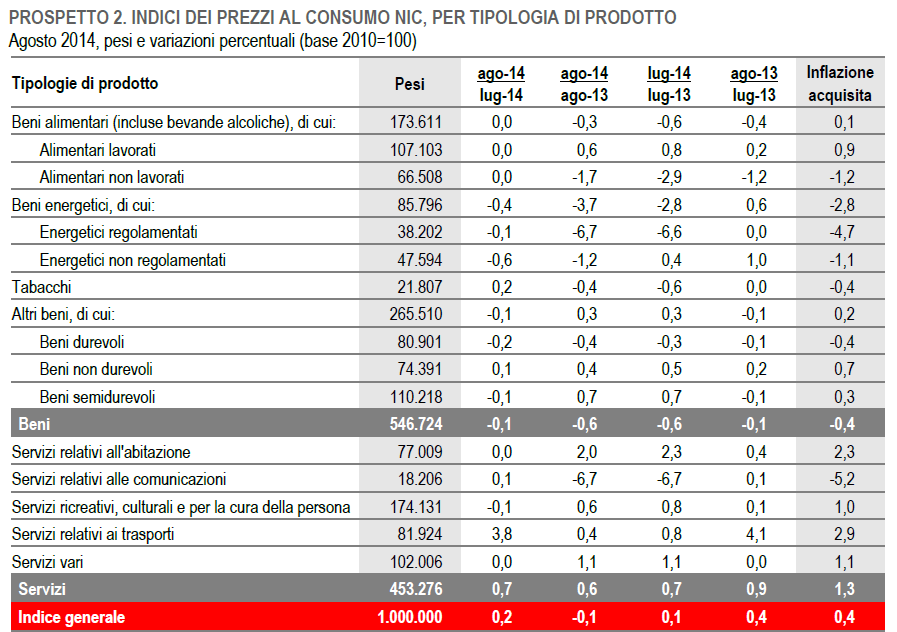
Giulio Zanella has a nice post on noisefromamerika, dissecting the sources of Italian deflation. (In Italian, but Google translate does a pretty good job.)  Deflation can come from lack of "demand," or from technical innovation and increases in supply. What do the data suggest?


The right hand column gives inflation by category. "Beni Alimentari" are food, +0.1%, "Beni Energetici" is energy, -2.8%. "Beni Durevoli" is durable goods, -0.4% and "nondurevoli", duh, nondurable goods at +0.7%. The services are all positive, except communications services


The message, suggests Giulio, is pretty clear. What's going down? Tradeables and commodities. Oil prices and agricultural commodity prices reflect global, not Italian, supply and demand.  Imported and import-competing durable prices go down. What's going up? Nontradeables and services. This looks like imported and supply deflation not lack-of-demand deflation
The subdivision goods / services is in fact for a country like Italy a good approximation of subdivision tradables ( tradables ) / non-tradable goods ( nontradables ). ... If deflation Italian was mainly due to the weakness of domestic demand, then we should observe deflation even (and especially) in the prices of services. Instead do not observe the contrary, we observe an increase of 0.6%. 
And prices go down when supply curves shift out,
note the strong (6.7%) reduction in the price of communications services, a reduction that is the clearest example of deflation induced by technological innovation and, probably, competition... in a rapidly expanding and highly contestable market.  [Yes, even in Italy] Multiplying this price reduction by its weight in the Istat basket, (6.7% * 1.82%), it turns out this item contributes 0.12%, a bit more than the whole of deflation.
The longer original is worth reading.

I guess the 16 euro gelato will still be with us for a while.