Showing posts with label Inflation. Show all posts

Friday, May 6, 2016

Global Imbalances

I gave some comments on “Global Imbalances and Currency Wars at the ZLB,” by Ricardo J. Caballero, Emmanuel Farhi, and Pierre-Olivier Gourinchas at the conference, “International Monetary Stability: Past, Present and Future”, Hoover Institution, May 5 2016. My comments are here, the paper is here 

The paper is a very clever and detailed model of "Global Imbalances," "Safe asset shortages" and the zero bound. A country's inability to "produce safe assets" spills, at the zero bound, across to output fluctuations around the world. I disagree with just about everything, and outline an alternative world view.

A quick overview:

Why are interest rates so low? Pierre-Olivier & Co.: countries can't  “produce safe stores of value”
This is entirely a financial friction. Real investment opportunities are unchanged. Economies can’t “produce” enough pieces of paper. Me: Productivity is low, so marginal product of capital is low.

Why is growth so low? Pierre-Olivier: The Zero Lower Bound is a "tipping point." Above the ZLB, things are fine. Below ZLB, the extra saving from above drives output gaps. It's all gaps, demand. Me: Productivity is low, interest rates are low, so output and output growth are low.

Data: I Don't see a big change in dynamics at and before the ZLB. If anything, things are more stable now that central banks are stuck at zero. Too slow, but stable.  Gaps and unemployment are down. It's not "demand" anymore.


Exchange rates. Pierre-Olivier  "indeterminacy when at the ZLB” induces extra volatility. Central banks can try to "coordinate expectations." Me: FTPL gives determinacy, but volatility in exchange rates. There is no big difference at the ZLB.

Safe asset Shortages. Pierre-Olivier: driven by a large mass of infinitely risk averse agents. Risk premia are therefore just as high as in the crisis. Me: Risk premia seem low. And doesn't everyone complain about "reach for yield" and low risk premia?

Observation. These ingredients are plausible about fall 2008. But that's nearly 8 years ago! At some point we have to get past financial crisis theory to not-enough-growth theory.

But, finally, praise. This is a great paper. It clearly articulates a world view, and you can look at the assumptions and mechanisms and decide if you think they make sense. I am in awe that Pierre-Olivier & Co. were able to make a coherent model of these buzzwords.

But great theory is great theory. To a critic, the assumptions are necessary as well as sufficient. I  read it as a brilliant negative paper, almost a parody: Here are the extreme assumptions that it takes to justify all the policy blather about "savings gluts" "global imbalances" "safe asset shortages" and so on. To me, it shows just how empty the idea is, that our policy-makers understand any of this stuff at a scientific, empirically-tested level, and should take strong actions to offset the supposed problems these buzzwords allude to.

I hope this taste gets you to read  my comments and the paper. 


Tuesday, April 26, 2016

Macro Musing Podcast

I did a podcast with David Beckworth, in his "macro musings" series, on the Fiscal Theory of the Price Level, blogging, and a few other things.


(you should see the link above, if not click here to return to the original).

You can also get the podcast at Sound Cloud, along with all the other ones he has done so far, or on itunes here.  For more information, see David's post on the podcast.

Tuesday, March 29, 2016

A very simple neo-Fisherian model

A sharp colleague recently pushed me to write down a really simple model that can clarify the intuition of how raising interest rates might raise, rather than lower, inflation. Here is an answer.

(This follows the last post on the question, which links to a paper. Warning: this post uses mathjax and has graphs. If you don't see them, come back to the original. I have to hit shift-reload twice to see math in Safari. )

I'll use the standard intertemporal-substitution relation, that higher real interest rates induce you to postpone consumption, \[ c_t = E_t c_{t+1} - \sigma(i_t - E_t \pi_{t+1}) \] I'll pair it here with the simplest possible Phillips curve, that inflation is higher when output is higher. \[ \pi_t = \kappa c_t \] I'll also assume that people know about the interest rate rise ahead of time, so \(\pi_{t+1}=E_t\pi_{t+1}\).

Now substitute \(\pi_t\) for \(c_t\), \[ \pi_t = \pi_{t+1} - \sigma \kappa(i_t - \pi_{t+1})\] So the solution is \[ E_t \pi_{t+1} = \frac{1}{1+\sigma\kappa} \pi_t + \frac{\sigma \kappa}{1+\sigma\kappa}i_t \]

Inflation is stable. You can solve this backwards to \[ \pi_{t} = \frac{\sigma \kappa}{1+\sigma\kappa} \sum_{j=0}^\infty \left( \frac{1}{1+\sigma\kappa}\right)^j i_{t-j} \]

Here is a plot of what happens when the Fed raises nominal interest rates, using \(\sigma=1, \kappa=1\):

When interest rates rise, inflation rises steadily.

Now, intuition. (In economics intuition describes equations. If you have intuition but can't quite come up with the equations, you have a hunch not a result.) During the time of high real interest rates -- when the nominal rate has risen, but inflation has not yet caught up -- consumption must grow faster.

People consume less ahead of the time of high real interest rates, so they have more savings, and earn more interest on those savings. Afterwards, they can consume more. Since more consumption pushes up prices, giving more inflation, inflation must also rise during the period of high consumption growth.

One way to look at this is that consumption and inflation was depressed before the rise, because people knew the rise was going to happen. In that sense, higher interest rates do lower consumption, but rational expectations reverses the arrow of time: higher future interest rates lower consumption and inflation today.

(The case of a surprise rise in interest rates is a bit more subtle. It's possible in that case that \(\pi_t\) and \(c_t\) jump down unexpectedly at time \(t\) when \(i_t\) jumps up. Analyzing that case, like all the other complications, takes a paper not a blog post. The point here was to show a simple model that illustrates the possibility of a neo-Fisherian result, not to argue that the result is general. My skeptical colleauge wanted to see how it's even possible.)

I really like that the Phillips curve here is so completely old fashioned. This is Phillips' Phillips curve, with a permanent inflation-output tradeoff. That fact shows squarely where the neo-Fisherian result comes from. The forward-looking intertemporal-substitution IS equation is the central ingredient.

Model 2:

You might object that with this static Phillips curve, there is a permanent inflation-output tradeoff. Maybe we're getting the permanent rise in inflation from the permanent rise in output? No, but let's see it. Here's the same model with an accelerationist Phillips curve, with slowly adaptive expectations. Change the Phillips curve to \[ c_{t} = \kappa(\pi_{t}-\pi_{t-1}^{e}) \] \[ \pi_{t}^{e} = \lambda\pi_{t-1}^{e}+(1-\lambda)\pi_{t} \] or, equivalently, \[ \pi_{t}^{e}=(1-\lambda)\sum_{j=0}^{\infty}\lambda^{j}\pi_{t-j}. \]

Substituting out consumption again, \[ (\pi_{t}-\pi_{t-1}^{e})=(\pi_{t+1}-\pi_{t}^{e})-\sigma\kappa(i_{t}-\pi_{t+1}) \] \[ (1+\sigma\kappa)\pi_{t+1}=\pi_{t}+\pi_{t}^{e}-\pi_{t-1}^{e}+\sigma\kappa i_{t} \] \[ \pi_{t+1}=\frac{1}{1+\sigma\kappa}\left( \pi_{t}+\pi_{t}^{e}-\pi_{t-1} ^{e}\right) +\frac{\sigma\kappa}{1+\sigma\kappa}i_{t}. \] Explicitly, \[ (1+\sigma\kappa)\pi_{t+1}=\pi_{t}+\gamma(1-\lambda)\left[ \sum_{j=0}^{\infty }\lambda^{j}\Delta\pi_{t-j}\right] +\sigma\kappa i_{t} \]

Simulating this model, with \(\lambda=0.9\).


As you can see, we still have a completely positive response. Inflation ends up moving one for one with the rate change. Consumption booms and then slowly reverts to zero. The words are really about the same.

The positive consumption response does not survive with more realistic or better grounded Phillips curves. With the standard forward looking new Keynesian Phillips curve inflation looks about the same, but output goes down throughout the episode: you get stagflation.

The absolutely simplest model is, of course, just \[i_t = r + E_t \pi_{t+1}\]. Then if the Fed raises
the nominal interest rate, inflation must follow. But my challenge was to spell out the market forces
that push inflation up. I'm less able to tell the corresponding story in very simple terms.

Tuesday, March 8, 2016

Deflation Puzzle

Larry Summers writes an eloquent FT column "A world stumped by stubbornly low inflation"
Market measures of inflation expectations have been collapsing and on the Fed’s preferred inflation measure are now in the range of 1-1.25 per cent over the next decade.

Inflation expectations are even lower in Europe and Japan. Survey measures have shown sharp declines in recent months. Commodity prices are at multi-decade lows and the dollar has only risen as rapidly as in the past 18 months twice during the past 40 years when it has fluctuated widely

And the Fed is forecasting a return to its 2 per cent inflation target on the basis of models that are not convincing to most outside observers. 

Central bankers [at the G20 meeting] communicated a sense that there was relatively little left that they can do to strengthen growth or even to raise inflation. This message was reinforced by the highly negative market reaction to Japan’s move to negative interest rates.

So why is inflation slowly declining despite our central banks' best efforts? Here is a stab at an answer. I emphasize the central logical points with bullets.

  • Interest rates have two effects on inflation: a short-run "liquidity" effect, and a long-run "expected inflation" or "Fisher" effect.  

In normal times, to raise interest rates, the central bank sells bonds, which soaks up money. Less money drives up interest rates as people bid to borrow a smaller supply, and less money also reduces "demand," which reduces inflation.  In the long run, higher inflation and higher interest rates go together, as they did in the 1980s.

However, we are now in a classic "liquidity trap." Interest rates have been zero since 2008. Money and bonds are perfect substitutes. The proof of that is in the pudding: the Fed massively increased excess reserves from less than $50 billion to almost $3,000 billion, and inflation keeps trundling down.

  • In a liquidity trap, the liquidity effect is absent. 

The liquidity effect will remain absent as the Fed starts raising interest rates, and would remain absent if the Fed were to cut rates or reduce them below zero as other central banks are doing. You can't have more than perfect liquidity.

The Fed isn't even planning to try. It plans to keep the $3,000 billion of excess reserves outstanding and raise interest rates by raising the interest rate on reserves. There will be no open market operations, no "tightening" associated with this interest rate raise.  But even if it did, we're $2,950 billion of excess reserves away from any liquidity effect, so it wouldn't matter.

  • When the liquidity effect is absent, the expected inflation effect is all that remains. Inflation must follow interest rates. 

Central banks thought they were raising inflation by lowering interest rates, following experience from the normal-times liquidity-effect correlation between lower interest rates and higher inflation. But that experience does not apply when its liquidity effect is turned off.

With no liquidity effect, lowering interest rates further below zero can only, slowly, lower inflation further. Central banks desiring inflation may have followed a classic pedal mis-application.

Do I "believe" this story? Belief has no place in science. It is the simplest coherent story that explains the last few years, not needing lots of frictions, irrationalities, and other assumptions. I have some equations to back it up. But we don't "believe" anything at least until it's published and has survived critical examination, replication and dissection. Still, I think it merits consideration.

Shh. I like zero inflation. If central banks have the wrong pedal but are driving the right speed anyway, why wake them up? Even Larry seems to have given up on the Phillips curve:

...suppose that officials were comfortable with current policy settings based on the argument that Phillips curve models predicted that inflation would revert over time to target due to the supposed relationship between unemployment and price increases.

There is no sign of the dreaded "deflation vortex," any more than there is any sign of dreaded monetary hyperinflation. We're drifting down to the Friedman rule. As Larry emphasizes, don't get excited over forecasts from models that rather spectacularly did not forecast where we are today. 
Central banks' desire for 2% inflation, and the Fed's rather puzzling interpretation of its "price stability" mandate to mean perpetual 2% inflation may also be relics of the bygone liquidity-effect regime. 

Appreciate the first half of the column which turns the signs around. It's a great bit of rhetoric.

I have to register mild disagreement with Larry's "solution" to the supposed "problem," 

In all likelihood the important elements will be a combination of fiscal expansion drawing on the opportunity created by super low rates and, in extremis, further experimentation with unconventional monetary policies.

He doesn't say which monetary policies would work, given they have not done so yet. But these are topics for another day.

(Note: If quote and bullet formatting doesn't show up, come back to the original.)

Thursday, February 25, 2016

Negative rates and FTPL

I've devoted most of my monetary economics research agenda to the Fiscal Theory of the Price Level in the last two decades (collection here). This theory says, fundamentally, that money has value because the government accepts it for taxes, and inflation is fundamentally a fiscal phenomenon over which central banks' conventional tools -- open market operations trading money for government bonds -- have limited power.

Since I grew up in the 1970s, I figured the FTPL would have its day when inflation unexpectedly broke out, again, and central banks were powerless to stop it. I figured that the spread of interest-paying electronic money would so clearly undermine the foundations of MV=PY that its pleasant stories would be quickly abandoned as no longer relevant.

I may have been  exactly wrong on both points: It seems that uncontrolled disinflation or deflation will be the spark for adoption of FTPL ideas; that the equivalence of money and bonds at zero interest rates,  and central banks powerless to create inflation will be the trigger.

These thoughts are prodded by two pieces in the Economist, "Out of Ammo:" and "Unfamiliar Ways Forward" (HT and interesting discussion by Miles Kimball)

If you want inflation (a big if -- I don't, but let's go with the if) how do you get it? Ultra-low rates, huge bond purchases, and lots of talk (forward guidance, higher inflation targets) seem to have no effect. What can governments actually do?


"Out of ammo" explains
... At least some of them [politicians] have failed to grasp the need to have fiscal and monetary policy operating in concert....
... One such option is to finance public spending (or tax cuts) directly by printing money—known as a “helicopter drop”. Unlike QE, a helicopter drop bypasses banks and financial markets, and puts freshly printed cash straight into people’s pockets. The sheer recklessness of this would, in theory, encourage people to spend the windfall, not save it. 
The "recklessness" part is crucial. "Unfamiliar ways" has a more intricate scheme to communicate that recklessness
..a central bank and its finance ministry ... collude in printing money to pay for public spending (or tax cuts). ...the government announces a tax rebate and issues bonds to finance it, but instead of selling them to private investors swaps them for a deposit with the central bank. The central bank proceeds to cancel the bonds, and the government withdraws the money it has on deposit and gives it to citizens. “Helicopter money” of this sort—named in honour of a parable told by Milton Friedman, a famous economist—is as close as you can get to raining cash from a clear blue sky like manna from heaven, untouched by banks and financial markets.
Such largesse is, in effect, fiscal policy financed by money instead of bonds... But the unaccustomed drama—indeed, the apparent recklessness—of helicopter money could increase the expected inflation rate, encouraging taxpayers to spend rather than save.
Simpler, in my mind, the Treasury borrows and sends checks to voters. The Fed buys the bonds and then cancels them.

In addition to rather convoluted scheme, the pieces are not quite clear why the fiscal counterpart is necessary -- or why money has to be involved with fiscal policy.  That was not a central part of Friedman's helicopters. Miles is clearer about this:
the government give[s] away so much money that people would be convinced there was no way the government could ever sell enough bonds to soak that money up. 
This is clear and good FTPL thinking. The value of money is set by how much there is vs how much people expect the government to soak up via taxes -- or bond sales, backed by credible promises of future taxes.

If the government drops $100 in every voter's pocket but simultaneously announces "austerity" that taxes are going up $100 tomorrow, even helicopter drops would have no effect.

Helicopter drops are a clever fiscal signaling device. Canceling the bonds in the Economists plan is the crucial signaling device. They say "we are really going to be reckless."  When governments sell a lot of bonds, people think  the government is sooner or later going to soak up these bonds with taxes, and do not spend. That's the whole point -- bond sales are set up to raise revenue, not to create inflation.  The whole canceling the bonds thing in the Economists's plan, or the helicopter drama in Friedman's, is a clever psychological device, to convince people that no, the government is not going to raise taxes to soak money or underlying bonds up, so you'd better spend it now before it loses value.

Well if (if) our central banks want inflation, why not get out the helicopters?
Such shenanigans are not possible in the euro zone, where the ECB is forbidden by treaty from buying government bonds directly. Elsewhere they might work as follows: 
monetary financing is prohibited by the treaties underpinning the euro, for example
The US Federal reserve is similarly constrained to always buy something in return for creating money -- it can't send checks to voters.

Why?  The people who set up our monetary systems understood all this very well. Their memories were full of disastrous inflations, and they understood that printing money without clear promises that taxes would eventually soak up that money would lead quickly to inflation. So, yes, central banks are prohibited from doing the one thing that would most quickly produce inflation! For about the same reason that wise parents don't keep the car keys in the liquor cabinet.  (There are also all sorts of good political economy reasons that an independent central bank should not lend to specific businesses or send checks to voters.)

The Economist articles are also quite good at the evidence that current monetary policy is essentially powerless.
If policymakers appear defenceless in the face of a fresh threat to the world economy, it is in part because they have so little to show for their past efforts. The balance-sheets of the rich world’s main central banks have been pumped up to between 20% and 25% of GDP by the successive bouts of QE with which they have injected money into their economies (see chart 1). The Bank of Japan’s assets are a whopping 77% of GDP. Yet inflation has been persistently below the 2% goal that central banks aim for.
The power of open market operations -- buying bonds in return for money - is just dramatically refuted, at least at zero interest rates, by recent experience.
One way to get them back up might be to set a higher inflation target. But when inflation sits so persistently below today’s targets, persuading people that higher targets would produce higher rates will require action, not just words.
Or as I call it, the speak loudly because you have no stick policy. If central banks announce a 5% inflation target, and inflation goes down anyway, now what? Announce a 10% target?

Miles goes on about the power of negative interest rates to stoke inflation, which will be a topic for another day. If negative 2% real rates (2% inflation, 0% interest) didn't stoke "demand" and revive the extinct Phillips curve,  I don't see how negative 3% (2% inflation  -1% interest rate) or negative 5% will finally do the trick. In the standard models I've been playing with,  raising nominal interest rates, and committing to keep them there, is the way for central banks to raise expected inflation. That action would, however, also cool the economy, producing stagflation, and thus be particularly pointless.

I also fully admit that I'm cherry-picking the things I like from the Economist article, and ignoring all sorts of things that seem pretty silly to me. The point: I'm glad to see fiscal-theory thinking making its way out of academic debate into real-world commentary, if only in the "radical ideas" section.  Now, on to the "conventional wisdom" section!

Tuesday, November 24, 2015

Early Fisherism

John Taylor has an interesting blog post with a great title, "Staggering Neo-Fisherian Ideas and Staggered Contracts." John goes back to a paper he wrote in 1982 for the Jackson Hole conference, on the issue of that time, how to lower inflation. He presented simulations of a model with staggered wage setting, which I reproduce below.


So as far back as 1982, here is a model in which lower interest rates correspond with lower inflation, both in the short run and the long run.  John's model has money in it, so the mechanics are a pre-announced monetary contraction.

Sargent's famous "Ends of four big inflations"  tells an even more radical story.

On solving the governments' fiscal problems, inflation ends instantly. Sargent and Wallace alas do not have interest rate data, but from the inflation data it's pretty plausible that interest rates fell like a stone when the fiscal reforms are implemented. They have money stock measures -- and the ends of these inflations did not have any monetary tightening at all. Money stock measures all expanded substantially as inflation ended.

I've been having an interesting back and forth with a correspondent about Milton Friedman's views. In  "Do higher interest rates raise or lower inflation?" I quoted Friedman's 1968 address, and said he believed that an interest rate peg is unstable. Not so fast says my correspondent, and passed on a lovely memo written by Milton Friedman -- better still once owned by Anna Schwartz. (Yes I checked that it's ok to post this)


and later


As I read this quote, Friedman emphasizes that lower interest rates come only with lower inflation in the long run, so there is some Fishery theory here. But in the short run, if the Fed lowers money growth, then interest rates will first rise but then decline as inflation declines. So the implied short run relationship goes the other way.

As I read it, then, Friedman says it is possible to target interest rates. But to do so requires particularly active money growth policy to offset the instability that would result from simply announcing a fixed interest rate.

That leads to a very interesting question, how the same interest rate path could be supported by different money growth paths.

Monday, November 23, 2015

Inflation Drumbeat

Noah Smith has an interesting Bloomberg View piece on Japanese inflation. Three crucial paragraph struck me
... Japanese unemployment is very low, and the economy is expanding at or above its long-term potential growth rate of around 0.5 percent to 1 percent. So according to mainstream theory, inflation would be an unnecessary and pointless negative for Japan’s economy. Why, then, are there always voices calling for Japan to raise its inflation rate?
Actually, there are several reasons. The main one is that inflation reduces the burden of debt. Japan’s enormous government debt represents the government’s promise to transfer resources from young people (who work and pay taxes) to old people (who own government bonds). Since Japan is an aging society, there are more old people than young people. That makes the burden especially difficult to bear. Young people also tend to have mortgages, the repayment of which is another burden.
Sustained higher inflation would represent a net transfer of resources from the old to the young. That would increase optimism, and hopefully raise the fertility rate, helping with demographic stabilization. It would also decrease the risk that the Japanese government will eventually have to take extreme measures to stabilize the debt.
I like these paragraphs because they so neatly distill the language used by the standard policy establishment to advocate inflation. Noah clearly separates the usual "stimulus" arguments from the new "debt" argument, which helps greatly.

Debt is a "burden." Sort of like snow on your roof, debt appears from the sky somehow and then represents a "burden" requiring "lifting," which would be beneficial to all.

Debt "represents the government’s promise to transfer resources from young people ... to old people.." Apparently, the government woke up one morning, and said "we promise to grab about two and a half years worth of income from young people and give it to old people." Undoing such an ill-advised promise does indeed sound worthy.

But, lest these soothing words lull you into idiocy, let us remember where debt actually comes from. The Japanese government borrowed a lot of money from people who are now old, when they were young. Those people consumed less -- they lived in small houses, made do with fewer and smaller cars, ate simply, lived frugally -- to give the government this money. The promise they received was that their money would be returned, with interest, to fund their retirements, and to fund their estates which young people will inherit.

Noah is advocating nothing more or less than a massive government default on this promise, engineered by inflation. The words "default,"  "theft," "seizure of life savings," apply as well as the anodyne "transfer." I guess Stalin just "transferred resources."


Amazingly, to Noah (and the views he ably summarizes here) this "transfer" will "increase optimism." Hmm. Let's look at the evidence for that. We have seen many large inflations, which wiped out middle-class savings along with government debts. Those events have generally been regarded as economically, politically, and psychologically destabilizing tragedies, not FDR-fireside-chat "optimism"-raising sessions. No surprise that few societies have voluntarily signed up for such treatment as Noah recommends. I would be curious to hear of a single happy historical antecedent. (I mean that. Perhaps I am mistaken in my understanding of Noah's proposal. A successful example might correct me.)

How does a government default benefit young people anyway? It does so if a large amount of tax revenue is being used to pay interest or principal on the debt, and the default is accompanied by a large tax cut for young families. Not by the same level of taxes and increased government spending on more railway-to-nowhere stimulus projects.  Without tax cut, there is no transfer. Noah is strangely silent on the essential big tax cut aspect of his plan.

Quiz: Find in Japanese (or American) government finances the actual "promise to transfer resources from young people (who work and pay taxes) to old people." If you say "government bonds," you (like Noah) got the wrong answer. The right answer is Social Security, Medicare, and public employee pensions. If Noah wishes to reduce the "burden" of intergenerational transfers, no matter that governments have promised to make those transfers and people have planned their lives around them, the silence on these promises is deafening.

If the purpose is default, why not just advocate default? A massive inflation also destroys private savings and wipes out private contracts. Oh wait, that's the point:
Young people also tend to have mortgages, the repayment of which is another burden.
Like the government, young people too I guess woke up one day and this "burden" parachuted down on top of their surprisingly big house.

So, according to Noah, a self-induced hyperinflation to generate an economy-wide debt default is necessary... to "decrease the risk that the Japanese government will eventually have to take extreme measures to stabilize the debt." I find it hard to imagine what more extreme measures he has in mind.

One practical difficulty: Like most governments, Japan rolls over debt fairly frequently. So inflation must come really quickly if it is to wipe out debt. A second practical difficulty: The BOJ, like our own Fed, seems completely unable to induce any inflation. With advice like this, thank goodness.

Another puzzle: What exactly is the "burden" of Japan's debt? Japan's interest rates have been zero for 20 years. Japan's growth rate g, as low as it is, is larger than its interest rate r. Japan pays next to nothing in debt service.  Is Noah joining the despised ranks of worrywarts like me that this can't last? But if it comes to an end, in a run on Japanese government debt and consequent inflation, then Noah gets what he wants. If it does not come to an end, Japan pays no debt service and gradually grows out of the debt. Where's the fire?

Again, this is not a post about Noah. One writes columns quickly, and space often prevents a full development of arguments.  I am resolved not to discuss or even imply criticism of a writer's motives, so if you infer that, undo the inference now.

Rather, let us appreciate and dissect Noah's language, logical loose ends, insouciant willingness to upend the lives of millions, and answers in search of questions, for how well they summarize so much policy blather; and therefore not to be lulled by that blather's repetition.  

Thursday, November 12, 2015

Permazero

St. Louis Fed President Jim Bullard gave a very interesting paper at the Cato monetary conference, with this great title.

Jim starts with this great picture. It's a simulation of the standard three equation new Keynesian model as we go from 2% interest rate to zero. This is an upside down version of the first graph in my "Do higher interest rates raise or lower inflation." (Blog post) But Jim makes a new and insightful point with it, that had not occurred to me.

Jim reads this as an account of what happened in 2008, not (my) tentative prediction for what might happen in 2016 in the other direction. It's compelling: The Fed lowers rates. This boosts output (black line) over what it would otherwise be, overcoming the horrendous negative shocks to the economy from a financial crisis. Inflation gently declines, which is also what inflation did after a one time shock in 2009, related to the output shock which the Fed was offsetting.


Jim then ties that together with my Figure 3 in an artful way. The same model that accounts well for slow disinflation in the recovery suggests that raising rates now, in the absence of other shocks, would just raise inflation and lower output.


Jim goes on to present some data averaged across a variety of countries. Here you see a pattern quite similar to the model's prediction. After recovering from the severe shock, inflation starts its gentle decline.

Like me, Jim is nervous about these conclusions. The data seem to be telling us that interest rate pegs are not unstable. The standard model turns out to have that prediction, but also predicts that raising interest rates, while lowering output as we have long been told, will just smoothly raise inflation. It's very hard to turn around decades of contrary doctrine -- that pegs are unstable, and raising rates lowers inflation. One should be nervous about such conclusions. Maybe inflation is, finally, just around the corner. So Jim makes very clear he's not yet recommending a rate rise to cause more inflation!

But one should also start thinking about what these conclusions mean if they are right, and Jim summarizes with a number of such implications. A few that seem especially important, with comment:
Third, longer‐run economic growth would still be driven by human capital accumulation and technological progress, as always, but without the accompanying stabilization policy as conventionally practiced from 1984‐2007. In principle, the economy would still be expected to grow at a pace dictated by fundamentals.
A little more bluntly, Japan-bashers cannot blame 20 years of poor growth on the zero bound. Nor should we worry that permazero will cause lower growth. (The other way around is much more likely: low marginal product of capital leads to low rates.) Japan's growth and inflation, like our own for the last seven years, has also been quite stable, raising the next question of just how much stabilization this policy was doing.
Fourth, the celebrated Friedman rule would arguably be achieved, so that household and business cash needs are satiated. In many monetary models this is a desirable state of affairs.
Yes!! Shout it from the rooftops.

Just what is so terrible about zero rates and very low inflation? Zero rates are the optimum quantity of money. They have financial stability benefits too. Banks sitting on huge piles of cash don't go under.

Conventional modeling has been treating the zero bound as a "trap," or a terrible outcome to be avoided. But it's a honey trap, at least in these models. The main complaint one could make is that they don't last, that they lead to spiraling deflation or hyperinflation. But the models said "trap" -- they last -- and the data seem to agree.
Fifth, the risk of asset price fluctuations may be high. In the New Keynesian model, the near‐zero interest rate policy with little or no response to incoming shocks is associated with equilibrium indeterminacy. This means there are many possible equilibria, all of which are consistent with rational expectations and market clearing. In a nutshell, a lot of things can happen. Many of the possible equilibria are exceptionally volatile. One could interpret this theoretical situation as consistent with the idea that excessive asset price volatility is a risk.
This is spot on. In the models, the trouble with the zero bound "trap" is not high unemployment, low growth, or spiraling inflation or deflation -- it has none of these. The problem is "indeterminacy," the possibility that inflation can bounce around a bit, each time returning stably back again. That's also what we seem to see, and it hasn't been a huge problem: We don't see any more inflation, output, or asset market volatility in the last 7 years than in the period before the crisis.

And this is a simple problem to solve in the theory. Add back the missing fiscal theory of the price level -- deliberately thrown out in the theory -- and you have determinacy again. In words, a jump to an alternative equilibrium requires that fiscal policy expectations also jump. If people's expectations of long-term fiscal policy are stable, then we have determinacy and no more volatility at the zero bound too.
Sixth, and finally, the limits on operating monetary policy through ordinary short‐term nominal interest rate adjustment in this situation would surely continue to fire a search for alternative ways to conduct monetary stabilization policy. The favored approach during the past five years within the G‐7 economies has been quantitative easing, and there would surely be pressure to use this or related tools.
I.e. in permazero, eventually markets get tired of reacting to whispers that the Fed might someday raise rates. Monetary policy overall becomes ineffective, leading central banks to try other levers. Which may not be such a great idea!

Thursday, October 22, 2015

Open-Mouth Operations

(Note: This post uses mathjax and has embedded pictures. When posts are reposted elsewhere these often get mangled. If it's not displaying well, come to the original at johnhcochrane.blogspot.com)

Our central banks have done nothing but talk for several years now. Interest rates are stuck at zero, and even QE has stopped in its tracks. Yet, people still ascribe big powers to these statements. Ms. Yellen sneezes, someone thinks they hear "December" and markets move.

Buried deep in the paper I posted earlier this week is a potential model of "open mouth" operations, that might of interest to blog readers.

Use the standard "new-Keynesian" model \[ x_{t} = E_{t}x_{t+1}-\sigma(i_{t}-E_{t}\pi_{t+1}) \] \[ \pi_{t} = \beta E_{t}\pi_{t+1}+\kappa x_{t} \] Add a Taylor rule, and suppose the Fed follows an inflation-target shock with no interest rate change \[ i_t = i^\ast_t + \phi_\pi ( \pi_t - \pi^\ast_t). \] \[ i^\ast_t = 0 \] \[ \pi^\ast_t = \delta_0 \lambda_1^{-t} \] Equivalently express the Taylor rule with a ``Wicksellian'' shock, \[ i_t = \hat{i}_t + \phi_\pi \pi_t \] \[ \hat{i}_t = - \delta_0 \phi_\pi \lambda_1^{-t}. \] In both cases, \[ \lambda_{1} =\frac{\left( 1+\beta+\kappa\sigma\right) +\sqrt{\left( 1+\beta+\kappa\sigma\right) ^{2}-4\beta}}{2} \gt 1 \] Yes, this is a special case. The persistence of the shocks is just equal to one of the roots of the model. Here \(\delta_0\) is just a parameter describing how big the monetary policy shock is.

Now, solve the model by any standard method for the unique locally bounded solution. The answer is \[ \pi_{t} = \delta_0 \lambda_1^{-t}, \] \[ \kappa x_{t} = \delta_0 (1-\beta \lambda_1^{-1}) \lambda_1^{-t} \] \[ i_t = 0 \]


Here is the equilibrium path of inflation and interest rates (flat red line at zero).


And here is the path of output.  In each case \(\delta_0\) in the graph gives the size of the monetary policy shock. It's also the size of the inflation jump at time zero induced by the monetary policy shock.

Watch this mom, no hands... Interest rates do not budge throughout the episode. The Fed announces a monetary policy shock, and inflation moves just enough so that the systematic part of monetary policy offsets the shock, and Fed doesn't end up actually doing anything! We get the traditional results of monetary policy -- lower inflation and lower output, for example -- based just on talk!

If you're inclined to this sort of model, you might want to pursue this sort of solution as a model of our current "open-mouth" regime.

Tuesday, October 20, 2015

Swiss Deflation

The Wall Street Journal Monday Oct 19 offers a reflection on deflation in Switzerland.

"It’s as close to an economic consensus as you can get: Deflation is bad for an economy, and central bankers should avoid it at all costs."

I differ, as does Milton Friedman's "Optimum quantity of money." And my "who's afraid of a little deflation" in... The Wall Street Journal.

"Then there’s Switzerland, whose steady growth and rock-bottom unemployment is chipping away at that wisdom."

"At a time of lively global debate about low inflation and its ill effects, tiny Switzerland—with an economy 4% the size of the U.S.—offers a fascinating counterpoint, with some even pointing to what they call 'good deflation.' ”

Indeed. The 1970s had stagflation. Now we have the opposite, "good deflation."  The Phillips curve lives on in "consensus."

Switzerland also is a good case for just how powerless central banks are to do much about it.


I don't think there really is such a thing as monetary policy any more. Money and government bonds are perfect substitutes. At that point, central bank interest rate setting is the same thing as if the Treasury simply decreed the rate it will pay on government debt. When (if) the Fed raises interest on reserves, and Treasury interest goes up similarly, it will be just as if the Treasury announced it will pay 1% on short term debt. (p. 77-78 of Monetary Policy with Interest on Reserves or p. 6-7 ungated here makes this point with equations.)

But you have to be careful when you set a price. If you set the wrong price, you are either overwhelmed or starved with demand.

That's how I read recent events: The Fed talks about raising rates, a sea of foreign capital starts to want to buy US debt at that higher rate. The treasury is not offering an elastic supply -- they're setting both price and quantity. So with the interest rate fixed, the dollar goes up. Then the Fed has to back down. The Fed can't raise rates if it wants to.

Switzerland also taught that lesson when its central bank tried to peg to the Euro and was overwhelmed.

Monday, October 19, 2015

Do higher interest rates raise or lower inflation?

A new working paper by that title (pdf).  Some of the main ideas are in a longish post from last August.

The fact that inflation is so stable when interest rates are stuck at zero has profound implications. If inflation is stable at a zero peg, it must be stable at a higher peg as well, which means raising interest rates must sooner or later raise inflation. The open question, which this paper goes after, is whether inflation can temporarily decline when interest rates rise. (Graphs from an earlier blog post here.)

Classical "Keynesian" or "Monetarist" models say that inflation is unstable in a peg. They must be wrong. "New-Keynesian" models say that inflation is stable in a peg, a good point in their favor. The important difference is rational expectations. If people drive a car looking in the rear view mirror, cars are unstable and veer off the road. If people look forward, then cars are stable and get back on the road on their own.

But the standard new-Keynesian model also predicts that inflation goes up if interest rates rise, as shown in the graph.  Interest rates are blue, inflation is red, output is black. The dashed line is when people know the rise is coming, the solid line for when it's a surprise.  Raising rates does lower output, just as you thought.

The paper tries everything to revive the idea that higher interest rates lower inflation, without luck.

Abstract:
The standard new-Keynesian model accounts well for the fact that inflation has been stable at a zero interest rate peg. However, If the Fed raises nominal interest rates, the same model model predicts that inflation will smoothly rise, both in the short run and long run. This paper presents a series of failed attempts to escape this prediction. Sticky prices, money, backward-looking Phillips curves, alternative equilibrium selection rules, and active Taylor rules do not convincingly overturn the result. The evidence for lower inflation is weak. Perhaps both theory and data are trying to tell us that, when conditions including adequate fiscal-monetary coordination operate, pegs can be stable and inflation responds positively to nominal interest rate increases.

Monday, September 28, 2015

Japan Deflation

Deflation returns to Japan. Tyler Cowen has a thoughtful Marginal Revolution post, expressing puzzlment. Scott Sumner discussion here, and Financial Times coverage.

Let's look at the bigger picture. Here is the discount rate, 10 year government bond rate and core CPI for Japan. (CPI data here if you want to dig.)
If you parachute down from Mars and all you remember from economics is the Fisher equation, this looks utterly sensible. Expected inflation = nominal interest rate - real interest rate. So, if you peg the nominal interest rate, inflation shocks will slowly melt away. Most inflation shocks are individual prices that go up or down, and then it takes some time for the overall price level to work itself out.


The recent experience looks a lot like 1998. As of 2001, it would have been reasonable to think that the dreaded deflationary vortex was going to break out. But it didn't. Inflation came trundling back. As of 2008, you might have thought that low rates would finally spark inflation. But they didn't. In 2014-2015 you might have thought that the latest in a 20-year string of fiscal stimuli, bond purchases, bridges to nowhere and xx-onomics programs were finally going to produce inflation. But, so far at least, no.

It's tough to make predictions, especially about the future,  as the late great Yogi Berra reminds us. Still, this is the third strike.

The long term bond market continued its linear trend throughout the recent episode, a strong sign that expected inflation had not moved. And the sharp jump up and then back down again exactly a year later smacks of data errors, or one specific component. I hope a commenter has more patience for wading through the data than I do to find it. 

To be sure, Tyler emphasizes a central puzzle. Even if you accept the view that the Fisher equation is a stable steady state, that ties down expected inflation, but not actual inflation. There are troublesome multiple equilibria. The fiscal theory of the price level can tie down one equilibrium in theory, but not yet in practical application. But I wonder if we're not overblowing this problem. If we interpret the shocks not as shocks to individual prices that take time to melt away, but as expectational shocks, we still get a pretty good view of the data. Nominal interest rates plus a slowly time-varying real rate tie down expected inflation, little multiple equilibrium shocks let actual inflation vary, but such shocks melt away.

And the earthquake fault under all of this: Even the theory that says pegs can be stable warns they can only be stable if bond investors think they will be paid back. At some point -- 250% debt to gdp, slow growth and no population growth? 300%? What does it take? -- they change their minds. And then Japan gets the inflation it has so long desired, and a bit more to boot.

In the meantime, perhaps rather than worry-worry, we should celebrate 20 years of the optimum quantity of money, achieved at last.

Update David Beckworth on the same topic. I'm less of a NGDP target fan. It's like saying all the Chicago Cubs need is a "win the world series" target. OK, but what do you want them actually to do differently? What 3 trillion of QE wasn't enough, but 6 will do the trick? I know the answer, that talk alone tweaks some off equilibrium paths to generate more "demand" today. And monetary policy does seem to be just talk these days. But still... I'm also less of a fan of looking at monetary aggregates. At zero rates, money = bonds, and MV=PY becomes V = PY/M.  But it's a well stated analysis in these terms, and nice coverage of the fiscal theory at the end.

Tuesday, September 22, 2015

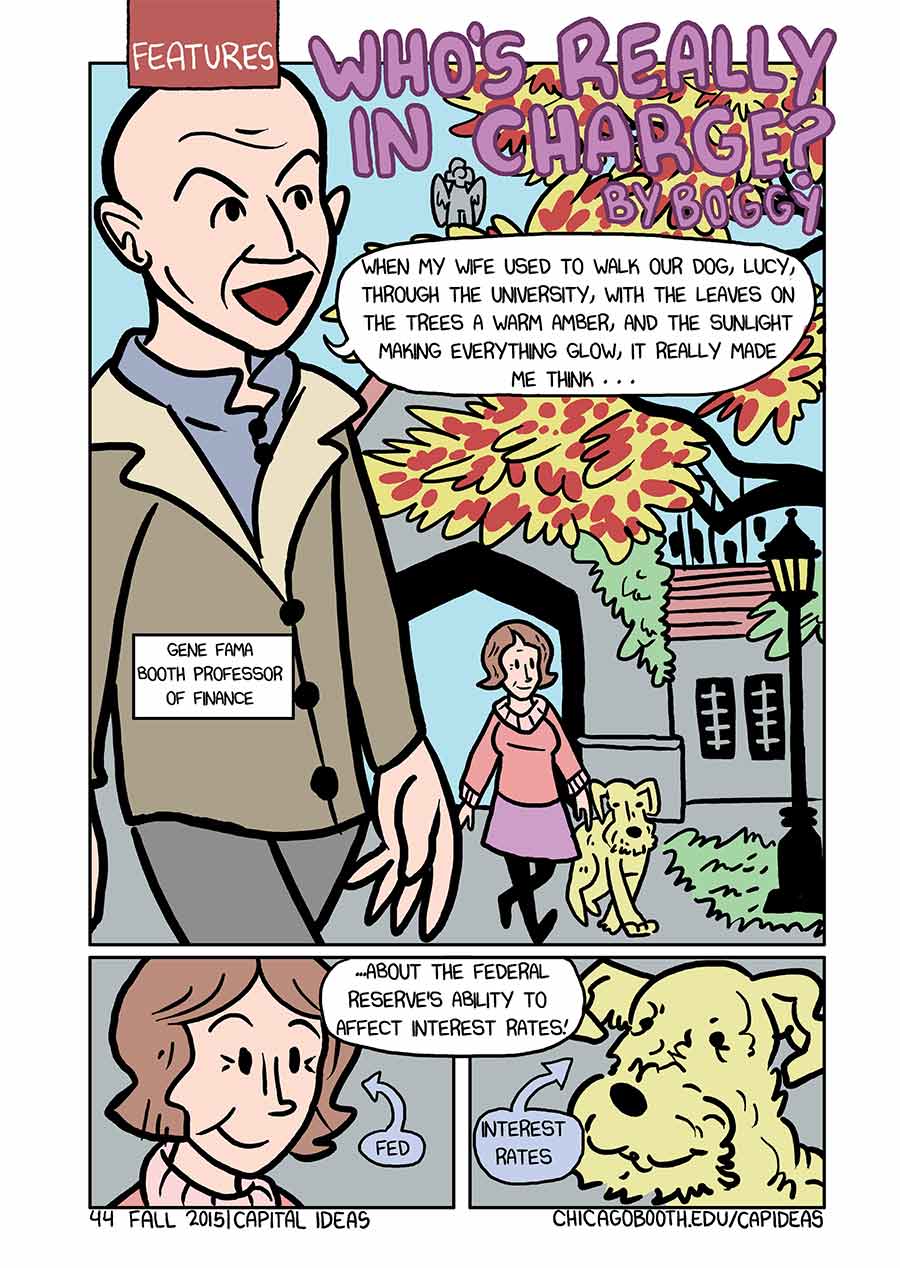
Who is walking who?

Click here for the rest

It's a graphic novel treatment of Gene Fama's Does the Fed Control Interest Rates? paper, from the Booth school's Capital Ideas magazine, by Eric Cochrane (yes, we're related). If it appears squished, use a wide browser window. The art is better in the printed form. 

Eric captured cointegration and error correction, and Gene's regressions of short and long-term interest rates, cleverly with the story. Does Sally take Lucy for a walk, or is Lucy really leading Sally around?  Well, when Lucy goes off hunting for a squirrel, who then moves to catch up?  

Wednesday, September 16, 2015

WSJ oped, director's cut

WSJ Oped, The Fed Needn’t Rush to ‘Normalize’ An ungated version here via Hoover.

Teaser:
The outcomes we desire from monetary policy are about as good as one could hope. Inflation is low and steady. Interest rates are lower than Americans have seen in generations. Unemployment, at 5.1%, has recovered to near normal. And banks and businesses sitting on huge piles of cash don’t go bust, a boon to financial stability.

Yes, economic growth is too slow, too many Americans have dropped out of the workforce, earnings are stagnant, and the country faces other serious challenges. But monetary policy can’t solve long-term structural problems.
Opeds are real Haikus -- 950 words is torture for me. So lots of good stuff got left on the cutting room floor, especially acknowledgement of objections and criticisms.

Yes, I'm aware of recent empirical work that QE has some effect:
Even the strongest empirical research argues that QE bond buying announcements lowered rates on specific issues a few tenths of a percentage point for a few months. But that's not much effect for your $3 trillion. And it does not verify the much larger reach-for-yield, bubble-inducing, or other effects.

An acid test: If QE is indeed so powerful, why did the Fed not just announce, say, a 1% 10 year rate, and buy whatever it takes to get that price? A likely answer: they feared that they would have been steamrolled with demand. And then, the markets would have found out that the Fed can’t really control 10 year rates. Successful soothsayers stay in the shadows of doubt.
Yes,  I'm aware of lots of theory going on:
Granted, economic theories are always in flux. Advocates are ready with after-the-fact patches for traditional theories’ failures. Maybe wages are eternally "sticky" downward, so deflation spirals can't happen. Never mind. Also, researchers are busy adding “frictions” to modern models to try to make them generate huge QE effects. But for policy-making, all of this is new, hypothetical and untested.
We lost an important warning
Economic theories are useful for working out logical connections. The forward-looking [new-Keynesian] theory predicts that an interest rate peg is only stable if fiscal policy is solvent, so people trust government debt. Past interest rate pegs have fallen apart when their governments ran in to fiscal problems. That’s an important warning.
And we lost a lot of nice metaphors
The deflationary spiral story posits that the economy is inherently unstable, like a broom being held upside down. The Fed must actively move interest rates around, as you move the bottom of a broom to keep it toppling over. But when interest rates hit zero, the Fed could no longer adjust interest rates. The broom should have tipped over.  The lesson is clear: In fact, our economy is stable. Small movements of inflation will melt away on their own. The Fed does not need constantly to adjust interest rates to avoid “spirals.”
Later,
This forward-looking (new-Keynesian)  theory predicts inflation is stable because it assumes that people are smart, and look ahead. Traditional theories assume that people form their views of the future mechanically from the past. Yes, if you try to drive a car while looking in the rear view mirror, your driving will be unstable, and a Fed sitting in the right seat telling you where to go would help. But if people look out the front window, cars stably converge to the road without direction.
And on theory vs. practice
As Ben Bernanke wisely noted, “The problem with QE is that it works in practice, but it doesn’t work in theory.” That’s a big problem. If we have no theory why something works, then maybe it doesn’t really work. Doctors long saw that bleeding worked in practice— they bled patients, patients got better — but had no theory for it. 
I also had a lot more on the wonders of living the optimal quantity of money. $3 trillion of reserves means 100% reserve deposits are sitting before us. No inflation means no inflation-induced distortions of the tax code. You don't pay capital gains taxes on inflation, or return taxes on the component of return due to inflation. But all that will wait for the next one, I guess.

And the whole Neo-Fisherian question got left on the cutting room floor too. But if a 0% interest rate peg is stable, then so is a 1% interest rate peg. It follows that raising rates 1% will eventually raise inflation 1%. New Keynesian models echo this consequence of experience. And then the Fed will congratulate itself for foreseeing the inflation that, in fact, it caused.

I didn't go so far as to advocate this, back in draft mode. I don't like the way so many economists have a pet theory and rush to Washington to ask that it be implemented. But given that just how monetary policy works is so uncertain,  a robust policy choice ought to put at least some weight on such a cogent view.

The word "normal" has many connotations. John Taylor likes return to "normal," meaning return to something like a Taylor rule. When the Fed says "normal," I sense they simply mean higher nominal interest rates, and a smaller balance sheet, but continuing lots of talk and lots of discretion.   The "normal" I'm dubious of in the oped is the latter version.

Friday, September 11, 2015

Sargent on Friedman

I ran across a little gem by Tom Sargent, "The Evolution of Monetary Policy Rules." Alas, it's gated in the JEDC so you'll need a university IP address to read it, and I haven't found a free copy. It's a transcript of a talk, so doesn't have Tom's usual prose polish, but insightful nonetheless.

Milton Friedman, like the rest of us, changed his mind over the course of a lifetime.

Coordinating monetary and fiscal policy:
...At different times, Friedman advocated two apparently polar opposite recommendations. In Friedman (1948), he proposed the following rule. He recommended to the fiscal authorities that they run a balanced budget over the business cycle. And he said what the monetary authorities should do, whatever the fiscal authority does, is to monetize 100% of government debt. That monetary rule implies that the entire government deficit is going to be financed with money creation. That is it.

It is interesting to contemplate what Friedman׳s monetary policy rule would imply if the fiscal authority chooses to deviate from Friedman׳s fiscal recommendation by running sustained deficits over the business cycle. Friedman׳s monetary rule then throws responsibility for inflation control immediately at the foot of the fiscal authority. Friedman׳s (1948) monetary rule tells the fiscal authority that if it wants stable money, then it better do the right things. If you want a stable price level, you had better recognize that you need a sound fiscal policy, period.  The division of responsibilities between monetary and fiscal authorities is clearly and unambiguously delineated. It is a completely clean set of rules. And this is what Friedman advocated until 1960.

Friedman (1960) advocated what looks to be exactly an opposite set of rules for coordinating monetary and fiscal policy. Friedman now advocated that the Federal Reserve, come hell or high water – it is not a Taylor Rule (for technical reasons) – should increase high-powered money, or something close to it, at k-percent a year, where k is the growth rate of the economy. The Fed is told to stick to the k-percent rule no matter what, recession or no recession. Under this rule, the arithmetic of the government budget constraint will force the fiscal authority to balance its budget in a present value sense.
What is beautiful about both sets of rules, the 1948 set and the 1960 set, is that they are both very clear descriptions of the lines between monetary and fiscal policy. But the rules ascribe quite different duties to the monetary [and fiscal! - JC] authority.
The line between money and credit
... In his 1960 A Program for Monetary Stability, and also earlier, Friedman embraced the Chicago tradition of 100% reserves for banks, namely, institutions that offer perfect substitutes for government currency. This amounts to setting an iron curtain line between money and credit. Here is the classic Chicago justification: If you want price level stability, you want to prevent shocks that originate in the borrowing and lending markets from impinging on the supply or demand for money. If you want to do that, just do it: 100% reserves basically puts anybody who issues anything that looks like money out of the business of intermediating. But then who intermediates? It would be firms that engage in the business of servicing lenders who are willing to chase higher returns than offered by money by taking term structure and investment risks. That is a socially desirable business, but according to the 100% reserves rule, it is not what banks or the monetary authority should do.

As someone given to qualifying his recommendations, on the very page that he recommends the 100% reserves rule, Friedman cites in a footnote an unpublished paper by Becker (1956) that convinced Friedman that 100% reserves may be exactly the opposite of what you should do. Instead, you should have free banking, but not like Michael Bordo (2014) described in this conference volume. Becker and Friedman really meant free banking. No charters. Free entry. Let anybody issue bank notes if that they want and let the market value them. That is very much like Adam Smith׳s recommendation in the “Wealth of Nations”. In the footnote, Friedman said Becker and Smith might be correct. Then in the text, Friedman proceeded to discuss how you might finance the interest at a market rate that he recommended be paid on those 100% reserves. He said that how you finance those interest payments is an important issue that will affect outcomes.

So even when he recommended one position, Friedman respectfully entertained a diametrically opposed one. Actually, near the end of his professional life, in one of the last papers he wrote with Anna Schwartz, Friedman virtually endorsed free banking, adding some nice words about Hayek (Friedman and Schwartz, 1986).
Is this waffling? No.
Again, the reason I mention Friedman׳s shifting positions is that superficially they seem to be diametrically opposed. They are united at a deeper level by their respect for government inter-temporal budget constraints and their clear division of responsibilities. They are very clear proposals. They’re not ambiguous. They are definite rules. You do not need a dynamic stochastic general equilibrium model to write them down or describe them. But technically, in the instructions to monetary authorities and regulators, they seem to be opposite.

Notice that Friedman does not recommend adopting “something in the middle” – that would confuse issues and only expand a mischievous role for exceptions and “judgment”.

What I take away from all of this is that if Milton Friedman thought that these are tough questions to decide, then they probably are. And they are not going to go away. And if Milton Friedman chose to spend a lot of time thinking about them, then they are probably very important problems to study and resolve.

The rest of the talk is good too, but I've surely exceeded the proper limit for lifting quotes.

Thursday, September 3, 2015

Historical Fiction

Steve Williamson has a very nice post "Historical Fiction", rebutting the claim, largely by Paul Krugman, that the late 1970s Keynesian macroeconomics with adaptive expectations was vindicated in describing the Reagan-Volker era disinflation.

The claims were startling, to say the least, as they sharply contradict received wisdom in just about every macro textbook: The Keynesian IS-LM model, whatever its other virtues or faults, failed to predict how quickly inflation would take off in the 1970, as the expectations-adjusted Phillips curve shifted up. It then failed to predict just how quickly inflation would be beaten in the 1980s. It predicted agonizing decades of unemployment. Instead, expectations adjusted down again, the inflation battle ended quickly. The intellectual battle ended with rational expectations and forward-looking models at the center of macroeconomics for 30 years.

Just who said what in memos or opeds 40 years ago is somewhat of a fodder for a big blog debate, which I won't cover here.

Steve posted a graph from an interesting 1980 James Tobin paper simulating what would happen. This is a nicer source than old memos or opeds from the early 1980s warning of impeding doom. Memos and opeds are opinions. Simulations capture models.

The graph:

Source: James Tobin, BPEA. 
I thought it would be more effective to contrast this graph with the actual data, rather than rely on your memories of what happened.

The black lines are the Tobin simulation. The blue lines are what actually happened. (I'm not good enough with photoshop to superimpose the graphs, so I read Tobin's data off his chart.)

The two curves parallel in 81 to 83, with reality moving much faster. But In 1984 it all falls apart. You can see the "Phillips curve shift" in the classic rational expectations story; the booming recovery that followed the 82 recession.

And you can see the crucial Keynesian prediction error: After the monetary tightening is over in 1986, no, we do not need years and years of grinding 10% unemployment.

So, conventional history is, it turns out, right after all. Adaptive-expectations ISLM models and their interpreters were predicting years and years of unemployment to quash inflation, and it didn't happen.


One can debate 1981 to 1983. Here reality followed the general pattern, moving down a Phillips curve. Perhaps that is the success.  But the move was much quicker than Tobin's simulation. One might crow that inflation was conquered much more quickly than Keynesians predicted. But perhaps the actual monetary contraction may have been larger than what Tobin assumed, and assuming a harsher contraction would have sent the economy down the same curve faster?

Tobin describes his simulation thus:
The story is as follows: beginning in 1980:1 the government takes monetary and fiscal measures that gradually reduce the quarterly rate of increase of nominal income, MV. It is reduced in ten years from 12 percent a year to the noninflationary rate of 2 percent a year, the assumed sustainable rate of growth of real GNP. The inertia of inflation is modeled by the average of inflation rates over the preceding eight quarters. The actual inflation rate each quarter is this average plus or minus a term that depends on the unemployment rate, U, relative to the NAIRU, assumed to be 6 percent. This term is (6/U(-1) - 1). It implies a Phillips curve slope of one-sixth a quarter, two-thirds a year at U = 6 and has the usual curvature.
So, I think the answer is no. A faster monetary contraction leaves the 8 quarter lag of inflation in place, so you'll get even bigger unemployment and not much contraction in inflation. If someone else wants to redo Tobin's simulation with the actual 81-83 inflation, that would be interesting. But it is a bit tangential to the central story, 1984. You can also see here in the highlighted passage (my emphasis) how adaptive expectations are crucial to the story.

Now, let's be fair to Tobin. Yes, as quoted by Steve, he came out in favor of "Incomes policies," which used to be a nice euphemism for wage and price controls, but have an even more Orwellian ring these days. But Tobin also wrote, just following this graph,
This is not a prediction! It is a cautionary tale. The simulation is a reference path, against which policymakers must weigh their hunches that the assumed policy, applied resolutely and irrevocably, would bring speedier and less costly results. There are several reasons that disinflation might occur more rapidly. When unemployment remains so high so long, bankruptcies and plant closings, prospective as well as actual, might lead to more precipitous collapse of wage and price patterns than have been experienced in the United States since 1932. Moreover, the very threat of a scenario like figure 6 may induce wage-price behavior that yields a happier outcome. A simulated scenario with rational rather than adaptive expectations of inflation would show speedier disinflation and smaller unemployment cost, to a degree that depends on the duration of contractual inertia, explicit or implicit.
My emphasis. Now, having seen only one big Phillips curve failure in the 1970s, it might be reasonable for policy-oriented people not to jettison their entire theoretical framework in one blow. And this Tobin piece, using adaptive expectations, does incorporate some of the lessons of the 1970s. In the 1960s, Keynesians used a fixed Phillips curve. Friedman famously pointed out that it would not stay fixed -- but even Friedman (1968) had adaptive expectations in mind. For policy purposes it might make sense to integrate over models and adapt slowly, an attitude I just recommended in present circumstances.

You can see Tobin clearly seeing the possibilities, and clearly seeing the conclusions that we would come to after seeing the "happier outcome." That he had not come to these conclusions before the fact is understandable.

That contemporary commentators should forget or obfuscate this history, in an effort to resuscitate a comfortable, politically convenient, but failed economics of their youth, is less forgivable.

I don't want to fully endorse the classic resolution of 1984. Lots of other things changed, in particular deregulation and a big tax reform in the air. There was a lot of new technology. Financial deregulation was kicking in. We may find someday that such "supply side" changes were behind the 1980s boom. And we may jettison or radically reunderstand the Phillips curve, even with the free expectations parameter to play around with. It certainly has fallen apart lately (here, here and many more). But ISLM / adaptive expectations as an eternal truth just doesn't hold up. It really did fail in the 70s, and again in the 80s.

PS: The chart using actual inflation FYI


Monday, August 31, 2015

Whither inflation?

(Note: This post uses mathjax to display equations and has several graphs. I've noticed that the blog gets picked up here and there and mangled along the way. If you can't read it or see the graphs, come back to the original .)

The news reports from Jackson Hole are very interesting. Fed officials are grappling with a tough question: what will happen to inflation? Why is there so little inflation now? How will a rate rise affect inflation? How can we trust models of the latter that are so wrong on the former?

Well, why don't we turn to the most utterly standard model for the answers to this question -- the sticky-price intertemporal substitution model. (It's often called "new-Keynesian" but I'm trying to avoid that word since its operation and predictions turn out to be diametrically opposed to anything "Keyneisan," as we'll see.)

Here is the model's answer:

Response of inflation (red) and output (black) to a permanent rise in interest rates (blue). 

The blue line supposes a step function rise in nominal interest rates. The red line plots the response of inflation and the black line plots output.  The solid lines plot the answer to the standard question, what if the Fed suddenly and unexpectedly raises rates? But the Fed is not suddenly and unexpectedly doing anything, so the dashed lines plot answers to the much more relevant question: what if the Fed tells us long in advance that the rate rise is coming?

According to this standard model, the answer is clear: Inflation rises throughout the episode, smoothly joining the higher nominal interest rate. Output declines.

The model: \begin{equation} x_{t} =E_{t}x_{t+1}-\sigma(i_{t}-E_{t}\pi_{t+1}) \label{one} \end{equation} \begin{equation} \pi_{t} =\beta E_{t}\pi_{t+1}+\kappa x_{t} \label{two} \end{equation} where \(x\) denotes the output gap, \(i\) is the nominal interest rate, and \(\pi\) is inflation. The solution  is \begin{equation} \pi_{t+1}=\frac{\kappa\sigma}{\lambda_{1}-\lambda_{2}}E_{t+1}\left[ i_{t}+\sum _{j=1}^{\infty}\lambda_{1}^{-j}i_{t-j}+\sum_{j=1}^{\infty}\lambda_{2} ^{j}E_{t+1}i_{t+j}\right] \label{three} \end{equation} \begin{equation*} x_{t+1}=\frac{\sigma}{\lambda_{1}-\lambda_{2}}E_{t+1}\left[ (1-\beta\lambda_1^{-1}) \sum _{j=0}^{\infty}\lambda_{1}^{-j}i_{t-j}+(1-\beta \lambda_2^{-1}) \sum_{j=1}^{\infty}\lambda_{2}^{j}E_{t+1}i_{t+j}\right] \end{equation*} where \[ \lambda_{1} =\frac{1}{2} \left( 1+\beta+\kappa\sigma +\sqrt{\left( 1+\beta+\kappa\sigma\right)^{2}-4\beta}\right) > 1 \] \[ \lambda_{2} =\frac{1}{2}\left( 1+\beta+\kappa\sigma -\sqrt{\left( 1+\beta+\kappa\sigma\right)^{2}-4\beta}\right) < 1. \] I use \(\beta = 0.97, \ \kappa = 0.2, \ \sigma = 0.3 \) to make the plot. As you see from \((\ref{three}\)), inflation is a two-sided geometrically-weighted moving average of the nominal interest rate, with positive weights. So the basic picture is not sensitive to parameter values.

The expected and unexpected lines are the same once the announcement is made. This standard model embodies exactly zero of the rational expectations idea that unexpected policy moves matter more than expected policy moves. (That's not an endorsement, it's a fact about the model.)

The Neo-Fisherian hypothesis and sticky prices

A bit of context. In some earlier blog posts (start here) I explored the "neo-Fisherian" idea that perhaps raising interest rates raises inflation. The idea is simple. The nominal interest rate is the real rate plus expected inflation, \[ i_t = r_t + E_t \pi_{t+1} \] In the long run, real rates are independent of monetary policy. This "Fisher relation" is a steady state of any model -- higher interest rates correspond to higher inflation.

However, is it a stable steady state, or unstable? If the nominal interest rate is stuck, say, at zero, do tiny bits of inflation spiral away from the Fisher equation? Or do blips in inflation melt away and converge steadily towards the interest rate? I'll call the latter the "long-run" Fisherian view. Even if that is true, perhaps an interest rate rise temporarily lowers inflation, and then inflation catches up in the long run. That's the "short-run" Fisherian question.

One might suspect that the new-Fisherian idea is true for flexible prices, but that sticky prices lead to a failure of either the short-run or long-run neo-Fisherian hypothesis. The graph shows that this supposition is absolutely false. The most utterly standard modern model of sticky prices generates a short-run and long-run neo-Fisherian response. And reduces output along the way.

Multiple equilibria and other issues 

Obviously, it's not that easy. There are about a hundred objections. The most obvious: this model with a fixed interest rate target has multiple equilibria. On the date of the announcement of the policy change, inflation and output can jump.

Inflation response to an interest rate rise: multiple equilibria

The picture shows some of the possibilities when people learn rates will rise three periods ahead of the actual rise. The solid red line is the response I showed above. The dashed red lines show what happens if there is an additional "sunspot" jump in inflation, which can happen in these models.

Math: You can add an arbitrary \(\lambda_{1}^{-t}\delta_\tau \) to the impulse-response function given by (\(\ref{three}\)), where \(\tau\) is the time of the announcement (\(\tau=-3\) in the graph), and it still obeys equations \( ( \ref{one})-(\ref{two})\). These are impulse response functions and sunspots must be unexepected. So the only issue is the jump on announcement. Response functions are thereafter unique.

A huge amount of academic effort is expended on pruning these equilibria (me too), which I won't talk about here. The bottom two lines show that it is possible to get a temporarily lower inflation response out of the model, if you can get a negative "sunspot" to coincide with the policy announcement.

But I think the plot says we're mostly wasting our time on this issue. The alternative equilibria have the biggest effect on inflation when the policy is announced, not when the policy actually happens. But we do not see big changes in inflation when the Fed makes announcements.  The Fed is not at all worried about inflation past that is slowly cooling as the day of the rise approaches, as these equilibria show. It's worried about inflation or deflation future in response to the actual rate rise.

The graph suggests to me that most of the "sensible" equilibria are pretty near the solid line.

The graph also shows that all the multiple equilibria are stable, and thus neo-Fisherian. At best we can have a short-run discussion. In the long run, a rate rise raises inflation in any equilibrium of this model.

Yeah, there's lots more here -- what about Taylor rules, stochastic exits from the zero bound, off-equilibrium threats, QE, better Phillips curves with lagged inflation terms, habits in the IS curve, credit constraints, investment and capital, learning dynamics, fiscal policy, and so on and so on. This is a blog post, so we'll stop here. The paper to follow will deal with some of this.

And the point is made. The basic simplest model makes a sharp and surprising prediction. Maybe that prediction is wrong because one or another epicycle matters. But I don't think much current discussion recognizes that this is the starting point, and you need patches to recover the opposite sign, not the other way around.

Data and models

I started with the observation that it would be nice if the model we use to analyze the rate rise gave a vaguely plausible description of recent reality.


The graph shows the Federal Funds rate (green), the 10 year bond rate (red) and core CPI inflation (blue).

The conventional way of reading this graph is that inflation is unstable, and so needs the Fed to actively adjust rates. Inflation is like a broom held upside down, with inflation on the top and the funds rate on the bottom. When inflation declines a bit, the Fed drives the funds rate down to push inflation back up, just as you would follow a falling broom. When inflation rises a bit, the Fed similarly quickly raises the funds rate.

That view represents the conventional doctrine, that an interest rate peg is unstable, and will lead quickly to either hyperinflation (Milton Friedman's famous 1968 analysis) or to a deflationary "spiral" or "vortex."

And this instability view predicts what will happen should the Fed deliberately raise rates. Raising rates is like deliberately moving the bottom of the broom. The top moves the other way, lowering inflation. When inflation is low enough, the Fed then quickly lowers rates to stop the broom from tipping off.

But in 2008, interest rates hit zero. The broom handle could not move. The conventional view predicted that the broom will topple. Traditional Keynesians warned that a deflationary "spiral" or "vortex" would break out. Traditional monetarists looked at QE, and warned hyperinflation would break out.

(I added the 10 year rate as an indicator of expected inflation, and to emphasize how little effect QE had. $3 trillion dollars of bond purchases later, good luck seeing anything but a steady downward trend in 10 year rates.)

The amazing thing about the last 7 years in the US and Europe -- and 20 in Japan -- is that nothing happened! After the recession ended, inflation continued its gently downward trend.

This is monetary economics Michelson–Morley moment. We set off what were supposed to be atomic bombs -- reserves rose from $50 billion to $3,000 billion, the crucial stabilizer of interest rate movements was stuck, and nothing happened.  

Oh sure, you can try to patch it up. Maybe we discover after the fact that wages are eternally sticky, even for 7 to 20 years while half the population changes jobs, so, sorry, that deflation vortex we predicted can't happen after all. Maybe the Fed is so wise it neatly steered the economy between the Great Deflationary Vortex on one side with just enough of the Hyperinflationary Quantitative Easing on the other to produce quiet. Maybe the great Fiscal Stimulus really did have a multipler of 6 or so (needed to be self-financing, as some claimed) and just offset the Deflationary Vortex.

But when the seas are so quiet, and the tiller has been locked at 0 for seven years, it's awfully hard to take seriously the Captain's stories of great typhoons, vortices, and hyperwhales narrowly avoided by great skill and daring.

Occam's razor says, let us take the facts seriously: An interest peg is stable after all.  The classic theories that predict instability of an interest rate peg -- and consequently that higher rates will lead to lower inflation -- are just wrong, at least in our circumstances (important qualifier follows).

But if those classic theories failed dramatically, what can take their place? Fortunately, I started this post with just one such theory. The utterly standard sticky-price model, sitting in Mike Woodford's and Jordi Gali's textbooks, predicts exactly what happened: inflation is stable under a peg, and thus raising interest rates to a new peg will raise inflation.

The difference between traditional Keynesian or Monetarist models and this modern sticky-price model is deep and essential. In this model, people are forward-looking. In the standard unstable traditional-Keynesian or Monetarist model, people look backward. When written in equations, the traditional "IS" curve (\(\ref{one}\)) does not have \(E_t x_{t+1} \) or \(E_t\pi_{t+1}\) in it, and the "Phillips curve" (\(\ref{two}\)) has past inflation in it,
not expected future inflation.

Forward looking people generates stability, and backward looking people generates instability. If you drove a car by looking in the rear-view mirror, the car may indeed regularly veer off the road, unless the Fed sitting next to you yells about things to come and stabilizes the car. But when people drive looking through the front windshield, cars are quite stable, reverting to the middle of the road when the wind buffets them to one side or the other.

The response function is also consistent with the experience of a few countries such as Sweden which did raise rates and swiftly abandoned the effort. Those rises didn't do much either way to inflation, but they did lower output. Just as the graph says.

What to do? A robust approach

I will not follow the standard economists' approach -- here's my bright new idea, the government should follow my advice tomorrow. Is this right? Maybe. Maybe not. I'm working on it, and hoping by that and this blog post to encourage others to do so as well.

But if you're running the Fed, you don't have the luxury of waiting for research. You have to face an uncomfortable fact, which the news out of Jackson hole says they're facing: They don't really know what will happen or how the economy works. Nor does anyone else. They know that their own forecasts and models have been wrong 7 years in a row -- as has everyone elses', except a few bloggers with remarkably spotty memories -- so pinpoint structural forecasts of what will happen by raising rates made by those same models and logic are darn suspect.

A robust policy decision should integrate over possibilities. So as far as I'll go is that this is a decent possibility, and should add to the caution over raising rates. Raising rates if there is a fire -- actual inflation -- might be sensible. Raising rates because of inflation forecasts from models that have been wrong seven years in a row seems a bit diceyer.

Of course, there is a bit of divergence in goals as well. The Fed wants more inflation, so might take this model as more reason to tighten. And if this model is right, the Fed will produce the inflation which it desires and can then congratulate itself for foreseeing!

I like zero.  Zero rates are pretty darn good. Zero inflation is pretty darn good too. We get the Friedman-optimal quantity of money. And more. Financial stability: With no interest cost, people and businesses hold a lot of money, and don’t conjure complex but fragile cash-management schemes. Three trillion dollars of reserves are three trillion dollars of narrow banking. Taxes: You don’t pay taxes on inflationary gains and taxes erode less of the return on investments.  We don't suffer sticky-price distortions from the economy.  Yeah, growth is too slow, but monetary policy has nothing to do with long-run growth.

So, face it, the outcomes we desire from monetary policy are just about perfect. We don't really know how this happened, but we should savor it while it lasts.

This last point might be the main one. The model I showed above is utterly standard, as is the main result. "New-Keynesian" papers about the "zero bound" have been analyzing this state for nearly 20 years. The result that inflation is stable around the steady state is at least 20 years old.  All the effort, however, has been about how to escape the zero bound. But why? If a very low interest peg is stable, and achieves the optimum quantity of money, why not leave it alone? OK, there's this multiple equilibrium technicality, but that hardly seems reason to go back to "normal."

The only real concern is that some hidden force might be building up to upend this delightful state of affairs. That's behind most calls for raising rates. But clearly, nobody knows with any certainty what that force might be or how to adjust policy levers to head it off.

One warning. In the above model, the interest rate peg is stable only so long as fiscal policy is solvent. Technically, I assume that fiscal surpluses are enough to pay off government debt at whatever inflation or deflation occurs.  Historically, pegs have fallen apart many times, and always when the government did not have the fiscal resources or fiscal desire to support them. The statement "an interest rate peg is stable" needs this huge asterisk.