Friday, September 5, 2014

Promotion


Once upon a time, in the Krugman pantheon, I was only "stupid." Then I made it to "mendacious idiot." I've been promoted again, to "Evil!"  And, better, corrupt, since "vested interests can buy the ideas they want to hear," and I am listed a seller.

All under the once-authoritative imprimatur of that impressive logo, reproduced above.  All the news that's fit to print. And then some.

Break out the champagne.  I wonder what I can aspire to next. I do have a Ph.D. Perhaps, dare I hope,...


Actually, I am flattered to be listed in the company of Alesina, Ardagna, Reinhart, Rogoff, and Lucas.  In other contexts, Fama, Prescott, Ferguson.

OK, enough Krugman blogging. It's just gotten to the point of humorous, in a pathetic sort of way.

Wednesday, September 3, 2014

Cool video


Nightingale and Canary from Andy Thomas on Vimeo.
Using 3D visualization software and other programs, Thomas breaks down photos of insects, orchids, and birds into their composite parts. He then reassembles the images in a sort of collage and builds trippy animations that react, based on rules he's set, to sound – in this case, archival bird song.
Source: This is Your Bird on Drugs, post by Julia Lowrie Henderson. Video by Andy Thomas

This has absolutely nothing to do with economics, or grumpiness. I just thought it was cool.

Krugman on the attack

In the New York Times, rehashing ancient calumnies. It must be a slow day.

Dear Paul, let me introduce you to parts of the distribution other than the mean. Inflation risk is a tail event.  I am in California now. There is a danger of big earthquakes. That the big one has not happened in the last 5 years does not mean the ground will be still forever, nor that geologists are mendacious idiots ignorant of Bayes' theorem.

My worries about inflation do not come from monetary policy. I've been as outspoken on the view that monetary policy is ineffective at the zero bound as the most solid Keynesian.  In the WSJ,  "Reserves that pay market interest are not inflationary. Period." If you bothered to read anything before venting, you'd know that.

My worries stem from the western world at 100% debt to GDP ratio, larger unfunded commitments to ageing populations, slow growth, and no solid plan to pay it back. I've been pretty clear that this is a self inflicted wound -- our governments can let economies grow and pay it back, but may choose not to.  If bond investors decide they don't want to be the ones holding the bag, inflation will come no matter what central banks do about it.

This mechanism remains a proper fault sitting underneath us. But one that can sit a long time. Just like, I hope, the San Andreas.  But the fact that sovereign debt must eventually be repaid, defaulted on, or inflated away, remains an accounting identity valid even in the most rabid Keynesian worldview.

For fun, I spent a few minutes googling Krugman and deflation (sometimes "spiral", sometimes "vortex"), which also did not happen, and in my view cannot happen.  But I will resist. It's just too easy to play this game. Economics is not soothsaying, and descending further into the pit dignifies it unneccessarily.


Monday, September 1, 2014

Italian deflation?

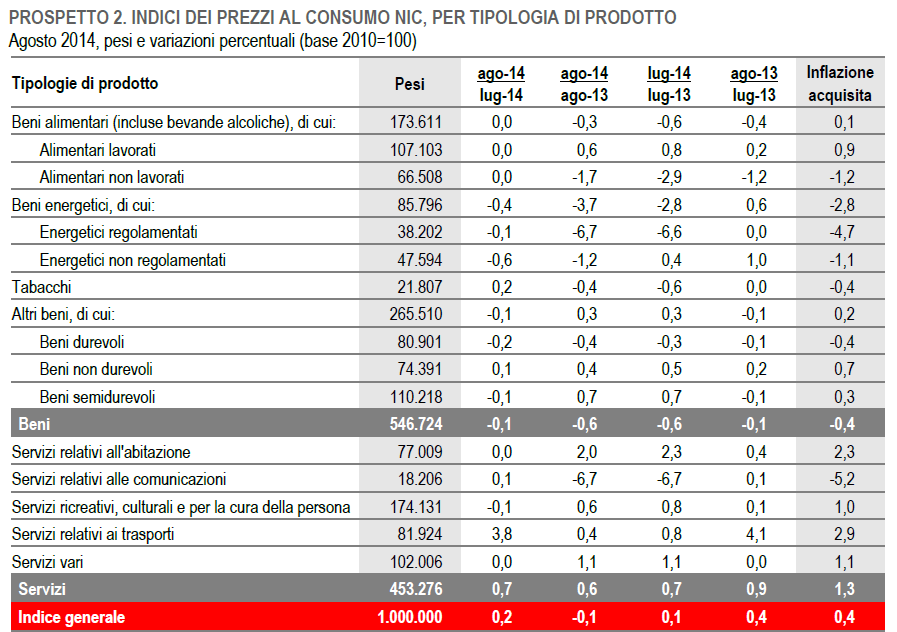
Giulio Zanella has a nice post on noisefromamerika, dissecting the sources of Italian deflation. (In Italian, but Google translate does a pretty good job.)  Deflation can come from lack of "demand," or from technical innovation and increases in supply. What do the data suggest?


The right hand column gives inflation by category. "Beni Alimentari" are food, +0.1%, "Beni Energetici" is energy, -2.8%. "Beni Durevoli" is durable goods, -0.4% and "nondurevoli", duh, nondurable goods at +0.7%. The services are all positive, except communications services


The message, suggests Giulio, is pretty clear. What's going down? Tradeables and commodities. Oil prices and agricultural commodity prices reflect global, not Italian, supply and demand.  Imported and import-competing durable prices go down. What's going up? Nontradeables and services. This looks like imported and supply deflation not lack-of-demand deflation
The subdivision goods / services is in fact for a country like Italy a good approximation of subdivision tradables ( tradables ) / non-tradable goods ( nontradables ). ... If deflation Italian was mainly due to the weakness of domestic demand, then we should observe deflation even (and especially) in the prices of services. Instead do not observe the contrary, we observe an increase of 0.6%. 
And prices go down when supply curves shift out,
note the strong (6.7%) reduction in the price of communications services, a reduction that is the clearest example of deflation induced by technological innovation and, probably, competition... in a rapidly expanding and highly contestable market.  [Yes, even in Italy] Multiplying this price reduction by its weight in the Istat basket, (6.7% * 1.82%), it turns out this item contributes 0.12%, a bit more than the whole of deflation.
The longer original is worth reading.

I guess the 16 euro gelato will still be with us for a while.

Friday, August 29, 2014

After Dodd-Frank


(Youtube link) A talk given at the Mercatus Center / CATO conference "After Dodd-Frank: The Future of Financial Markets." (The link has videos of the whole conference.) The talk is taken from the paper "Towards a Run-Free Financial System," which answers many objections you may have to claims in the talk. (Yes, I have plugged it before on the blog and will likely do again.)

The more I read about it, the more I think it's important to define what is not a problem, and can be left alone. If we have to solve housing subsidies, Fannie and Freddie, global imbalances, Wall Street greed, compensation, inequality, savings gluts, predatory lending, financial utilities, bankruptcy law, behavioral biases of equity managers, living wills, stress tests, capital ratios, Basel regulation, macroprudential bubble-detection and pricking, complexity of derivatives, exchange vs. otc trading, and so on and so on just to save ourselves from the next crisis, we might as well give up now.

Thursday, August 28, 2014

Liquidity and IOR

Re: the big balance sheet and how it improves financial stability.

Rodney Garratt, Antoine Martin, and James McAndrews at the New York Fed have a very nice post, Turnover in Fedwire Funds Has Dropped Considerably since the Crisis, but It’s Okay.

Before the crisis, banks held about $50 billion of reserves at the Fed. That's not a lot of money. When banks want to pay each other -- say you write a check to me, so my bank has to get money from your bank -- they do it by transferring reserves through the Fedwire.  So, that's why banks keep some reserves there.

But $50 billion is tiny compared to $10 trillion of M2, and banks use reserves to clear financial transactions too. A huge amount must flow by passing around these tiny reserves. How did banks do it? What happens if bank B says to bank A, "send us $10 million" and bank A didn't have $10 million left at that second in reserves?

Answer: "intraday overdrafts." The Fed would lend bank A the $10 million -- just flip a switch and put $10 million in their reserve account, and call the loan an asset corresponding to this liability. A then pays B, and works hard to make sure that it collects $10 million from C and D by the end of the day.

Source: Rodney Garratt, Antoine Martin, and James McAndrews at the New York Federal Reserve


As you can see, such "overdrafts" accounted for 50-60 percent of all Fedwire transactions before the vast increase in reserves.

It's a system that makes a lot of sense, so long as banks never fail and don't abuse it. It allows the system to produce a much higher volume of transactions with less non-interest-bearing assets. Instead of cash in advance for every purchase, settling up once per day means you only need to cover the worst possible daily total flow, not the worst possible intraday flow, like if $10 million goes out 10 minutes before another $10 million comes in.

But now, banks have $4 trillion of reserves. They're sitting around as investments, really. As long as they pay full market interest, there is no reason for banks to go to all this effort to get by with little reserves. And we seen in the graph exactly what you'd expect. If bank A owes bank B $10 million, it just sends the $10 million, no need to borrow it for 10 minutes from the Fed.

The article explains all this well. A few quibbles
The shift in funding away from overdrafts and toward account balances has significantly increased the amount of liquidity needed to fund payments in Fedwire Funds. 
I think reality is the other way. The vast amount of liquidity banks have chosen, and will continue to choose so long as reserves pay market interests, mean they have abundant liquidity to fund payments directly on Fedwire. It is not "needed." (Mistaking "choice" for "need" is a favorite Econ 101 fallacy.) The minute the Fed tries to pay less on reserves than short term T bills pay, banks will choose to go back to the old system.

And turnover -- which they point out has plummeted as in the graph below (ignore the "counterfactual") -- is a totally misleading statistic. Turnover is transactions / reserves. Transactions haven't fallen, reserves have exploded. I presume a graph of the total number of transactions shows little change, or at least no such cliff.

Source: Rodney Garratt, Antoine Martin, and James McAndrews at the New York Federal Reserve

But the closing paragraph is great:
A high turnover ratio is typically viewed as a good thing in a payment system, because more payments can be made with less liquidity. To do more with less is good when resources are scarce. However, reserves don’t have to be scarce. With interest on reserves, the Fed can implement monetary policy even though banks are flush with cash (as we noted in this Economic Policy Review article). And because banks have less need to economize on liquidity, payments are made earlier in the day, which benefits consumers and increases the resiliency of the system to operational outages or participant failures. So the large decrease in turnover should be viewed as a good thing; it is another symptom of how the high level of reserves benefits the payment system.
"Payments are made earlier in the day" is important. Demands for payment earlier and earlier in the day are a key part of failures.

H/T to Torsten Slok's weekend reading email which found the post.

Update: "Interest on Reserves and Daylight Credit" bv Huberto M. Ennis and John A. Weinberg in the Richmond Fed Economic Quarterly (2007) is a nice explanation of how the system worked. Towards the end it sketches how increasing reserves drive lower turnover, not less transactions.

Wednesday, August 27, 2014

Krugman on housing

I generally don't read Paul Krugman -- bad for the blood pressure -- and I even less often respond -- don't dignify the insults or feed the trolls. But I took a long plane flight yesterday, and the Times was all I had to read, so I stumbled across his column on housing.

After getting through the customary political barbs at Republicans (Rick Perry in this case), and snarky insults ("the habit economists pushing this line have of getting their facts wrong"), I found something almost sensible.

People, especially "middle class" people,  are moving away from New York and to California, and to Texas and Georgia. Nominal wages in Texas and Georgia are not higher. So why do they move? Answer: Real wages are a lot higher, because the cost of living is so much less. It's practically like moving to a foreign country (in  many ways!). You are earning $100,000 in the un-hip part of Brooklyn, they offer you 80,000 zingbats to move to Truckgunistan. Is it a good deal? Well, you get two dollars per zingbat, so sure!

Real wages are higher in large part because housing costs are lower. And housing costs are lower because...
high housing prices in slow-growing states also owe a lot to policies that sharply limit construction. Limits on building height in the cities, zoning that blocks denser development in the suburbs and other policies constrict housing on both coasts; meanwhile, looser regulation in the South has kept the supply of housing elastic and the cost of living low.
So conservative complaints about excess regulation and intrusive government aren’t entirely wrong,
Yup. When people want to live somewhere, you can build denser and higher -- the best answer -- you can build out -- causing a lot of transportation gridlock, long commutes, and pollution as people drive by artificially low density housing on their way to work -- or you can watch prices explode.

There is plenty more wrong in the economics of the column -- for example, "workers" aren't a homogenous lot, and "productivity" is not a constant of nature, independent of numbers or of occupation. Hedge fund managers are productive (at least by usual measurement) in New York. That does not mean that auto assembly workers will be more productive if they move back to New York. So moving everyone back to New York and California is not likely to double GDP. But it's nice to see an admission of a major problem caused by regulation.

On the second-to-last sentence, he's still going strong
It would be great to see the real key — affordable housing — become a national issue. 
Indeed it would. But faced with the inevitable, unavoidable, logically unassailable conclusion -- we need a massive liberalization of zoning laws, planning restrictions, and so forth, allowing people to build up and dense, and thereby create an immense supply of slightly used housing too as people move out into the new stuff--his political blinders just won't let him do it:
But I don’t think Democrats are willing to nominate Mayor Bill de Blasio for president just yet. 
Bill de Blasio?? That champion of free markets?  From that paragon of low-cost housing,.... New York City? Touting that well-proven, time-tested solution: more regulation, set-asides, rent control, government construction, and quotas? Just like they have in Texas and Georgia?

Well, today Grumpy got two good LOLs from the news.