Wednesday, September 10, 2014

Optimal quantity of money, achieved?

Here are three graphs, presenting inflation, long-term interest rates and short-term interest rates in the US, Germany and Japan.


Now, suppose you just returned from a long trip in outer space, started around 1979. What would you say of these three graphs?

If you didn't "know" anything and just look at these graphs, your response would most likely be, "Hoorray!,"at least if you blasted off somewhere near the University of Chicago.  It looks like our economies vanquished inflation and are all on a steady global trend towards the Friedman "Optimal  Quantity of Money."

You might sensibly forecast that the trend, so clearly established for 2 to 3 decades, will continue. Inflation will continue to trend down, to zero or slightly negative values. The short term nominal rate will stay at zero, or maybe rise to at most a percent or two.  Long term rates, read as expected short rates plus a risk premium, signal this future and might end up slightly positive.

You might suppose our central bankers are all off retired to write memoirs at think tanks, enjoying the accolades of a grateful public, and cutting ribbons at statues being built to their honor. You would be wrong, but that's another story.

The Friedman Optimal Quantity and Financial Stability

Milton Friedman long ago wrote a very nice article, showing that the optimum state of monetary affairs is a zero short-term rate, with  slow deflation giving rise to a small positive short-term real interest rate.

Friedman explained the optimal quantity in terms of "shoe-leather" costs of inflation. Interest rates are above zero,  people go to the bank more often and hold less cash, to avoid lost interest. This is a socially unproductive activity.  Bob Lucas once added up the area under the money demand curve to get a sense of this social cost, and came up with about 1% of GDP. Not bad, but not earth-shattering.

As I think about it, however, there are financial stability benefits to zero rates  far beyond what Friedman imagined.  This thought reoccurred this morning as I was thinking about Dan Tarullo's testimony on capital requirements.

Why do banks load up on debt? Well, one answer, interest payments are tax free and dividends aren't, so the "tax shield" leads to excessive debt. But if interest rates are zero, the value of the tax shield is zero, and this incentive to undercapitalization vanishes! 

Positive inflation induces all sorts of pointless tax arbitrage. Close to home, universities issue tax-free bonds, and invest in hedge funds.  But the whole profit-non-profit distortion in investing vanishes if interest rates are zero. If interest rates are zero, and you earn money from deflation, all interest is tax free.

The real costs of inflation are not shoe-leather trips to ATM machines. They are the fragile structures of overnight funding, which built up before the financial crisis, and crashed spectacularly, much of it designed to make sure "cash" earns interest. At zero rates, it is all needless.

Zero interest rates. Zero or slightly negative inflation. It's hard to tell just where long-term inflation is anyway. Would you really trade your imac for 1,000 Apple IIs? What's not to like?

Why not? 

So, why do so many people look at my graphs with deep foreboding and a sense of something wrong? Why is the "optimal quantity of money" and the "non-distorting interest rate" suddenly the "zero bound," as welcome at macroeconomic discussions as an ebola patient in an emergency room? What's wrong with an economy that has zero or slight deflation, and zero or very low interest rates? Why are central banks fighting so desperately to avoid their apparent victory?

One view, espoused frequently by Paul Krugman, sees the quiet approach of zero inflation or deflation with great foreboding, as it puts us in danger of "deflation spiral" or "vortex" about to break out at any time.   A little extra deflation raises real rates, which lowers "demand," which through a Phillips curve leads to more deflation, and the whole thing spirals out of control.

But it never happened, not even in Japan, though feared for nearly 20 years now. I don't know of a single historical event where a deflation "spiral" ever happened. (Deflation has happened, as in the US in the great depression. But it did not "spiral" out of control. It looked a lot like money demand went up, money supply didn't the price level fell, end of story.) And in my view of the world it can't happen. Real rates lowering "demand," are a tenuous idea, the Phillips curve is a correlation not a theory of price level determination specifying cause and effect from output to prices, and a serious deflation means governments must raise taxes to pay off higher real values of debt, which simply is not going to happen.

Another view is that we stand on a cliff of monetary-policy induced inflation or hyperinflation about to break out.  The zero bound is being held too long. Reserves have exploded from $50 billion to $4 trillion. Just wait.

The long trend and calm behavior of the data belie this view too.

A more nuanced view holds that we need positive inflation and positive rates so that the Fed has room to lower rates to ward off deflation spirals, as well as to counteract recessions. I'm dubious. This is like the view that you should wear shoes that are too tight, so it feels good to take them off at night.  A few monetarists have called for deliberately stifling financial innovation so the Fed could control the money supply. The high inflation target so we can lower rates is is the Keyensian (or interest-rateian) analogue. But do we really need to lose 1% of GDP in Lucas shoe leather costs, and the far larger financial stability costs that artificially high rates imply, just so the Fed can jigger around rates when it wants to do so?

At least for inflation, the graphs do not scream the necessity of this view. They certainly do not endorse the view that the disinflationary trend was caused by a Taylor rule: You do not see interest rates moving 1.5 times as much, or in response, to inflation, and you do not see rates dropping more than 1.5 times inflation to ward off deflation.  Producing a coefficient above one takes a lot more fiddling with a regression. You see pretty much a Fisher rule -- interest rates move one for one with inflation. The graphs are just as consistent with the story that talk policy somehow "anchored expectations" and then central banks slowly lowered rates.

Our astronaut, on hearing all these views, might well conclude that none has a good handle on just why inflation is falling to zero, what central banks or other parts of the government actually did to bring about these great trends. And he would be correct. But that emptiness surely means that chicken-little "the sky is falling" about this three-decade trend suddenly exploding is overstated.

(Someone will quickly point out that I too have worried about inflation. But my worries have nothing to do with monetary policy or the level of nominal rates. My worry has to do with fiscal policy, and is more like a worry that low mortgage backed security rates in 2006 could not last. )

What about wage stickiness? A standard answer to "what's wrong with slow deflation" is "wages are sticky so you'll get a secular stagnation." Now, wages arguably are sticky at the 1-6 month horizon, and when we're talking about large, say, 20% shocks, like if a country's banking system implodes.

But that's not what we're talking about here. Does wage stickiness really get in the way of 1-2% steady deflation?

Now, nobody likes to have their wages cut.  But nobody has to. As Alex Tabarrok points out in a splendid Marginal Revolution post, half of US employees have changed jobs since the bottom of the Great Recession.  This is one of many ways in which the popular imagination of having one job all your life butts up against the reality of huge churn in the labor market.

Now stickiness fans will come up with some new story about people not wanting to take lower wages at new jobs, or social limitations to hiring new people at lower wages and so on. But that's a new and different story than "employers don't want to cut people's wages." Again, we're thinking about the long run here, not recessions.

Moreover, each individual can ascend an age-earnings profile while wages overall are declining. And productivity growth adds to the spread between wages and inflation.  If each individual's wages grow 2% per year as they age and move up the ladder, if aggregate productivity grows 2%, then we can have 4% deflation before anyone takes a wage cut.

So what is the problem? Yes, the reduction in inflation is associated with slower growth, see again Japan. But it's far from settled that zero inflation, butting against some sort of stickiness, caused the slow growth and everything else in Japan was a smoothly functioning market.  Anil Kashyap thinks Japan had zombie banks. Fumio Hayashi and Ed Prescott point to low TFP growth.  And similarly with us.

Bottom line

So, back to our graphs and returning astronaut. If you just look at the graphs, I think our astronaut would think there is a good chance this trend continues.  And, perhaps, we should see a long period of zero rates and slight deflation as a great achievement in monetary policy.  If only we honestly understood why it happened and therefore had more faith that it will continue.




Capital and Language

The Fed Scrutinizes Bank Capital, in the Popular Imagination
Fed Governor Dan Tarullo gave important testimony on financial regulation September 9. It got widespread media coverage, for example Wall Street Journal and Bloomberg View.

The good news. The Fed wants more capital. Banks should absorb their own risks, rather than all of us to count on the Fed to stand over their shoulders and make sure they never lose money again.

Confusing language has long been a roadblock in this effort, along with red herrings passed along thoughtlessly.


"Costly"

The WSJ writes
The Federal Reserve plans to hit the biggest U.S. banks with a costly new requirement 
Mr. Tarullo's testimony does not contain any mention of the idea that higher capital requirements will be "costly."  My view, expressed nicely by Admanti and Hellwig's book, is that there is zero social cost to lots more bank equity.  Disagree if you will, but source it please, don't just pass it on as if the source said it or as if this is a fact like the sun coming up tomorrow.

"Hold"


Here are three uses of "hold" in the WSJ article [my emphasis]
 At issue is a requirement for the world's largest banks to hold an extra layer of financial padding in case of another crisis. 
Last week, the Fed and other regulators adopted another set of rules that require banks to hold very safe assets they can sell for cash in a pinch.
Mr. Tarullo said Fed officials are working on a separate rule that would require all financial firms—not just banks—to hold a minimum amount of securities or other collateral 
An unsophisticated reader could well be excused for thinking that "capital" is some special "asset" that the bank "holds" in reserve against losses. Banks "hold" loans, reserves at the Fed, gold coins in some Uncle-Scrooge vault, and this "capital," whatever that is.

No. Capital is where banks get money, not where they put it. It's a liability, not an asset. Capital has nothing to do with reserves, liquidity, safe assets or other "holdings."

No. Banks "issue" capital.  They "retain" capital if you must. But banks simply do not "hold" capital, and let's stop saying so.

Alas, this isn't just the journal, as Mr. Tarullo himself mis-spoke
By further increasing the amount of the most loss-absorbing form of capital that is required to be held by firms that potentially pose the greatest risk to financial stability, we intend to improve the resiliency of these firms,
"Charge"

There are 20 instances in the WSJ article of the word "charge" or "surcharge," starting with
the regulator intends to impose a capital surcharge that will require the biggest U.S. banks to maintain fatter cushions to protect against potential losses.
This is just as profoundly misleading. It sounds like the Fed is taxing the banks. Much as I would like a Pigouvian tax on short term debt, a capital requirement is nothing of the sort. Banks are not being "charged" a cent.

Alas, here too I can't fault the Journal too badly, as there are 14 instances of "charge" in Mr. Tarullo's testimony, starting with a section heading "GSIB risk-based capital surcharges." In turn, Mr. Tarullo is echoing the Basel committee's language.

We don't have to pass it on. We can say "additional capital requirement."

Bloomberg did a much better job (Byline just "editors" so I don't know who to praise here)
...Fed Governor Daniel Tarullo said that the central bank plans to subject systemically important banks to an added capital buffer significantly greater than what international rules require. The purpose of the so-called surcharge, which could be as much as several percent of risk-weighted assets, is to discourage complexity and fragility. It will be larger, for example, for banks that depend heavily on short-term funding of the kind that proved unreliable during the 2008 crisis. 
"Subject to" and the nice "so-called surcharge" avoid the red herrings nicely. And putting short-term funding right up front is spot on.
The Fed, for example, is requiring that banks have extra capital to absorb the costs of operational failures, 
"Have" is better than "hold."

But best of all, Bloomberg goes right at the common fallacies and explains it all nicely.
The Fed's efforts to make big banks fund themselves with more capital should not be perceived as punishment. Capital, also known as equity, is money that banks can use to make loans or fund whatever activities they choose. Because it doesn't have to be paid back like debt, it makes them more resilient in times of crisis -- a feature that should be seen as an advantage.
Nonetheless, the biggest U.S. banks operate with astonishingly little capital. As of June 30, the six largest U.S. banks had an average of about $5 in tangible equity for each $100 in assets (by international accounting standards) -- far less than smaller banks and enough to absorb a loss of only 5 percent of assets. Executives prefer to rely heavily on debt for two main reasons: It's relatively cheap thanks to various taxpayer subsidies, and it makes banks' performance -- measured as the return on equity -- look better in good times.
Aah, clarity at last. The article does not use "hold" or "held" once.

The PC left has a point: little words do matter.


Friday, September 5, 2014

The $20,000 bruise

The $20,000 bruise story in the Wall Street Journal makes good reading. All of these health care disasters make good reading.
 I let the billing supervisor speak for a moment, and then cut him off using the ammo I had acquired from billing-coders' blogs. "You billed a G0390 for trauma-team activation. But chapters 4 and 25 of the MCPM require there be EMS or outside hospital activation if you are billing a G0390. There was no such activation here. So here is what I need you to do: Remove that $10,000 charge and reissue the bill."
He was silent for a moment. And then he said, " Let me talk to my supervisor."
...To the hospital's immense credit, they sent a refund to our insurance company and reissued the bill without the $10,000 trauma activation. They could have refused. What would my recourse have been? To hire a lawyer? Try to interest my insurer in fighting over a measly $10,000 charge? That is a tiny line item in their book of business.
All of us have experienced or know people who have experienced similar nightmares.

A question for any experts who read this blog. Surely there is a business opportunity here, no? "We negotiate your medical bill."  It is a huge waste of resources for Mr. David a "co-founder and chief strategy officer of Organovo Inc., a biotech company in California" to spend hours on the phone and more hours on the internet learning about medicare coding procedures. And all his acquired knowledge  is now wasted. Surely such a business could operate, like many lawyers, on a contingency fee basis, and take a fraction of money saved.

Yes, as Mr. David points out, this is what insurance companies are supposed to do. But copays are going up, and more people are gong to be paying out of pocket anyway.

Are there businesses like this that I, and Mr. David, simply don't know about?

Update: I knew that were there is demand there must be supply! A correspondent sends me a link to copatient.com, which looks like this:


Promotion


Once upon a time, in the Krugman pantheon, I was only "stupid." Then I made it to "mendacious idiot." I've been promoted again, to "Evil!"  And, better, corrupt, since "vested interests can buy the ideas they want to hear," and I am listed a seller.

All under the once-authoritative imprimatur of that impressive logo, reproduced above.  All the news that's fit to print. And then some.

Break out the champagne.  I wonder what I can aspire to next. I do have a Ph.D. Perhaps, dare I hope,...


Actually, I am flattered to be listed in the company of Alesina, Ardagna, Reinhart, Rogoff, and Lucas.  In other contexts, Fama, Prescott, Ferguson.

OK, enough Krugman blogging. It's just gotten to the point of humorous, in a pathetic sort of way.

Wednesday, September 3, 2014

Cool video


Nightingale and Canary from Andy Thomas on Vimeo.
Using 3D visualization software and other programs, Thomas breaks down photos of insects, orchids, and birds into their composite parts. He then reassembles the images in a sort of collage and builds trippy animations that react, based on rules he's set, to sound – in this case, archival bird song.
Source: This is Your Bird on Drugs, post by Julia Lowrie Henderson. Video by Andy Thomas

This has absolutely nothing to do with economics, or grumpiness. I just thought it was cool.

Krugman on the attack

In the New York Times, rehashing ancient calumnies. It must be a slow day.

Dear Paul, let me introduce you to parts of the distribution other than the mean. Inflation risk is a tail event.  I am in California now. There is a danger of big earthquakes. That the big one has not happened in the last 5 years does not mean the ground will be still forever, nor that geologists are mendacious idiots ignorant of Bayes' theorem.

My worries about inflation do not come from monetary policy. I've been as outspoken on the view that monetary policy is ineffective at the zero bound as the most solid Keynesian.  In the WSJ,  "Reserves that pay market interest are not inflationary. Period." If you bothered to read anything before venting, you'd know that.

My worries stem from the western world at 100% debt to GDP ratio, larger unfunded commitments to ageing populations, slow growth, and no solid plan to pay it back. I've been pretty clear that this is a self inflicted wound -- our governments can let economies grow and pay it back, but may choose not to.  If bond investors decide they don't want to be the ones holding the bag, inflation will come no matter what central banks do about it.

This mechanism remains a proper fault sitting underneath us. But one that can sit a long time. Just like, I hope, the San Andreas.  But the fact that sovereign debt must eventually be repaid, defaulted on, or inflated away, remains an accounting identity valid even in the most rabid Keynesian worldview.

For fun, I spent a few minutes googling Krugman and deflation (sometimes "spiral", sometimes "vortex"), which also did not happen, and in my view cannot happen.  But I will resist. It's just too easy to play this game. Economics is not soothsaying, and descending further into the pit dignifies it unneccessarily.


Monday, September 1, 2014

Italian deflation?

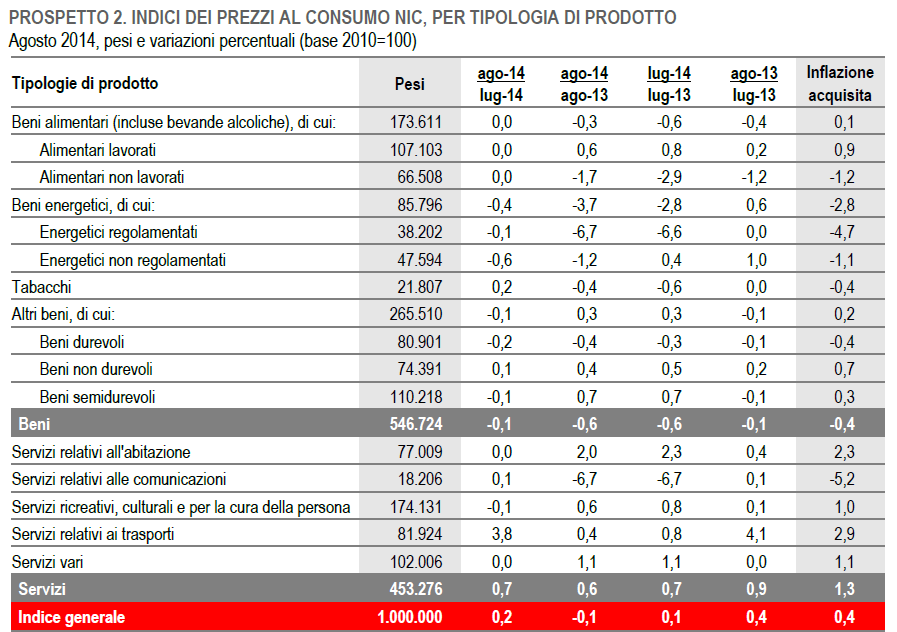
Giulio Zanella has a nice post on noisefromamerika, dissecting the sources of Italian deflation. (In Italian, but Google translate does a pretty good job.)  Deflation can come from lack of "demand," or from technical innovation and increases in supply. What do the data suggest?


The right hand column gives inflation by category. "Beni Alimentari" are food, +0.1%, "Beni Energetici" is energy, -2.8%. "Beni Durevoli" is durable goods, -0.4% and "nondurevoli", duh, nondurable goods at +0.7%. The services are all positive, except communications services


The message, suggests Giulio, is pretty clear. What's going down? Tradeables and commodities. Oil prices and agricultural commodity prices reflect global, not Italian, supply and demand.  Imported and import-competing durable prices go down. What's going up? Nontradeables and services. This looks like imported and supply deflation not lack-of-demand deflation
The subdivision goods / services is in fact for a country like Italy a good approximation of subdivision tradables ( tradables ) / non-tradable goods ( nontradables ). ... If deflation Italian was mainly due to the weakness of domestic demand, then we should observe deflation even (and especially) in the prices of services. Instead do not observe the contrary, we observe an increase of 0.6%. 
And prices go down when supply curves shift out,
note the strong (6.7%) reduction in the price of communications services, a reduction that is the clearest example of deflation induced by technological innovation and, probably, competition... in a rapidly expanding and highly contestable market.  [Yes, even in Italy] Multiplying this price reduction by its weight in the Istat basket, (6.7% * 1.82%), it turns out this item contributes 0.12%, a bit more than the whole of deflation.
The longer original is worth reading.

I guess the 16 euro gelato will still be with us for a while.