Showing posts with label Taxes. Show all posts

Tuesday, August 9, 2016

Summers on growth and stimulus

Larry Summers has an important, and 95% excellent, Financial Times column. Larry is especially worth listening to. I can't imagine that if not a main Hilary Clinton adviser he will surely be an eminence grise on its economic policies. He's saying loud and clear what they are, so far, not: Focus on growth.


The title "the progressive case" for growth, is interesting enough. Perhaps Larry now uses the word "progressive" to describe himself. More importantly, Larry's audience here is the Clinton campaign and the Democratic party. He's saying loud and clear: you're not paying enough attention to growth, and growth ought to be at the center of the party, and the new Administration's, economic plans.
...many people, in their eagerness to focus on fairness, neglect the single most important determinant of almost every aspect of economic performance: the rate of growth of total income,
Hooray. Not only is this vitally important and factually correct, a growth oriented policy, if sold without the usual demonization, could well attract bipartisan support. That sentence could come from Paul Ryan's a better way

Alas, Larry blows that spirit right off the bat with a sentence that take a gold medal for convoluted calumny and bombastic bulverism:
Because those who champion strategies that centre on business tax-cutting and deregulation and favour the wealthy have placed the most emphasis on growth over the past 35 years, the objective of increasing growth has been discredited in the minds of too many progressives.
Translated into something approximating English: because people whose only and base motive was "favoring the wealthy" happened to advocate growth to sell their (as later described) useless tax-cutting and deregulation strategies, the goal of growth has become tarnished in the minds of good progressives.

This is below Larry -- in person I have always known him to recognize that conservatives and free-marketers have exactly the same dispassionate goal, advocate growth primarily to help the less well off, and tax-cutting and deregulation as time-proven policies that improve growth.  But, again, his audience is to the left, so perhaps one can excuse some I-hear-you agreeing with common demonizations.

But then he gets to well written and praiseworthy work, so good I must quote it in entirety:  
It can hardly be an accident that the decades of maximum growth, the 1960s and 1990s, also saw the most rapid job growth and most rapid increase in middle-class living standards.

Growth provides the wherewithal for increased federal revenue and so encourages the protection of vital social insurance programmes such as Social Security and Medicare.... 
Tight labour markets are the best social programme, as they force employers to hire and mentor inexperienced people in order to be adequately staffed. Some years ago, I estimated that for each 1 per cent point increase in adult male employment, the employment of young black men rose 7 per cent. More recent research confirms economic growth has an outsized benefit for younger people and minorities.

Rising growth has other benefits, as well. It strengthens the power of the American example in the world. It obviates the need for desperation monetary policies that risk future financial stability. Greater growth also has historically operated to reduce crime, encourage environmental protection and contributes to public optimism about the country that our children will inherit.

The reality is that if American growth continues to have a 2 per cent ceiling, it is doubtful that we will achieve any of our major national objectives.

If, on the other hand, we can boost growth to 3 per cent, interest rates will normalise, middle-class wages will rise faster than inflation, debt burdens will tend to melt away and the power of the American example will be greatly enhanced.
...the vast majority of job creation and income growth comes from the private sector. If the next president is lucky enough to oversee the creation of 10m jobs from 2017-20, more than 8m of them will surely come from businesses hiring in response to profit opportunities. 
All true, excellent, well-stated, and bipartisan (at least for the pre-Trump era). Jeb Bush's 4%, Paul Ryan's opportunity society agree totally. Heck, even Gary Johnson might find little to quibble with here. If growth could be the mantra for the Hilary Clinton administration, and if Larry can persuade his fellow "progressives," great things could follow.

And now to the remaining 5%:
There is no case for reducing already low corporate taxes or removing regulations unless it can be shown that these have costs in excess of benefits.

What is needed is more demand for the product of business. This is the core of the case for policy approaches to raising public investment, increasing workers’ purchasing power and promoting competitiveness.
No case? Really? The higher taxes, steadily more convoluted tax code, vast expansion of regulation (Dodd-Frank, Obamacare are just the start) that coincided with our epic slow growth, have nothing at all to do with that sorry experience?   There is absolutely nothing wrong with the microeconomics of the American economy and its vast administrative, judicial and regulatory state, we just need a bit more "demand?"

Leave aside the last 30 years of growth theory, which is silent on "demand," we can do nothing better than move around 1970s era IS and LM curves, and revive ideas from the 1930s?

Read the second paragraph carefully. "More demand" is the ""core of the case for policy approaches to raising public investment, increasing workers’ purchasing power and promoting competitiveness."

That "more demand" is the "core of the case" for (The Federal Government to borrow a lot of money and spend it on things labeled as) "public investment" admits up front that the actual value of such investment is at best secondary. Public investment in a great Ice Wall of Westeros on the southern border, or for high-speed trains from Tonopah to Winemucca, do just as well in boosting "demand."

What is needed is a serious negotiation: Fund needed infrastructure investment, but put in serious cost-benefit analysis,  buy it at reasonable prices, and so forth. That negotiation should start by abandoning the whole idea that we're doing it to provide "jobs" and "demand." If you're not wiling to do that, at least be honest and state that Mr. Trump's wall provides the same "demand."

Then explain to us how Japan has been at this for 20 years, producing no great shakes of growth.

"policy-approaches to... increasing worker's purchasing power" is another classic hidden-subject clause. I presume it means [The Federal Government, by legislation, regulation, or threat, will force companies to pay workers more, and then control employment to make sure those companies don't just fire workers or select better ones in order to ] increase [some] worker's purchasing power." Gary Johson's program also increases worker's purchasing power, and I don't think that's what Larry has in mind. I'm also curious where in modern economics forced transfers increase employment and long-run growth.

But in context, this is a small complaint. If Larry can persuade Mrs. Clinton and the "progressives" in the Democratic Party to focus on growth, to state goals for growth, and to hold themselves accountable for growth, then we can have an honest and very productive conversation about what's stopping growth and what steps can further it.


Tuesday, July 12, 2016

Blueprint for America

"Blueprint for America" is a collection of essays, organized, edited and inspired by George P. Shultz. You can get an overview and chapter by chapter pdfs here. The hardcover will be available from Amazon or Hoover Press October 1.

Some of the inspiration for this project came from the remarkable 1980 memo (here) to President-elect Ronald Reagan from his Coordinating Committee on Economic Policy.

Like that memo, this is a book about governance, not politics.  It's not partisan -- copies are being sent to both campaigns. It's not about choosing or spinning policies to attract voters or win elections.

The book is about long-term policies and policy frameworks -- how policy is made, return to rule of law, is as important as what the policy is --  that can fix America's problems. It focuses on what we think are the important issues as well as policies to address those issues -- it does not address every passion of the latest two-week news cycle.

The book comprises the answers we would give to an incoming Administration of any party, or incoming Congress, if they asked us for a policy package that is best for the long-term welfare of the country.

The chapters, to whet your appetite:

INTRODUCTION
CHAPTER 1: The Domestic Landscape by Michael J. Boskin
IN BRIEF: Spending by George P. Shultz
CHAPTER 2: Entitlements and the Budget by John F. Cogan
CHAPTER 3: A Blueprint for Tax Reform by Michael J. Boskin
CHAPTER 4: Transformational Health Care Reform by Scott W. Atlas
CHAPTER 5: Reforming Regulation by Michael J. Boskin
CHAPTER 6: National and International Monetary Reform by John B. Taylor
CHAPTER 7: A Blueprint for Effective Financial Reform by John H. Cochrane
IN BRIEF: National Human Resources by George P. Shultz
CHAPTER 8: Education and the Nation’s Future by Eric A. Hanushek
CHAPTER 9: Trade and Immigration by John H. Cochrane
IN BRIEF: A World Awash in Change
CHAPTER 10: Restoring Our National Security by James O. Ellis Jr., James N. Mattis, and Kori Schake
CHAPTER 11: Redefining Energy Security by James O. Ellis Jr.
CHAPTER 12: Diplomacy in a Time of Transition by James E. Goodby
CLOSING NOTE: The Art and Practice of Governance by George P. Shultz

My chapter on a Blueprint for Effective Financial Reform is a better version of the talk on Equity Financed banking which I posted here. (The talk was based on the paper. Now you have the paper.)

My chapter on Trade and Immigration is new, and an uncompromising red-meat free-market view. I don't think one should compromise centuries old economic understanding just because it's not politically popular at the moment.
 
If you got this far, you might also be interested in my Economic Growth essay written for a parallel but similar project.

Thursday, June 2, 2016

WSJ growth oped -- full version

WSJ Oped. Now that 30 days have passed, I can post the whole thing. Previous post.

Ending America’s Slow-Growth Tailspin

Sclerotic growth is America’s overriding economic problem. From 1950 to 2000, the U.S. economy grew at an average rate of 3.5% annually. Since 2000, it has grown at half that rate—1.76%. Even in the years since the bottom of the great recession in 2009, which should have been a time of fast catch-up growth, the economy has only grown at 2%. Last week’s 0.5% GDP report is merely the latest Groundhog Day repetition of dashed hopes.

The differences in these small percentages might seem minor, but over time they have big consequences. By 2008, the average American was more than three times better off than in 1952. Real GDP per person rose from $16,000 to $49,000. And those numbers understate the advances in the quality of goods, health and environment that came with growth. But if U.S. growth between 1950 and 2000 had been the 2% of recent years, instead of 3.5%, income per person in 2000 would have risen to just $23,000, not $50,000. That’s a huge difference.

Looking ahead, solving almost all of America’s problems hinges on re-establishing robust economic growth. Over the next 50 years, if income could be doubled relative to 2% growth, the U.S. would be able to pay for Social Security, Medicare, defense, environmental concerns and the debt. Halve that income gain, and none of those spending challenges can be addressed. Doubling income per capita would help the less well off far more than any imaginable transfer scheme.


Why is growth slowing down? One camp says that we’ve run out of ideas. We were supposed to have flying cars and all we got was Twitter. Get used to it, the thinking goes, and start fighting over the shrinking pie.

Another camp holds that the culprit is “secular stagnation,” a “savings glut” demanding sharply negative interest rates that the Federal Reserve cannot deliver. That outlook attracts clever new economic theories and promotes vast new stimulus spending of the sort that Japan has fruitlessly followed.

The third camp (mine) holds that the U.S. economy is simply overrun by an out-of-control and increasingly politicized regulatory state. If it takes years to get the permits to start projects and mountains of paper to hire people, if every step risks a new criminal investigation, people don’t invest, hire or innovate. The U.S. needs simple, common-sense, Adam Smith policies.

America is middle-aged and overweight. The first camp says, well, that’s nature, stop complaining. The second camp looks for the latest miracle diet—try the 10-day detox cleanse! The third camp says get back to the tried, true and sometimes painful: eat right and exercise.

The first two camps are doubtful. How much more growth is really possible from better policies? To get an idea, see the nearby chart plotting 2014 income per capita for 189 countries against the World Bank’s “Distance to Frontier” ease-of-doing-business measure for the same year. The measure combines individual indicators, including starting a business, dealing with construction permits, protecting minority investors, paying taxes and trading across borders. Unlike the more popular ease-of-doing business rankings, this is a measure of how good or bad things are with 100 being the best observed so far, or “Frontier,” score.

In general, the higher a country’s score, the higher its per capita income. The Central African Republic scores a dismal 33, and has an annual per capita income of just $328. Compare that to India (50.3, $1,455), China (61, $7,000) and the U.S. (82, $53,000).

The U.S. scores well, but there is plenty of room for improvement. A score of 100 unites the best already-observed performance in each category. So a score of 100—labeled Frontier—is certainly possible. And, following the fitted line in the chart, Frontier generates $163,000 of income per capita, 209% better than the U.S., or 6% additional annual growth for 20 years. If America could improve on the best seen in other countries by 10%, a 110 score would generate $400,000 income per capita, a 650% improvement, or 15% additional growth for 20 years.

If you think these numbers are absurd, consider China. Between 2000 and 2014, China averaged 15% growth and a 700% improvement in income per capita. This growth did not follow from some grand stimulus or central plan; Mao tried that in the 1960s, producing famine, not steel. China just turned an awful business climate into a moderately bad one.

It is amazing that governments can do so much damage. Yet the evidence of the graph is strong. The nearly controlled experimental comparison of North Korea versus South Korea, or East Germany versus West Germany, is stronger. But if bad institutions can do such enormous harm, it follows inescapably that better institutions can do enormous good.

A growth agenda doesn’t fit neatly into current policy debates. This is fortunate, as new ideas are easier to swallow than defeats.

Parties argue over tax rates, but what’s really needed is deep tax reform, cleaning out the insane complexity and cronyism.

Parties argue over how much to raise or cut spending for social programs, but what’s needed is a thorough overhaul of the programs’ pernicious incentives. For example, Social Security disability needs to remove its disincentives to work, move or change careers.

Parties argue about education spending, but America needs the better schools that come from increased choice and competition.

Most of all, the country needs a dramatic legal and regulatory simplification, restoring the rule of law. Middle-aged America is living in a hoarder’s house of a legal system. State and local impediments such as occupational licensing and zoning are also part of the problem.

Growth-oriented policies will be resisted. Growth comes from productivity, which comes from new technologies and new companies. These displace the profits of old companies, and the healthy pay and settled lives of their managers and workers. Economic regulation is largely designed to protect profits, jobs and wages tied to old ways of doing things. Everyone likes growth, but only in someone else’s backyard.

There is hope. Washington lawmakers need to bring about a grand bargain, moving the debate from “they’re getting their special deal, I want mine,” to “I’m losing my special deal, so they’d better lose theirs too.” While the current presidential front-runners are not championing economic growth, House Speaker Paul Ryan (R., Wis.) and other House members are. And if economic-policy leadership moves from a chaotic presidency to a well-run Congress, that may be healthy for America’s political system as well as for the economy.

Update: response to some criticis

Tuesday, May 3, 2016

Growth Interview


I did a short interview with the WSJ's Mary Kissel about my growth oped. If you can't see the embed above, try this direct link or this one

WSJ Growth Oped

I did an oped on growth in the Wall Street Journal, titled "Ending America’s Slow-Growth Tailspin." I'll post the full thing here in 30 days.

Blog readers will recognize a distilled version of my longer essay on growth (blog post herehtml here,   pdf here), and the graph from Smith v. Jones blog post. I think out loud. The growth essay is much more detailed on diagnosis and especially on policy.

There are three basic ideas (two too many for a good oped).

1) Growth is everything. Increasing growth will do way more for every problem you can name than anything else on the economic agenda. Even if workers in 1910 could have taken all of Rockefeller's wealth, they would have been disastrously poor compared to today.

2) Can policies actually improve growth? The tut-tutters mocked Jeb Bush's 4% aspiration. I outline the "we've run out of ideas" school of thought, most recently in Bob Gordon's thoughtful book; the "everything is right but the zero bound" secular-staglation school, and the view that the growth giant is being held back by a liliputian army of politicized regulators.

As evidence,  I improved on the graph from an earlier post of the World Bank's ease of doing business score vs. GDP per capita,


(if you can't see the graph, click here)

This graph adds a few things relative to the one in WSJ. I added some outliers. Libya and Venzuela seem like countries with good reasons to have temporarily more GDP than their institutions can long support, Rwanda and Georgia the opposite. So the correlation is even better than it looks. Given how crude the world bank measure is, it's surprising it works so well. It's mostly about the difficulties of starting small businesses. I added Greece too to gives some sense of variation within the Euro-US world.

The point: Bad policies can do dramatic harm. Ipso facto, good policies must be able to do a lot of good. The US is not perfect!

A famous economist challenged my view that regulation is causing a lot of problems, noting that all of the big business types he talks to don't complain that much. But I think that's a horrendous selection bias. If you talk to the people still in business, you are talking to the ones that have figured out the political and regulatory game. Go talk to the ones whose businesses are closed, or not even started.

Another point, regulation has been getting worse for decades. Why the slump now? I think that a lot of the government onslaught's effect has been to make the economy less resilient. For example, social security disability is not a problem as long as you have a job. When you lose a job, and go on disability, now the huge disincentive to work, study, move, kicks in.  Recovering from a recession needs new jobs, new businesses, new innovations.

3) A very brief outline of policies to get growth going again. I think the key is to move past the standard rhetoric that defines our current partisan bickering. It's not how much we spend, really, it's how we spend it. Free market economics is not "trickle-down" economics, it's about incentives, simplicity, rule of law, and so forth.


Tuesday, April 5, 2016

Next Steps for FTPL

Last Friday April 1, Eric Leeper Tom Coleman and I organized a conference at the Becker-Friedman Institute,  "Next Steps for the Fiscal Theory of the Price Level." Follow the link for the whole agenda, slides, and papers.

The theoretical controversies are behind us. But how do we use the fiscal theory, to understand historical episodes, data, policy, and policy regimes? The idea of the conference was to get together and help each other to map out this the agenda. The day started with history, moved on to monetary policy, and then to international issues.

A common theme was various forms of price-related fiscal rules, fiscal analogues to the Taylor rule of monetary policy. In a simple form, suppose primary surpluses rise with the price level, as
\[ b_t = \sum_{j=0}^{\infty} \beta^j \left( s_{0,t+j} + s_1 (P_{t+j} - P^\ast) \right) \]
where \(b_t\) is the real value of debt, \(s_{0,t}\) is a sequence of primary surpluses budgeted to pay off that debt, \(P^\ast\) is a price-level target and \(P_t\) is the price level. \(b_t\) can be real or nominal debt \( b_{t}= B_{t-1}/P_t\), but I write it as real debt to emphasize the point: This equation too can determine price levels \(P_t\). If inflation rises, the government raises taxes or cuts spending to soak up extra money. If inflation declines, the government does the opposite, putting extra money and debt in the economy but in a way that does not trigger higher future surpluses, so it does push up prices.

(Note: this post has embedded figures and mathjax equations. If the last paragraph is garbled or you don't see graphs below, go here.)

That idea surfaced in many of the papers.


The morning had several papers studying the gold standard and related historical arrangements. To a fiscal theorist the gold standard is really a fiscal commitment. No gold standard has ever backed its note issue 100%; and none has even dreamed of backing its nominal government debt 100%. If a government had that much gold, there would be no point to borrowing.

So a gold standard is a  commitment to raise taxes, or to borrow against credible future taxes, to get enough gold should it ever be needed. The gold standard says, we commit to pay off this debt at one, and only one, price level. If inflation gets big, people will start to want to exchange money for gold, and we'll raise taxes. If inflation gets too low, people wills tart to exchange gold for money, and we'll print it up as needed. Usually, in the fiscal theory,
\[ \frac{B_{t-1}}{P_t} = E_t \sum_{j=0}^{\infty} \beta^j s_{t+j}\]
the expectation of future surpluses is a bit nebulous, so inflation might wander around a lot like stock prices. The gold standard is a way to commit to just the right path of surpluses that stabilize the price level.

A summary, with apologies in advance to authors whose points I missed or misunderstood:

Part I: History


George Hall presented his work with Tom Sargent on the history of US debt limits, together with a fantastic new data set on US debt that will be very useful going forward.


Price of a Chariot Horse: 100,000 Denarii
François Velde and Christophe Chalmley took us on a lighting tour of monetary arrangements across history, prompting a thoughtful discussion on just where Fiscal theory starts to matter and where it really is not relevant. (François easily gets the prize for the best set of slides. Picking just one was hard.)

Michael Bordo and Arunima Sinha presented an analysis of suspensions of convertibility: Governments temporarily abandon the gold standard during war, then go back at parity afterward. Maybe. By going back afterward, people are willing to hold a lot of unbacked debt and currency during the war. But sometimes the fiscal resources to go back afterward are tough to get, the benefits of establishing credibility so you can borrow in the next war seem further off. When people are unsure whether the country will go back, the wartime inflation is worse, and the cost of going back on parity are heavier. They analyze France vs. UK after WWI.


Martin Kleim took us on a tour of a big inflation in a previous European currency union, the Holy Roman Empire in the early 1600s. Europe has had currency union without fiscal union for a long time, under various metallic standards and coinages.  In this case small states, under fiscal pressure from the 30 years' war, started to debase small coins, leading to a large inflation. It ended with an agreement to go back to parity, with the states absorbing the losses. (In my equation, they needed a lot of surpluses to match \(P\) with \(P^\ast\)). We had an interesting discussion on just where those funds came from. Disinflation is always and everywhere a fiscal reform.


Margaret Jacobson presented her work with Eric Leeper and Bruce Preston on the end of the gold standard in the US in the 1930s. (Eric modestly stated his contribution to the paper as finding the matlab color code for gold, as shown in the graph.)  Margaret and Eric interpret the fiscal statements of the Roosevelt Administration to say that they would run unbacked deficits until the price level returned to its previous level, the \(P^\ast\) in my above equation.  Much discussion followed on how governments today, if they really want inflation, could achieve something similar.

 Part II Monetary Policy 

Chris Sims took on that issue directly. If you want inflation, just running big deficits might not help. Hundreds of years in which governments built up hard-won reputations that when they borrow money, they pay it off, are hard to upend immediately. Even if you want to break that expectation -- all our governments have mixed promises of stimulus now with deficit reduction later.  A devaluation would help, but we don't have a gold standard against which to devalue, and not everyone can devalue relative to each other's currency.

Chris' bottom line is a lot like Margaret and Eric's, and my fiscal Taylor rule,
Coordinating fiscal and monetary policy so that both are explicitly contingent on reaching an inflation target — not only interest rates low, but no tax increases or spending cuts until inflation rises. 
But,
• This might work because it would represent such a shift in political economy that people would rethink their inflation expectations.
Chris led a long discussion including thoughts on rational expectations -- it's a stretch to impose rational expectations on policies that have never been tried before (though our history lesson reminded us just how few genuinely novel policies there are!)

Steve Williamson followed with a thoughtful model full of surprising results. The stock of money does not matter, but fed transfers to the treasury do. (I hope I got that right!)

My presentation (slides also  here  on my webpage) took on the "agenda" question. The basic fiscal equation is
\[\frac{B_{t-1}}{P_t} = E_t \sum M_{t,t+j} s_{t+j} \]
For the project of matching history, data, analyzing policy and finding better regimes, I opined we have spent too much time on the \(s\) fiscal part, and not nearly enough time on the \(M\) discount rate part, or the \(B\) part, which I map to monetary policy.

I argued that in order to understand the cyclical variation of inflation -- in recessions inflation declines while \(B\) is rising and \(s\) is declining -- we need to focus on discount rate variation. More generally, changes in the value of government debt due to interest rate variation are plausibly much bigger than changes in expected surpluses. As interest rates rise, government debt will be worth a lot less, an additionan inflationary pressure that is often overlooked.

Then I presented short versions of recent papers analyzing monetary policy in the fiscal theory of the price level. Interest rate targets with no change in surpluses can determine expected inflation, but the neo-Fisherian conundrum remains.


Harald Uhlig presented a skeptical view, provoking much discussion.  Some main points: large debt and deficits are not associated with inflation, and M2 demand is stable.

I found Harald's critique quite useful. Even if you don't agree with something, knowing that this is how a really sharp and well informed macroeconomist perceives the issues is a vital lesson. I answered somewhat impertinently that we addressed these issues 15 years ago: High debt comes with large expected surpluses, just as in financing a war, because governments want to borrow without creating inflation. The stability of M2 velocity does not isolate cause and effect. The chocolate/GDP ratio is stable too, but eating more chocolate will not increase GDP.

But Harald knows this, and his overall point resonates: You guys need to find something like MV=PY that easily organizes historical events. The obvious graph doesn't work. Irving Fisher came up with MV=PY, but it took Friedman and Schwartz using it to make the idea come alive. That is the purpose of the whole conference.


Francesco Bianchi presented his work with Leonardo Melosi on the Great Recession. New Keynesian models typically predict huge deflation at the zero bound. Why didn't this happen? They specify a model with shifting fiscal vs money dominant regimes. The standard model specifies that once we leave the zero bound we go right back to a money-dominant, Taylor-rule regime with passive fiscal policy. However, if there is a chance of going back to a fiscal-dominant regime for a while, that changes expectations of inflation at the end of the zero bound. Even small changes in those expectations have big effects on inflation during the zero bound (Shameless plug for the New Keynesian Liquidity Trap which explains this point very simply.) So, as you see in the graph above, the "benchmark" model which includes a probability of reverting to a fiscal regime after the zero bound, produces the mild recession and disinflation we have seen, compared to the standard model prediction of a huge depression.


Fiscal policy is political of course. Campbell Leith presented, among other things,  an intriguing tour of how political scientists think about political determinants of debt and deficits. My snarky quip, we learned with great precision that political scientists don't know a heck of a lot more than we do! But if so, that is also wisdom.

Part III International

red line regime switching probability of 30%, blue line 0 % 

Alexander Kriwoluzky presented thoughts on a fiscal theory of exchange rates, applying it to the US vs. Germany, the abandonment of the gold standard and switch to floating rates in the early 1970s. An exchange rate peg means that Germany must import US fiscal policy as well, importing the deficits that support more inflation. Germany didn't want to do that.  People knew that, so a shift to floating rates was in the air. Expectations of that shift can explain the interest differential and apparent failure of uncovered interest parity.


Last but certainly not least, Bartosz Maćkowiak presented a thoughtful analysis of "Monetary-Fiscal Interactions and the Euro Area’s Malaise" joint work with Marek JarosiÅ„sky.

Echoing the fiscal Taylor rule idea running through so many talks, they propose a fiscal rule
\[ S_{n,t} = \Psi_n + \Psi_B \left( B_{n,t-1} - \sum_n \theta_n B_{n,t-1} \right) + \psi_n (Y_{n,t}-Y_n) \]
In words, each country's surplus must react to that country's debt \(B_n\), but total EU surpluses do not react to total EU debt. In this way, the EU is "Ricardian" or "fiscal passive" for each country, but it is "non-Ricardian" or "fiscal active" for the EU as a whole. In their simulations, this fiscal commitment has the same beneficial effects running through Leeper and Jabcobson, Bianchi and Melosi, Sims, and others -- but maintaining the idea that individual countries pay their debts.

A big thanks to the Harris School and the Becker-Friedman Institute who sponsored the conference.


Friday, February 26, 2016

Sanders multiplier magic

The critiques of Gerald Friedman's analysis of the Sanders economic plan  continue. The latest and most detailed and careful so far is by David and Christina Romer.

Bottom line:

  1. The central idea in Friedman's analysis is that taking $1 from Peter to give to Paul raises overall income by 55 cents.  From this, you get multipliers from raising taxes and spending, from higher minimum wages, more unions, and so forth. 
  2. I chuckle a little bit that so many economists who previously liked multipliers now don't like their logical conclusions. 
  3. The Romers charge a serious, elementary arithmetic mistake in treating levels vs. growth rates. If they're right Friedman's whole analysis is just wrong on arithmetic.

The analysis

One might have expected that a sympathetic analysis of the Sanders plan would say, look, this is going to cost us a bit of growth, but the fairness and (claimed) better treatment of disadvantaged people are worth it.

Friedman's having none of that. In his analysis, the Sanders plan will also unleash a burst of growth, claims for which would make a fervent supply-sider like Art Laffer blush.


"The Sanders program... will raise the gross domestic product by 37% and per capita income by 33% in 2026; the growth rate of per capita GDP will increase from 1.7% a year to 4.5% a year." And, apparently, raise the growth rate permanently.

More stunning still are Friedman's claims about employment, shown at left here

and here.

Multipliers

So, where does this spurt of growth come from? The answer is the magic of multipliers.

But it's not just run of the mill fiscal stimulus multipliers.  After all, Friedman also says that the Sanders program would reduce the deficit, and by 2025 turn the Federal Budget to surplus!

How are multipliers so strong?

There seem to be two basic answers. First, Sanders assumes that there is a large multiplier from income transfers.

If the government takes $1 from rich Peter, and gives that $1 to poor Paul, overall income rises 55 cents! The one quote that makes this clearest is
The stimulus from regulator[y] changes is in Table 9. In general, the assumption is that wages have a multiplier of 0.9 compared with a multiplier of 0.35 for profits accruing to high-income persons. A wage increase coming out of profits, therefore, has a multiplier of 0.55.
It's also visible here explaining how a balanced budget still has a multiplier
the average value of the (governent spending) multiplier from 2017-26 is 0.89, falling from 1.25 to 0.87 as the output gap closes 
Other taxes are assumed to reduce effective demand with a multiplier of 0.35
[The] balance of revenue and spending programs will increase employment and economic growth because the spending program has a larger fiscal multiplier than do progressive tax increases. 
So tax $1 and spend $1 raises GDP by 54 cents.

He cites many standard sources for multipliers. He does not give a theory.  The standard story is that poor Paul consumes a lot more of his income, while rich Peter was investing it all in venture capital startups.  Consumption is good, savings is bad, so GDP rises.

From this central assumption, the rest of the magic follows.  Friedman creatively goes far beyond conventional deficit multipliers, to conjure multipliers out of tax increases, raises in the minimum wage, greater unionization, increased social program spending, and so forth. For example
 I assume that the Paycheck Fairness Act will raise women’s wages by 1% relative to men’s, and there will be an increase of 0.2% a year for the next decade.  I assume that 50% of the increased cost goes to higher prices and 50% comes from profits, and these are assumed to lower spending by higher income people with a multiplier of 0.35.
This, I think, is the central case. Admire it for its courage, and creative use of Keynesian arguments. These are the kind of interventions that most economists admit reduce growth, but some argue for on other grounds. But in Keynesian economics, taking money from low marginal propensity to consume people, and giving it to high marginal propensity to consume people raises GDP.

Snark

At this point, I stop in a bit of amusement at all the criticism. After all, these are just standard Keynesian arguments. The individual multipliers in Friedman's analysis are all conservative, and cite standard middle-of-the-road sources. The economists now so critical of this analysis, including the Romers, former democratic administration CEA chairs who wrote the open letter from past CEA chairs, and Paul Krugman, have been making big multiplier arguments for years to argue for more spending.  The "new Keynesian" academic literature includes multipliers far above two, so one can point to "science" if you wish. (Gauti Eggertsson, Christiano, Eichenbaum and Rebelo ; a simple example with multipliers as large as you want.)

The Romers are right to emphasize that multipliers only operate where "demand" is slack, and monetary policy doesn't steal the show. But the asterisks about fixed interest rates and output below "capacity" have been overlooked by the mainstream many times before. It's a rare Keynesian economist who ever thinks the economy is operating at full capacity. And Friedman has the former monetary asterisk, and he addresses the latter by claiming a large return to the labor force and increased productivity.

Even that view is not so out of the mainstream. For example,  Brad DeLong and Larry Summers wrote an influential Brookings paper arguing for very large fiscal multipliers, with some of the same flavor. There is hysterisis; a multiplier will bring people back to the labor market (as Friedman claims), those people will regain skills, productivity will increase; higher investment will give us better capital and also increase productivity. Demand creates its own supply.

Friedman is apparently just taking the consumption-first, poor-people-spend-more-than-rich-people, undergraduate ISLM analysis, with a bit of Delong-Summers hysterisis, to its logical conclusion. I agree in a way: take those ideas to their logical conclusion and you get silly propositions (old essay on that). Robbing Peter to pay Paul raises income; wasted government spending is good; theft improves the economy, transfers even from thrifty poor to spendthrift rich improve the economy, hurricanes are good for us, social programs, unions, minimum wages raise GDP, and so forth. Well, if the logical conclusions are patently silly, maybe one shouldn't have been making small versions of those arguments all along. Economic Homeopathy is not wisdom. 

Arithmetic 

But the Romers uncover a deeper puzzle. Even with these assumptions -- government spending multipliers around 0.8, and a transfer multiplier of around 0.55 -- you still don't get the wild increase in growth that Friedman claims. So how does he do it? Their answer: 
We have a conjecture about how Friedman may have incorrectly found such large effects. Suppose one is considering a permanent increase in government spending of 1% of GDP, and suppose one assumes that government spending raises output one-for-one. Then one might be tempted to think that the program would raise output growth each year by a percentage point, and so raise the level of output after a decade by about 10%. In fact, however, in this scenario there is no additional stimulus after the first year. As a result, each year the spending would raise the level of output by 1% relative to what it would have been otherwise, and so the impact on the level of output after a decade would be only 1%.
If this is right, it's absolutely damning. This is a question of arithmetic, not economics. (And I would have to swallow some of my above snark!) 

A clearer (maybe) example: The government spends an extra $1 for one year.  With a 1.0 multiplier GDP goes up $1 that year, period. If the government stops spending next year, GDP goes back to where it was. That's the conventional definition of multiplier, and the one that all Fridman's cited sources have in mind. Per Romers, Friedman misread that calculation and assumed the first $1 of spending raises GDP by $1 forever. In 10 years, you have a multiplier of 10! 

The Romers are cautious, and don't directly make this charge. It's not my job to get into the Hilary vs. Bernie whose-numbers-add-up fight. (At least someone here actually seems to care about numbers and economic plans!) But whether the spreadsheets make this arithmetic mistake or not is an answerable question. I hope to inspire someone with a spreadsheet and a nose for such things to check. This is a great time for a replication exercise! 

(Note: This post has pictures and quotes, which don't translate well when the post is picked up elswhere. If you're not seeing them, come back to the original.)

Update: Joakim Book tries to reproduce the numbers and comes up way short.

Update 2: Justin Wolfers at the New York Times did some old-fashioned journalism: He called up Friedman for a reaction.  The article is great, and clear. Yes, Friedman did the calculation as the Romers allege: An extra dollar of government spending today raises GDP permanently; an extra dollar of permanent government spending raises GDP growth permanently. That is at least not what the cited sources have in mind.


Monday, February 22, 2016

Greece and Taxes

An interview for the Greek Reporter, in English, perhaps cheering the like-minded and sure to infuriate some conventional wisdom.

I agree with the "anti-austerians" on one point: Raising taxes was a bad idea. In my emphasis what counts are marginal tax rates on growth-producing activities, rather than Keynesian pump-priming, however, which is an important distinction.

The article says "A recently released study by the Economics Department at the National Kapodistrian University of Athens revealed that Greece has the third highest taxation rate among 21 European countries." If anyone has a link, especially if it's in English, send it in the comments.

Friday, January 22, 2016

Tax Oped -- full version

Source: Wall Street Journal
An Oped at the Wall Street Journal, "Here's what genuine tax reform looks like." I posted the teaser a month ago, now I can post the whole thing.

Left and right agree that the U.S. tax code is a mess. The men and women running for president in 2016 are offering reform plans, and proposals to fix the code regularly surface in Congress. But these plans are, and should be, political documents, designed to attract votes. To prevent today’s ugly bargains from becoming tomorrow’s conventional wisdom, we should more frequently discuss the ideal tax structure.

The first goal of taxation is to raise needed government revenue with minimum economic damage. That means lower marginal rates—the additional tax people pay for each extra dollar earned—and a broader base of income subject to tax. It also means a massively simpler tax code.


In my view, simplification is more important than rates. A simple code would allow people and businesses to spend more time and resources on productive activities and less on attorneys and accountants, or on lobbyists seeking special deals and subsidies. And a simple code is much more clearly fair. Americans now suspect that people with clever lawyers are avoiding much taxation, which is corrosive to compliance and driving populist outrage across the political spectrum.

What would a minimally damaging, simple, fair tax code look like? First, the corporate tax should be eliminated. Every dollar of taxes that a corporation seems to pay comes from higher prices to its customers, lower wages to its workers, or lower dividends to its shareholders. Of these groups, wealthy individual shareholders are the least likely to suffer. If taxes eat into profits, investors pay lower prices for less valuable shares, and so earn the same return as before. To the extent that taxes do reduce returns, they also financially hurt nonprofits and your and my pension funds.

With no corporate tax, arguments disappear over investment expensing versus depreciation, repatriation of profits, too much tax-deductible debt, R&D deductions, and the vast array of energy deductions and credits.

Second, the government should tax consumption, not wages, income or wealth. When the government taxes savings, investment income, wealth or inheritance, it reduces the incentive to save, invest and build companies rather than enjoy consumption immediately. Taxes on capital gains discourage people from moving or reallocating capital toward their most productive uses.

Recognizing the distortion, the federal government provides a complex web of shelters, including IRAs, Roth IRAs, 527(b), 401(k), health-savings accounts, life-insurance exemptions, and the panoply of trusts that wealthy individuals use to shelter their wealth and escape the estate tax. If investment isn’t taxed, these costly complexities can disappear.

All the various deductions, credits and exclusions should be eliminated—even the holy trinity of tax breaks for mortgage interest, charitable donations and employer-provided health insurance. The extra revenue, over a trillion dollars annually, could finance a large reduction in marginal rates. This step would also simplify the code and make it fairer.

Imagine that Congress proposed to send an annual check to each homeowner. People with high incomes, who buy expensive houses, borrow lots of money or refinance often, would get bigger checks than people with low incomes, who buy smaller houses, save up more for down payments or pay down their mortgages. There would be rioting in the streets. Yet that is exactly what the mortgage-interest deduction accomplishes.

Similarly, suppose Congress proposed to match private charitable donations. But rich people would get a 40% match, middle class people only 10%, and poor people nothing. This is exactly what the charitable deduction accomplishes.

Zeroing out deductions, credits, and corporate and investment taxes matters—for permanence, for predictability and for simplicity. If the corporate rate is drastically reduced, or if deductions are capped, it seems that the economic distortions go away. But the thousands of pages of tax code are still in place, the army of lawyers and accountants and lobbyists is still in place, and the next administration will itch to raise the caps, and the rate.

Why is tax reform paralyzed? Because political debate mixes the goal of efficiently raising revenue with so many other objectives. Some want more progressivity or more revenue. Others defend subsidies and transfers for specific activities, groups or businesses. They hold reform hostage.

Wise politicians often bundle dissimilar goals to attract a majority. But when bundling leads to paralysis, progress comes by separating the issues. Thus, we should agree to first reform the structure of the tax code, leaving the rates blank. We will then separately debate rates, and the consequent overall revenue and progressivity.

Consumption-based taxes can be progressive. A simplified income tax, excluding investment income and allowing a full deduction for savings, could tax high-income earners’ consumption at a higher rate. Low-income people can receive transfers and credits. I think smaller government and less progressivity are wiser. But we can agree on an efficient, simple and fair tax, and debate revenues and progressivity separately.

We should also agree to separate the tax code from the subsidy code. We agree to debate subsidies for mortgage-interest payments, electric cars and the like—transparent and on-budget—but separately from tax reform.

Negotiating such an agreement will be hard. But the ability to achieve grand bargains is the most important characteristic of great political leaders.

Mr. Cochrane is a senior fellow at Stanford University’s Hoover Institution.

Wednesday, December 23, 2015

Tax Oped

Source: Wall Street Journal
An Oped at the Wall Street Journal, "Here's what genuine tax reform looks like." With a new art style by WSJ. (Ungated via Hoover. I have to wait 30 days to post the whole thing.)

 I buried the lead, which I'll excerpt here:
"...Why is tax reform paralyzed? Because political debate mixes the goal of efficiently raising revenue with so many other objectives. Some want more progressivity or more revenue. Others defend subsidies and transfers for specific activities, groups or businesses. They hold reform hostage.

Wise politicians often bundle dissimilar goals to attract a majority. But when bundling leads to paralysis, progress comes by separating the issues. 
Thus, we should agree to first reform the structure of the tax code, leaving the rates blank. We will then separately debate rates, and the consequent overall revenue and progressivity.... we can agree on an efficient, simple and fair tax, and debate revenues and progressivity separately.

We should also agree to separate the tax code from the subsidy code. We agree to debate subsidies for mortgage-interest payments, electric cars and the like—transparent and on-budget—but separately from tax reform.

Negotiating such an agreement will be hard. But the ability to achieve grand bargains is the most important characteristic of great political leaders."
This is, I think, the most novel idea in the oped. All tax reform packages mix changes to the structure of the tax code with specific rates. Then, the wonkosphere goes on a witch hunt of who pays more and who pays less, and the attempt to fix pathological problems in the structure falls apart.

I think our politicians really could negotiate a tax code in which all the rates are left blank. Then, we have a separate debate about what those rates will be.  In fact, tax rates ought to change a lot more often than the tax code itself.

Similarly,  the key to removing the pernicious subsidies in the tax code is again to separate the issues. Taxes are for taxing, then we can debate subsidies.

We need to move from the equilibrium of, I have my subsidy/deduction/credit/special deal, so I won't complain about yours, to the equilibrium of, I gave up my subsidy/deduction/credit special deal, so I'll make darn sure you give up yours too.


Tuesday, December 15, 2015

Institutions and experience

These are remarks I prepared for a symposium at Hoover in honor of George Shultz on his 95th birthday. Willie Brown was the star of the symposium, I think, preceded by a provocative and thoughtful speech by Bill Bradley.

Institutions and Experience

Our theme is “learning from experience.” I want to reflect on how we as a society learn from experience, with special focus on economic affairs. Most of these thoughts reflect things I learned from George, directly or indirectly, but in the interest of time I won’t bore you with the stories.

An English baron in 1342 tramples his farmers’ lands while hunting. The farmers starve. Then, insecure in their land, they don’t keep it up, they move away, and soon both baron and farmers are poor.

How does our society remember thousands of years of lessons like these? When, say, the EPA decides the puddle in your backyard is a wetland, or — I choose a tiny example just to emphasize how pervasive the issues are — when the City of Palo Alto wants to grab a trailer park, how does our society remember the hunter baron’s experience?

The answer: Experience is encoded in our institutions. We live on a thousand years of slow development of the rule of law, rights of individuals, property rights, contracts, limited government, checks and balances. By operating within this great institutional machinery, these “structures” as senator Bradley called them last night, these “guardrails” as Kim Strassel called them in this morning’s Wall Street Journal, our society remembers Baron hunter’s experience in 1342, though each individual has forgotten it.


In particular, self-appointed technocrats — us economists — do not offer “advice” to benevolent “policymakers” to implement, though we often so flatter ourselves. Strong institutions of limited government defend against bad and transitory ideas.

Hayek told us how prices transmit information through an economy, information that no individual knows. In a similar manner, these institutions encode memories and wisdom that no individual remembers.

These great institutions do not operate of their own. They need maintenance, repair, continual improvement, and the incorporation of new experience. I am not arguing for mindless conservatism. Many of our legal structures have been, and continue to be, in need of fundamental changes.

But the mechanics who fix them, their operators, and us, their beneficiaries, need to be vaguely aware of how the machine works and why it is built the way it is. When institutions, structures, long standing traditions, rights, separations of power and so forth are abandoned or broken, when guardrails are smashed, the treasure trove of experience involved in their construction can be lost.

The Era of Forgetting

In this regard, I fear we live in an era of great forgetting.

Foreign policy increasingly seems unhinged from simplest lessons of history as well as from the carefully built institutions of the postwar order. Eisenhower and Roosevelt did not call a press conference, announce the US putting 5000 soldiers on Omaha beach, and promise the soldiers would be out by July. They set a goal, and promised to unleash whatever resources are needed for that goal. As senator Bradley reminded us, they knew that managing the peace is just as important as winning the war.

As John Taylor reminds us in his remarks today, monetary and financial policy has veered away from its traditional base in both domestic and international institutions and institutional limitations.

In economic and domestic affairs, the administration and its regulatory agencies are more and more telling people and businesses what to do, unconstrained by conventional rule-of-law restrictions and protections.

But what will happen on a change of administration? Will a new administration retreat, say we must restore rights and rule of law? Or will a new administration — once again — admire an expanded set of tools for ramming through its agenda, punishing political enemies, demanding cooperation of people and business, and set to work institutionally grabbing power for itself?

The temptation will be strong: To direct Lois Lerner’s successor to blackball different applications; to use campaign laws to persecute a different set of officials; to have its environmental, health care, and financial regulators demand the same tribute and that a different set of doors revolve; to wipe out its predecessors executive orders and issue new ones.

Or will it say, no, we eschew these methods, we will go back to respect and rebuild institutional limits, though it will take a long time and reduce our hold on power? Once the traditional restraints are broken, it’s awfully hard to go back.

The leading candidates have already promised which way they’re going. For example, Ms. Clinton, quoted by Kim Strassel, promises to use Treasury regulation to punish companies that legally reduce taxes by moving abroad. And Mr. Trump outrages the law and constitution daily.

Every society needs institutions to pass on its structures and traditions to the next generation. Grade for yourselves how well our schools and universities, even Stanford, are doing to pass on the lessons of limited government, rule of law, individual rights; the institutional wisdom of western democracy.

Our society’s premier institution for collecting, vetting, and passing on experience, science itself, is in trouble. The politicization of climate research is only the latest example.

Our policy debates are taking on a magical tone. Simple lessons of hundreds of years of experience, simple logic of cause and effect, and basic quantification, are disappearing.

Long experience tells us simple steps that encourage economic activity: Low, stable and simple taxes, good public infrastructure, an efficient legal system, predictable simple and uncorrupt regulations, and largely stay out of the way.

Long experience also teaches us many mistakes. For example, price and quantity controls induce scarcity, illegality, sclerosis and poverty. It also teaches that grand plan after grand plan for government directed growth or development has fallen apart.

But our policy debates chase ghosts instead. Rather than fix these humble and broken institutions, we are consumed whether Ms. Yellen might pay banks a quarter of a percentage more on their reserves. Action is regularly demanded over “bubbles,” “imbalances,” “reach for yield” “risk premiums” and so forth, as if anyone had any idea what these meant let alone scientific understanding of what one should do about them.

Serious people and international institutions advocate that the road to prosperity is for the government to borrow money and deliberately waste it; to confiscate wealth by extortionate taxation; to welcome natural disasters for their stimulative rebuilding opportunities; to deliberately throw sand in the gears of productivity; almost magic recommendations that ignore centuries of experience.

(To clarify: yes, we should keep our minds open new ideas. Quantum mechanics sounded like magic when introduced. I play with radical ideas too, such as the idea that higher interest rates lead to more, rather than less, inflation. The issue is, how quickly should new, revolutionary, everything you thought you knew is wrong ideas make their way to public policy? Too much economic policy jumps from "here's a cool idea I thought up on the plane" to "the US should spend a trillion bucks."  I do not advocate that the Fed should act on my latest paper!)

Our regulatory policy seems a parody of making the same mistakes over and over and refusing to learn the lessons.  The Dodd-Frank act is not a new idea. It simply tries again and bigger the same set of ideas that failed in crisis after crisis — guarantee debts, bail out banks, and add more regulators in the vain hope to stop increasingly large, politicized, too big to fail and hugely over leveraged banks from ever losing money again. The ACA/Obamacare is not a new idea. It just adds layer after layer of the same health insurance and care regulations that failed before. This time price controls will surely work to lower costs without cutting supply or innovation — let’s forget the thousands of times they have failed.

And economics is relatively sensible. Magical beliefs pervade our political system’s discussion about terrorism, migration, or the environment. No, a high speed train will not fill California’s reservoirs, or stop terrorism or refugee migration.

There is a late Roman empire feeling in the air. Conventional limitations on action are ignored. People distrust the great institutions of their society, have neglected them, and now they have forgotten how those institutions work. People follow inspirational leaders, who use any tools at their disposal to crush enemies — only to be crushed in turn. New magical faiths sweep through. I fear that our grandchildren will walk among wondrous ruins like medieval villagers, having forgotten how to make concrete.

Optimism

But I learned an important lesson from George Shultz: Any time I start down this sort of line of thought, he says, "Stop being so grumpy!"  As Ronald Reagan famously put it, there must be a pony in here somewhere.  There is.

Our society also has self-correcting institutions. You’re sitting in one, and you’re part of that process today. We’re here. The ideas that define a free — and prosperous — society are alive. The memory of a rule of law structure is alive.

We still have a free press, for now relatively free speech and most people still understand how important that is. The full potential of the regulatory and surveillance state to silence dissent has not yet been used. And in that press, and Internet, horror stories are adding up. People are getting sick of it.

Congress has noticed. There are good people who want to pass simple clear laws and bring back its rule.

For example, In November the House Judiciary Committee passed (WSJ commentary) a package of regulatory reforms. One is, to be guilty of a crime, you must have some intent to violate the law. They can’t charge you after the fact with unknowable laws or regulations, evidence such as statistical discrimination programs that you cannot see or challenge, and fine you millions or put you in jail without even claiming you intended any harm.

This principle of intent, “mens rea”, is a centuries-old bedrock of common law. It encodes a thousand years of experience. It is sad that Federal regulations forgot and trampled it. But it is great news that an effort to fix it is under way. A wider set of rights against regulators, a magna carta for the regulatory state, reestablishing the rights to know the rules ahead of time, to see and challenge evidence, to appeal, and to speedy judgment could well follow.

Financial regulators are seeing daily how ineffective the Dodd-Frank apparatus is. Slowly but surely, the realization that very simple capital standards can obviate this mess is making way. You heard it from Senator Bradley last night.

I see hope on climate. There is a small but increasing alliance between environmentalists and free-marketers. The environmentalists think carbon is such a big problem, that they want policies that will actually do something about it. Free marketers are aghast at the waste and cronyism of energy policy. They are coming together on a deal: A simple straightforward carbon tax in place of wasting money and economic capacity on tax dodges, crony subsidies and ineffective regulations. Sure, there will be a big discussion on the rate, but any conceivable rate will be a big improvement for both environment and economy.

Similar grand bargains on taxes and entitlements are sitting before us, needing only a small amount of leadership and public pressure. The experience of 1982 and 1986 is not forgotten.

A hunger for monetary policy anchored in rules or at least strong institutional traditions and constraints is palpable, even producing bills in Congress. Those may not be perfectly crafted, and may not pass. But the force for rebuilding an institutional structure for monetary policy is there.

Collegiate humanities and social science education has passed the point of the fashionable to the ridiculous, so that study of the successes of western civilization, and not just its many sins, is returning.

I don’t yet hear “it’s your property, do what you want with it” from the Palo Alto zoning board, or the citizens who elect them, but who knows, that too is possible someday.

Even the widely reported disgust with government has a silver lining. People who distrust the government are less likely to vote for the next big personality promising big new programs. Instead, they might be more attracted to candidates who promise restraint and rule of law; to administer competently and to repair broken institutions.

Our society codes its experience into its institutions; in a grand edifice we call limited government and rule of law. The old boat is rusty, but she’s not beyond hope. The bilge pumps are working. And we face no real external pressures. ISIS is the JV; compared to the Visigoths, or to Germany, Japan and the Soviet Union. A rich China should be a godsend, posing no more threat than a rich Europe and Canada. Silicon valley is full of ideas and entrepreneurs waiting to unleash prosperity on the country. If only they can get the permits. If we fail, and the grand forgetting takes over instead, the fault will only be our own.

Sunday, November 8, 2015

The 13 Trillion Dollar Question

On Tuesday Nov 10 there will be a conference in Chicago on "The $13 Trillion Question: Managing the U.S. Government’s Debt" hosted by the Initiative on Global Markets at Chicago Booth, and the Hutchins Center on Fiscal and Monetary Policy at Brookings. (The Brookings announcement here.)

Robin Greenwood will present "The Optimal Maturity of Government Debt and Debt Management Conflicts between the U.S. Treasury and the Federal Reserve" arguing that the Fed and Treasury are working to cross-purposes -- the Fed buys what the Treasury sells -- and that the government  should go after low rates on long term bonds rather than the budget insurance of issuing long term bonds.

(The government faces the same decision a homeowner does: borrow at near-zero floating rates,  but maybe rates shoot up and so do your payments, or borrow long at 2% rates, and pay more if rates don't go up. Robin and Larry favor the former. I'm more risk averse. Maybe living in California has sensitized me  that just because you haven't seen an earthquake recently doesn't mean you shouldn't buy earthquake insurance. But it's a good argument to have qualitatively -- what's the risk, and what's the reward.)

I will present "A new structure for Federal Debt," arguing for an overhaul of which instruments the Treasury issues, to make them more useful for financial markets and financial stability as well as for government borrowing and risk management. (Earlier blog post about this paper here.)

There will be extensive discussion and broader issues, and (the big draw) a panel of Seth  Carpenter, Charles Evans, and Sara Sprung, moderated by David Wessel.

The conference is by invitation, but you can still sign up here until they run out of room, or email Jennifer (dot) Williams at chicagobooth (dot) edu. It will also be viewable by live webcast, link here, starting 1:30 central.

Update: Video of the event here.


Program

Session I - The Optimal Maturity of Government Debt and Debt Management Conflicts between the U.S. Treasury and the Federal Reserve

Speakers

Robin Greenwood, George Gund Professor of Finance and Banking, Harvard Business School
Samuel G. Hanson, Assistant Professor of Business Administration, Harvard Business School

Discussant

Guido Lorenzoni, Breen Family Professor, Northwestern University

Moderator

Austan Goolsbee, Robert P. Gwinn Professor of Economics, University of Chicago Booth School of Business

Session II - A New Structure for U.S. Federal Debt

Speaker

John H. Cochrane, Senior Fellow, Hoover Institution and Distinguished Senior Fellow, University of Chicago Booth School of Business

Discussant

James J. McAndrews, Executive Vice President, Federal Reserve Bank of New York

Moderator

Anil K Kashyap, Edward Eagle Brown Professor of Economics and Finance, University of Chicago Booth School of Business

Session III - Panel Discussion

Panelists

Seth B. Carpenter, Assistant Secretary for Financial Markets, Department of the Treasury
Charles Evans, President and Chief Executive Officer, Federal Reserve Bank of Chicago
Sara Sprung, Managing Director, Neuberger Berman

Moderator

David Wessel, Director, The Hutchins Center on Fiscal and Monetary Policy, Brookings Institution

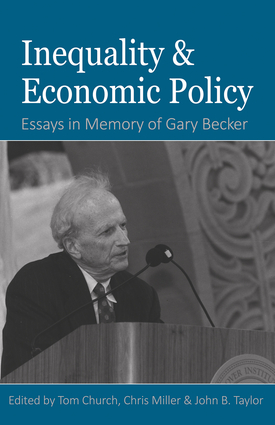
Inequality and Economic Policy Published

The Hoover Press put up for free the chapters of Inequality and Economic Policy: Essays In Memory of Gary Becker, edited by Tom Church, John Taylor, and Christopher Miller. You can of course still buy the book for a reasonable $14.95.

This includes the published version of my essay Why and How We Care about Inequality, also available on my webpage.  Bryan Caplan was kind enough to cover it positively last week, now you can read the original. I put a draft up on this blog last year, so I won't repeat it all today. As usual, the published version is better.

The rest of the contents:

Chapter 1: Background Facts By James Piereson

Chapter 2: The Broad-Based Rise in the Return to Top Talent By Joshua D. Rauh

Chapter 3: The Economic Determinants of Top Income Inequality By Charles I. Jones

Chapter 4: Intergenerational Mobility and Income Inequality By Jörg L. Spenkuch

Chapter 5: The Effects of Redistribution Policies on Growth and Employment By Casey B. Mulligan

Chapter 6: Income and Wealth in America By Kevin M. Murphy and Emmanuel Saez

Chapter 7: Conclusions and Solutions By John H. Cochrane, Lee E. Ohanian, and George P. Shultz

Chapter 8: Contents by Edward P. Lazear adn George P. Shultz

Wednesday, October 28, 2015

Davis on Regulation and More

Steve Davis has a thoughtful speech on regulation, policy uncertainty, and above all the need for simplicity.  (On the policy uncertainty website).  A few excerpts:
... the Code of Federal Regulations (CFR), which compiles all federal regulations in effect each year...grew nearly eight-fold over the past 55 years, reflecting tremendous growth in the scale and complexity of federal regulations. At 175,000 pages, the CFR contains as many words as 130 copies of the King James Bible.  While Ten Commandments sufficed for the Hebrew God of the Old Testament, the CFR contains about one million commandments in the form of “shall,” “must,” “may not,” “prohibited,” and “required.”...
The size and complexity of the U.S. tax code also grew dramatically in recent decades. As of 2011, it takes 70,000 pages of instructions to explain the federal tax code (McCaherty, 2014). The code has about four million words and 67,000 sections, subsections and cross-references. It’s all crystal clear if you read the instructions carefully. ...
And the best paragraph:
The good Catholic Sisters who saw to my moral instruction in primary school devoted many hours to the Ten Commandments. They wanted my classmates and me to avoid sins. Their success in that regard is in doubt. But at least the Sisters could be confident that we did not sin out of ignorance or uncertainty. How they would have instructed us on one million commandments, I do not know. The delinquents in my school found it hard to absorb a mere ten....

Monday, October 26, 2015

Economic Growth

An essay. It's an overview of what a growth-oriented policy program might look like. Regulation, finance, health, energy and environment, taxes, debt social security and medicare, social programs, labor law, immigration, education, and more. There is a more permanent version here and pdf version here. This version shows on blogger, but if your reader mangles it, the version on my blog or one of the above will work better.

I wrote it the Focusing the presidential debates initiative. The freedom of authors in that initiative to disagree is clear.

Economic Growth

Growth is central


Sclerotic growth is the overriding economic issue of our time. From 1950 to 2000 the US economy grew at an average rate of 3.5% per year. Since 2000, it has grown at half that rate, 1.7%. From the bottom of the great recession in 2009, usually a time of super-fast catch-up growth, it has only grown at two percent per year.2 Two percent, or less, is starting to look like the new normal.

Small percentages hide a large reality. The average American is more than three times better off than his or her counterpart in 1950. Real GDP per person has risen from $16,000 in 1952 to over $50,000 today, both measured in 2009 dollars. Many pundits seem to remember the 1950s fondly, but $16,000 per person is a lot less than $50,000!

If the US economy had grown at 2% rather than 3.5% since 1950, income per person by 2000 would have been $23,000 not $50,000. That’s a huge difference. Nowhere in economic policy are we even talking about events that will double, or halve, the average American’s living standards in the next generation.

Even these large numbers understate reality.

GDP per capita does not capture the increase in lifespan — nearly 10 years — in health, in environmental quality, security and quality of life that we have experienced. The average American today lives far better than a 1950s American would if he or she had three rather than one 1950s cars, TVs, telephones, encyclopedias (in place of internet), or three annual visits to a 1950s doctor.

But even these less quantified benefits flow from economic growth. Only wealthy countries can afford environmental protection and advanced health care. We can afford to worry about global warming. India worries about 600 people per toilet, emphysema from burning cow patties, and easily treatable parasitic infections. Our ability to defend freedom around the world — even if we are wise enough to do it sensibly — depends on robust economic growth. If GDP had grown at 2%, not 3.5%, we would only be able to afford half the military we have today. The immense improvements in the quality of goods and many services we have today are part of the engine of economic growth.

Looking forward, solving almost all our problems hinges on reestablishing robust economic growth. Tax revenue equals tax rate times income, and growth determines how much income there will be. The amount of tax revenue our government has available to pay off debt and to pay the ballooning social security and health care expenses depends almost entirely on economic growth. Larger tax rates can’t come close to raising that much money.

For example, the Congressional Budget Office, making its regular gloomy analysis of the US long-run budget outlook, assumes 2.2% growth from now until 2040.3 But if GDP grew by 3.5% instead, even with no structural reforms at all, GDP in 2040 would be 38% higher, tax revenues would be 38% higher, and a lot of the problem would go away on its own. A 38% increase in Federal Revenue by higher tax rates or a 38% cut in spending are unlikely. Conversely, if GDP only grows 1%, GDP and tax revenues will be 26% lower than the CBO forecasts, which will force a fiscal crisis.

38% more income — or 26% less income — drives just about any agenda one could wish for, from strong defense, to environmental protection, to the affordability of social programs, to the welfare of any segment of the population, to public investments, health, and fundamental research.

And 3.5% is only a return to the post-WWII norm. Pre-2000 economic policies were not ideal. If we achieve 4% or more growth, even greater benefits occur.

The source of growth


Over long periods of time, economic growth comes from one source: productivity, the value of goods and services each worker can produce in a unit of time.

In turn, productivity comes from new ways of doing things. New ideas, at heart; new inventions, new products, new processes, new technology; new ways of organizing companies; new and better skills among workers. Southwest Airlines figuring out how to turn a plane around in 20 minutes, and Walmart mastering supply logistics, are as much productivity growth as installing scanners or ATMs. Workers who know how to use computers rather than shovels produce a lot more per hour.

Higher productivity typically comes from new companies, which displace old companies — and displace the profits of their owners, and the healthy pay and settled lives of their managers and workers. Southwest enters and either displaces the legacy carriers — Pan Am and TWA — or forces wrenching changes for survivors such as American and United. A&P displaced mom and pop stores. Walmart displaced A&P. Amazon may displace Walmart. Nobody likes the process. Everyone needs the results.

Nothing other than productivity matters in the long run. A factor of three increase in income in 50 years, and the much larger rise in income and health since the dawn of the industrial age, dwarfs what unions bargaining for better wages, progressive taxes or redistribution, monetary, fiscal or other stimulus programs, minimum wage laws or other Federal regulation of labor markets, price caps and supports, subsidies, or much of anything else the government can do.

More people working, and working longer hours, can improve income a bit, but soon runs in to an upper limit. Our grandparents worked long hours, but were much worse off than we are.

Saving, investment and capital formation can improve income a bit, but its benefit is limited as well. A 1950 worker working with twice as many 1950 machines produces much less than a modern worker using current technology. Only new ideas, new products, new technologies, new organizations, and new skills produce such huge increases in prosperity.

In this context, the decline of US GDP growth coincides with more worrying changes. Productivity growth is declining. New business formation is sharply down. Mobility of people from job to job has declined.

Restoring growth: a general strategy


A debate rages among economists why America’s growth has slowed. Most commentators advocate one side of that debate, and advocate strong policies according to their favorite theory. Lots of new ideas and grand policy programs are being dreamed up. Someone putting together a policy program might feel they have to choose a side in that debate, or they might wish to let that debate settle, to identify the most important policies.

Either approach is, I think, a mistake, given the urgency and magnitude of the problem, and given the likelihood that such a highly politicized economic debate will come to useful resolution anytime soon.

Let us instead work on the simple, common-sense things that everyone knows are broken, everyone understands are retarding growth, and that when fixed can increase growth. As opposed to looking for big magic bullets, new and clever theories, and ignoring the simple problems staring us in the face.

Will this approach restore 3.5% growth? Will it bring us to 4% or more growth? Well, really, it doesn't matter. When we have a big problem, and we know simple steps will help that problem, we should take those steps. We should do so, especially, because most of these simple steps can be taken at no fundamental economic or other cost.

Our economy is like a garden, but the garden is choked with weeds. Rather than look for some great new fertilizer to throw on it, why don’t we get down on our knees and pull up the weeds? At least we know weeding works! For another metaphor, our economy has become like a hoarder’s house. For a while he could get through the passages and keep life going, but now the junk is closing in. Well, rather than read the architectural magazines about just what the perfect house will look like, let’s get to work cleaning up the mess.

Politics


Alas, such a common-sense, weed-the-garden program has little attraction to many ambitious politicians. Many politicians want a big new program, big new laws and initiatives — a New Deal, a Fair Deal, a Great Society. They don’t see cleaning up the mess left behind by their predecessors as the way to getting one’s face carved on Mt. Rushmore, let alone to win an election. Economists like big new ideas and programs too. Nobody got a Nobel prize for saying, let’s take Adam Smith’s 250 year old classics to heart.

But it is a big idea, a big program, and one that needs and will reward the courageous leadership of great politicians. Everybody has to give up their little deal, protection, tax break and subsidy; everyone has to allow their businesses or profession to be open to competition. Each person must understand that the small loss that he or she will experience directly will be more than made up by everyone else giving up theirs. Politically, rather than fall back on “I’ll support your little deal, you support mine,” everyone has to become part of the coalition that supports reform — “no, I’m not getting mine, so I’m not going to support you getting yours.”

Forming such a coalition and keeping it together is hard. It is the essence of what great politicians can achieve.

Cleaning out the weeds also needs a large effort of simple governance. The President has to revisit and rewrite the mass of executive orders and memos. The Congress has to get serious and pass laws that are actually laws, not thousand page instructions for agencies to figure things out. It has to get around to repealing laws everyone understands are bad — the Jones act restricting shipping, the ban on oil exports, and so on — and reforming laws that everyone understands need to be reformed. It needs to actually follow its own budget law. The heads of agencies will have to renew the staff and reorient them to growth-oriented policy, and undertake a sweeping house-cleaning of regulations and procedures. They will have to implement managerial techniques such as pervasive cost-benefit analysis, regular retrospective review, and sunsets.

All of this is hard too. But it is the basic work of competent, growth-oriented government.

It is tempting to cast the question before us as growth vs. redistribution, or growth vs. inequality, as the rhetoric of redistribution and inequality pervades the arguments from those who want to continue the policies that are strangling growth.

But giving in to that rhetoric is a mistake. The US, in fact, has one of the most progressive tax systems in the world. And the relatively minor costs of government assistance to truly poor, needy, mentally ill or disabled people are not major impediments to growth. The weeds choking the economy represent cronyist redistribution to wealthy people, well-connected industries, and other powerful groups such as public employee unions, and large transfers among middle income people (social security and medicare). They are not, by and large, the result of genuine and effective redistribution from rich to needy poor.

When the average person (voter) expresses concern over inequality, what they really mean is that they are concerned that average people are not getting ahead economically. If the average person were getting ahead, whether some big shot CEOs fly on private jets or not would make little difference. Conversely, the average voter, if not the average left-wing pundit, does not support equality of misery. If the average person continues to do poorly, it would bring them little solace for the government to tax away the lifestyles of the rich and famous.

Long-term robust economic growth is the only way to deliver sustained improvements in the lot of average Americans, and the less fortunate in particular. Redistributing Marie-Antoinette’s jewelry did little for the average French farmer.

The golden rule of economic policy is: Do not transfer incomes by distorting prices or slowing competition and innovation. The golden rule of political economics seems to be: Transfer incomes by distorting prices and regulating away competition. Doing so attracts a lot less attention than on-budget transfers or subsidies. It takes great political leadership to force the political process to obey the economic rule.

Regulation


The vast expansion in regulation is the most obvious change in public policy accompanying America’s growth slowdown. Most recently, under the Dodd-Frank act and the ACA or Obamacare, these two large segments of the economy have seen radical increases in regulatory intervention. But environmental, labor, product, and energy regulation have all increased dramatically as well.4

Sometimes, regulation slows growth in return for public benefits, such as environmental protection or transportation safety. One can argue whether it does so efficiently, but there is a purpose.

Most economic regulation, however, is specifically designed to slow growth. The purpose of most economic regulation is to transfer money to a specific group of people, companies, or industry. It does so by slowing down new entrants, impeding competition, mandating uneconomic actions or cross-subsidies, slowing innovation, turning off price signals, distorting incentives, and encouraging waste. These are the tools of economic regulation, and they all impede economic growth.

People often complain that there are too many rules and regulations, or that the cost of filling out forms is too high, that there is too much red tape, that there are too many lobbyists, or that the direct measurable costs on industry are too large. The economic impact of regulation goes far beyond these standard complaints. The overwhelming cost of regulation is the economic dislocation: companies not started, products not produced, innovations not innovated, people not hired, costs not slashed, prices too high. And growth too slow. Just because it’s harder to measure these costs does not mean that these are not the overwhelmingly more important costs, and the costs that we need to address.

Economic regulation has left behind the rule-of-law framework that many Americans suppose governs their affairs. In the popular imagination, regulation is about rules, and there are just too many of them. In many areas, however, the regulations are so vast, so complex, self-contradictory and so vague, that they basically give the regulators free rein to do what they want. In many cases, there is not a set of rules that you can read and comply with. You need to ask for preemptive permission from a regulator, who determines if your project can go ahead. Delay in getting needed approval is as good as denial in many cases. Projects that cost millions cannot bear years or often decades of delay in getting approvals.

In other cases, vague and expansive laws and regulations give regulators ammunition to pursue a few selected victims, to extort big settlements or send a few examples to jail. And by doing so to frighten the others into following the regulators’ commandments. In many areas just about everyone is in technical violation of some law or regulation.

We are used to the right to see evidence against us, challenge witness testimony, and appeal decisions to an independent and higher court. These rights often do not apply to regulations, where the agency is prosecutor, police, judge, jury, and executioner all wrapped in one. The methods for determining an “abusive” practice or “discriminatory” outcome are not revealed ahead of time so that people could structure their actions in accordance with the rules.

Much of this state of affairs is Congress’ fault, for writing long vague bills which devolve legal power to the agencies. But in an increasing trend, regulatory agencies are going far beyond even the clear limits of their statutory authority and writing rules or commanding outcomes clearly far beyond the plain language of the law. The EPAs expansion of carbon regulation and the definition of wetland are good cases in point.

The popular debate is about “more” vs. “less” regulation. Regulation is not more or less, regulation is effective or ineffective, smarter or dumber, full of unintended consequences or well-designed, captured by industry or effective, based on rules or based on regulator whim, accountable or arbitrary, evaluated by rigorous cost benefit standards or by political winds, distorting economic activity or supporting it, and so forth.

So “de-regulation” is also an inappropriate slogan. “Smart regulation,” or “growth-oriented regulation” are much better descriptors of what needs to be done.

Finance


Financial regulation, even more transparently than other regulation, is just about who gives money and who gets money.

Under the Dodd-Frank act, a highly regulated industry has become suffocatingly regulated. The Federal Reserve embeds hundreds of employees at each major bank, who pass judgment on every decision. The justice department and SEC routinely pursue banks and other financial institutions for multibillion dollar settlements, and now will pursue individuals with criminal charges. The fixed costs of running a compliance department are so high that it is nearly impossible to start a new financial company in the US. Just one new bank has been chartered since the passage of Dodd-Frank.

The parts of the financial system that failed and were bailed out in 2008 — Fannie and Freddie, commercial banks — were already among the most highly regulated businesses in America. Regulation did not fail for being absent. Regulation failed for being ineffective.

Alas, the basic structure of the Dodd-Frank act simply doubles down on the same basic design that has failed again and again: The government guarantees a wide swath of debt, by promise (deposit insurance) and by ex-post bailout. An army of regulators tries to keep banks and other financial institutions from exploiting the guarantee and taking too much risk, and clairvoyantly to forecast panics and take action to stop them. That’s like sending your brother in law to Las Vegas with your credit card, but asking his kids to keep an eye on him.

Like much else in America, our government works to cross purposes. It subsidizes debt with tax deductibility, deposit insurance, too big to fail guarantees, regulatory preference for holding short-term assets, liquidity rules, credit guarantees, Fannie and Freddie, the home mortgage interest deduction, community reinvestment act, student loan programs and so forth. And then it tries to regulate against using debt with bank asset regulation, stress tests, consumer financial protection, macro-prudential policy, and so on.

The alternative is clearly laid out in many sources: Risky investments must be largely financed by issuing equity, not by borrowing very short term money. When that happens, the mass of regulation is simply not needed in order to stop financial crises. Then we will “only” face the task of removing needless regulations whose main purpose is to create subsidies and protections for various clienteles.

Health


The ACA, thousands of pages of law, tens of thousands of pages of regulations, and even more decision-making power by newly empowered regulators, such as the thousands of waivers given to individual companies, represents an enormous increase in Federal intervention in the market for health care and health insurance. Like finance, health was already highly regulated. And like finance, most of the ACA simply doubled down on the same basic regulatory structure that had caused so many pathologies before.

The central problem of preexisting conditions was an artifact of regulation. In the ideal form of health insurance, you buy cheap catastrophic insurance when young, but the insurance policy can follow you as you age, change jobs, and move from state to state, and does not radically increase premiums if you get sick.

Why don’t we have that ideal insurance? Because previous rounds of regulation outlawed it. In the 1940s the US government allowed tax deductions for employer-provided group insurance, but not employer contributions to individual insurance or individuals’ contributions to such insurance. By laws, insurance is not portable across state lines. Thus, there is no reason for anyone who might get a job or move to buy long-term individual insurance that protects against the emergence of pre-existing conditions. In response to the preexisting conditions problem, the ACA forces community rating — everyone pays the same price—tries to mandate healthy people to buy insurance, and steps up pressure on employer provided group plans, which are the source of the problem.

Similarly, once insurance was tax deductible, there was an incentive to salt it up. You would not buy car insurance that “paid for” oil changes — especially if you had to deal with insurance paperwork each time. But with a tax deduction it’s worth buying health insurance that “pays for” routine small expenses. Then the government (state and local too) instituted mandates that insurance must “pay for” — and, of course, charge premiums to cover — all sorts of additional procedures, which makes insurance too expensive.

We need to allow simple, portable, largely catastrophic, lifelong, guaranteed-renewable health insurance to emerge. Right now it’s illegal. To the extent that the government wishes to subsidize health insurance — and it should — then it should give straightforward vouchers, which people can use to buy insurance, or to fund health savings accounts. Such vouchers should take the place of Obamacare, Medicaid, and Medicare.

Health care and insurance is not just distorted from the demand side — too many people paying with someone else’s money. The supply side is ossifyingly restricted as well. New hospitals, new clinics that specialize in cheaply providing one service well, new doctors, new nurses, new insurance companies, all find a wall of laws, regulations, and officials blocking their path. For a reason: To maintain the profits of and cross-subsidies provided by the existing incumbents. Non-profit status itself blocks efficiency: you can’t take over an inefficient non-profit, and non-profits can’t issue equity to make important investments. In reducing the cost and improving the quality of health care, efficiency is far more important than trying to avoid a competitive rate of return to owners.

Energy and Environment


There are few places in the American government where one can witness inefficiency and growth-sapping regulatory bungling on the scale seen in our energy and much (not all) environmental regulation.

Like much else in America, our government pursues conflicting aims. It tries to subsidize and drive down the price of energy. And then it tries simultaneously to regulate against our using energy in a hundred different ham-handed ways, from mileage standards for cars, energy efficiency standards for windows and appliances, special parking places for electric vehicles,

$7,500 tax credits to subsidize $100,000 Tesla cars bought by silicon valley zillionaires, hundreds of annually extended tax credits for various energy boondoggles, and so forth.

The poster child for inefficiency may well be the mandate for gasoline producers to use ethanol. Corn ethanol, it turns out, does nothing to help the environment: It takes nearly as much petroleum energy to produce it as it contains, in the form of fertilizer, transport fuel and so on; it uses up valuable land, which directly emits greenhouse gases, and contributes to erosion and runoff; it drives up the price of food. The only thing sillier was the mandate to include cellulosic ethanol, because the government mandated a technology that simply did not work.

If you were wondering why we do this, it should come as no surprise that corn is produced by big companies in Iowa. If you need more evidence, note that the US also has heavy restrictions on the importation of sugar cane ethanol — as we restrict all sugar cane imports — which actually might be of some environmental benefit. The planet, of course, does not care whether corn is grown in Iowa or sugar cane in Brazil. Corn growers and sugar producers do care.

A litmus test for a presidential candidate ought to be the willingness to stand up in Iowa and say, “Ladies and Gentlemen, a huge government subsidy for corn ethanol is a rotten idea.”

Similarly, if you thought that subsidized production of photovoltaics and the various subsidies to putting solar cells on your roof, including the requirement that your fellow citizens buy electricity back from you at retail prices, are about the environment, you will be puzzled by our government’s heavy import restrictions on cheap Chinese made solar cells. Obviously, mother nature cares not where the cells are produced. Mother politics does.

Energy and transportation policy seem to indulge flights of magical thinking. California, facing a drought, and not having built water projects in decades, is going to spend well over $60 billion dollars on a high-speed rail line. This is advanced in the cause of carbon emission reduction. And quite literally, the case has been made that by building the rail line, we will lower global temperatures, and increase rainfall. If on a dollars per ton of carbon saved the rail line fails elementary cost-benefit analysis, on dollars per drop of water created, it fails the magic vs. reality test.

As this example makes clear, the Federal government is not alone. State and even local regulation is partly to blame as well.

Strong zoning laws forbid people from building houses near where they work, and forbid them from building workplaces near where people live, and from building shops near either. An electric car driving 60 miles is much less energy efficient than living in a high-rise apartment, in a mixed residential/commercial neighborhood, and walking!

A growth-oriented, and anti-cronyist energy policy is pretty simple. To the extent that the government wishes to reduce carbon emissions, impose a simple and straightforward carbon tax. In return, eliminate all the detailed mandates, subsidies, quantity regulations, and boondoggle unprofitable projects. If energy costs more, people will quickly figure out on their own what makes sense.

Energy is an economic paradox, as it is so highly regulated, with so much government picking of technologies, but simultaneously has such a flat long-run supply curve and there are so many technological alternatives. A large price of polluting energy is the most efficient way to induce clean energy innovation; far more efficient than massive amounts of federally subsidized research and development to financially unprofitable businesses and bureaucrats picking technologies. And price-induced behavior changes can reduce usage much more easily than mandating fancier technologies. Paying some attention to turning off the lights when you leave the room is more efficient than mandating LED bulbs and leaving the lights on.

If you are serious about carbon, let the words “nuclear power” pass your lips. We have sitting before us a technology that can easily supply our electricity and many transport needs, with zero carbon or methane emissions. New designs, if only they could pass the immense regulatory hurdle, would be much safer than the 1950s Soviet technology that failed at Chernobyl or the 1960s technology that failed at Fukushima. We are now operating antiques. And even with this rate of accident, nuclear power has caused orders of magnitude less human or environmental suffering than any other fuel.

Similarly, the most environmentally friendly way for people to live is in tightly packed cities, fed by genetically modified foods which yield more per acre of farmland and require fewer fertilizers and pesticides, from laser-leveled fields run efficiently by large corporations in the highest productivity locations. Federal policies to the contrary are not just anti-growth, they’re anti-environment too. When Federal policy can say these things in public, it will have a bit more standing to invoke the name of “science.”

Environmental policy at a minimum needs a far more frequent application of cost-benefit analysis!

As important as carbon may be, our environmental policy has become obsessed with this one danger. But slow warming and sea level rise in 100 years are not the only, or possibly the main, environmental danger we face.

Most of the large species going extinct — elephants, rhinos, lions, and so forth, to say nothing of the more numerous and less photogenic — will go extinct from human predation, poaching, and loss of habitat long before climate has any effect on them. Most of the world faces environmental problems far more pressing than climate. And by focusing on climate, our government is spending far too little time, research and money on small but catastrophic dangers such as global pandemics, crop failures, animal diseases, and so on. As in finance, the unexpected and swift dangers are more likely to cause a crisis than the slow moving widely anticipated ones.

Taxes


Perhaps one economic issue just about every corner of the political spectrum can agree on is that our tax code is a massively complex and broken mess, needing reform.

Practically everyone agrees on the basic structure of a growth-oriented tax reform: Lower marginal rates — the extra amount of taxes you pay on an extra dollar of income determines the disincentive to earning that income. To raise revenue at lower marginal rates, broaden the base, i.e. remove exemptions and loopholes. And massively simplify the code.

Admittedly, not everyone agrees that tax reform should be oriented to growth. The voices for higher taxes argue for redistribution or decapitation — removal of high incomes, even without benefit to lower-income people — freely admitting the growth consequences of high taxes are at least not positive. They just view distributional goals as more important than growth.

Often, however, tax reform proposals sacrifice too quickly the principles of what a good tax system should be with perceived political accommodations to powerful interest groups. Economists should not play politician. We should always start with “in a perfect world, here is what the tax code should look like,” and accommodate political constraints only when asked to. Political constraints change quickly. Economic fundamentals do not.

Herewith, then, a brief reminder of basic principles:

The right corporate tax rate is zero. Corporations never pay taxes. Every dollar of taxes that a corporation pays comes from higher prices of their products, lower wages to their workers, or lower returns to their owners.

Which one, depends on who can get out of the way. While it is politically tempting to suppose that wealthy stockholders bear the burden of corporate taxation, they are in fact the most likely to be able to avoid taxation. While imposing a corporate tax may hurts existing stockholders, by lowering the value of the stock, there is no reason new investors will give the corporation money unless they can get the same after-tax return they can get elsewhere, and in particular abroad. Thus, new investment dries up until the company can pay the same after-tax return to its investors — by raising prices, lowering wages, or reducing scale to generate greater before-tax profits. In addition, these days the owners and investors of corporations are as much your and my pension fund as they are rich individuals.

For all these reasons, eliminating the corporate tax is as likely to be more rather than less progressive. The higher prices a corporation charges hurt everyone. The lower wages corporations pay hurt workers. The income it passes along to its owners is subject to our highly progressive tax system.

A growth-oriented tax system taxes consumption, not income. When we tax income that is saved, or the investment income that results from past saving, we reduce the incentive to save, invest, start companies and build them, vs. enjoy consumption immediately. One of the first theorems you learn in an economics class on taxation is that the right tax on rates of return is zero.

A person-based consumption tax can be progressive. It is useful to collect the basic tax as a VAT. Then people in higher brackets can declare income and receive credit for investments.

The estate tax is a particularly distorting tax on saving and investment. One may sympathize with the the moral judgment that rich kids don’t “deserve” inherited wealth. But the point is on the incentives of the giver. The tax code should not give strong incentives to middle-age people to stop building their businesses, investing their money, spend their money on round the world cruises and their time with tax lawyers. Nor should it force the breakup of privately held businesses to pay taxes. Maybe the kids don’t deserve it, but if people cannot provide better lives for their children, we remove one of the strongest and oldest human incentives for economic activity.

Taxing corporations rather than people and taxing income rather than consumption is behind many complexities of the tax code. For example, right now the corporate and individual tax rates must be at roughly the same level. If we tax corporate income less, then people rush to incorporate themselves. If we tax personal income less, the opposite. But if we tax consumption and not income, then there is no tax benefit to incorporating yourself. As another example, we only need special health savings accounts and college savings accounts because we tax income. If we taxed consumption we would just save for health, college, and retirement as we do everything else.

In partial recognition of the distortions caused by taxing rates of return, our tax code includes an absurdly complex web of ways of getting around capital income taxes, from IRAs, Roth IRAs, 527(b), 401(k), special tax treatment of pension funds and life insurance, lower rates for long-term capital gains, and the various trust shenanigans of the estate tax. Removing the attempt to tax investment income would make all of these complex structures irrelevant. Then they can be removed, greatly simplifying the code.

The economic distortions of the tax system result from the overall marginal tax rate, not each tax alone. The economic distortion due to taxation does not care that there are separate federal, state and local taxes. The economic distortion is the sum of all these. Start by producing one dollar more of value for your employer. Now subtract the corporate income tax, the payroll tax (social security, medicare, etc.), your federal, state, and local income taxes; the investment taxes, capital gains taxes or estate taxes paid between earning and consuming, and the sales taxes, excise taxes, property taxes, gas taxes and so forth that you pay when you buy something, to see how much of value you actually get in return for the dollar of value you provided to your employer. That’s the overall marginal tax rate.

Far too much tax discussion considers federal income taxes alone as if the others did not exist. They do exist. I only half-jokingly suggested an alternative maximum tax.5 Add up all the taxes you pay, including all the taxes companies whose stock you own pay, to any level of government. If it’s above some high number — say, 70% — you’re done and have to pay no more.

When we say broaden the base by removing deductions and credits, we should be serious about that. Thus, even the holy trinity of mortgage interest deduction, charitable donation deduction, and employer provided health insurance deduction should be scrapped. The extra revenue could finance a large reduction in marginal rates.

Why? Consider the mortgage interest deduction. Imagine that in the absence of the deduction, Congress proposes to send a check to each homeowner, in proportion to the interest he or she pays on money borrowed against the value of the house. Furthermore, rich people, people who buy more expensive houses, people who borrow lots of money, and people who refinance often to take cash out get bigger checks than poor people, people who buy smaller houses, people who save up and pay cash, or people who pay down their mortgages. A rich person buying a huge house in Palo Alto, who pays 40% marginal income tax rate, gets a check for 40% of his huge mortgage. A poor person buying a small house in Fresno, who pays a 10% income tax, gets a check for 10% of his much smaller mortgage. There would be riots in the streets before this bill would pass. Yet this is exactly what the mortgage interest deduction accomplishes.

Charitable donations follow the same logic. Suppose Congress proposed to match private charitable donations with federal dollars. Rich people get 40% match, but poor people only get 10%. Not only would that cause riots, but then there would be a much closer eye on just what “charities” mean in today’s America if they received direct checks from the Treasury. We may moan at the complexities of federal expenditures, but there is at least some oversight. Charities spend tax money largely in the dark. The shenanigans of the Clinton foundation are only the most recent visible example of how “nonprofits” are often the latest scam in the American legal system. Notice how every sports star or celebrity has a charitable foundation? They are great ways to escape estate taxes and investment taxes as well as campaign finance laws. Your kids can serve as the executives of the foundation.

Yes, universities (such as my employer) may suffer. Well, I started this essay with the idea that everyone must give up their little subsidy so that the rest will give up theirs. So too must academics.

Americans remain generous. Even without a tax incentive, Americans will give to worthy causes, as they give now to political campaigns. Worthy charities, such as my employer, may even gain by substitution away from tax and political scams.

In sum, the ideal tax system taxes people, it taxes consumption not investment income, and it taxes at a very low rate with a very large base.

The political debate on taxes


Why is this so hard? Because our political debate mixes different goals.

The central goal of a growth-oriented tax system is to raise the revenue needed to fund necessary government spending at minimal distortion to the economy, and in particular minimizing the sorts of distortions that impede the growth process.

A first objection comes from those who want to pair reform of the code with substantial rises in overall revenue. This has been the main stumbling block to tax reform under the Obama Administration.

Second, our tax code mixes raising revenue with a host of special provisions designed to encourage specific activities and transfer income to specific groups or businesses. Objections come from those who what to preserve one or another subsidy, deduction, or exemption.

Third, our tax code mixes raising revenue with efforts to redistribute resources across income and various demographic classes.

The result is paralysis. The answer lies in separating the arguments. One could go so far as to separate the actual legislation.

First, we should discuss the structure of the tax code separately from the proper level of revenues. Let us agree that we will eliminate deductions and exemptions and have three brackets. Start with a revenue-neutral code. But agree that we can separately and much more frequently adjust the rates, which adjust the overall level of revenues.

Second, we should separate the tax code from the subsidy and redistribution code. Let us agree, the tax code serves to raise revenue at minimal distortion. All other economic policy goes into the subsidy code. And subsidies should be on-budget and explicit. So, you want a subsidy for home mortgage interest payments? Sure, let’s talk about it. But it will be an on-budget expense — we will send checks to home buyers if we do it. You want to give $7,500 to each purchaser of electric cars? Sure, let’s talk about it. But it will be an on-budget expense. We will send $7,500 checks electric car purchasers if we do it.

Yes, advocates will object. Congress is not at all likely to appropriate money in this way! Tax credits and deductions are very useful for hiding things like this. But again, honest political leadership should say, if we have to hide what we’re doing from the American people, then we shouldn’t be doing it. Or, we should structure it in a way that is acceptable.

This discussion reflects another reality: The size of the US government is vastly greater than we think. It looks like Federal spending is only about 20% of GDP. But each deduction and mandate is the same thing as a tax and a subsidy. By bringing each deduction and tax credit on budget, we can correctly see exactly the size of our government, and more wisely vote on that size.

Even if my dream of putting all subsidies on budget fails, they should at least be conceptually separate parts of the tax code, and debated separately. The key is to keep the basic tax code focused on raising revenue at smallest possible economic distortion, and to argue separately about subsidies.

The art of politics is, of course, bundling things in a way to get deals done. But it is clear that the current bundling is producing paralysis. Those on the left that wish to raise revenue suspect that those who wish to reform the tax code will not later allow a discussion on revenue, so they must hold reform hostage. Likewise with those who want subsidies. Rather than produce another bundled mess, a great politician should be able to promise an honest hearing on revenue and unpalatable subsidies to get a clean growth-oriented reform.

Redistribution by our federal government fails because of its similarly chaotic approach. Discussions of progressivity consider redistribution through the federal income tax code forgetting about the smorgasbord of social programs and other taxes. Social security, medicaid, food stamps, unemployment insurance, and so on and so on all overlap to an incoherent mess. These should be condensed into one coherent approach to helping lower-income Americans. You can redistribute, if desired, by checks as well as by differing tax rates.

The central problem is again the tension between economics and politics. When a growth-oriented economist writes about taxes, the most important question is the distortion. What economic decision is distorted by taxes? If you produce $2 for your employer but only receive $1 in value, does that distort your decision to work, to take a job, or to invest in the skills needed for the job? Who gets how much money is really not that important to growth.

When the political system discusses taxes, the only question is who gets how much money, subdivided into minute income, geographic, racial and industry categories. Nobody pays attention to the distortions. But the distortions lower growth, and it is the job of wise political leadership to move the public discussion in that direction.

The current tax discussion understates, I think, the importance of simplicity in the tax code. A simple code makes its incentives transparent. A simple code vastly reduces compliance costs. And most of all, a simple code is much more clearly fair. Americans now look at the tax code and suspect — often rightly — that rich smart people with clever lawyers are getting away with things. Our voluntary tax code depends vitally on removing this suspicion. The Greek equilibrium in which each person cheats because he knows everyone else is cheating, corrosive far beyond its effect on revenue, can break out here too.

Tax lawyers and economists often come up with complex schemes to achieve parts of the principles I advocate, without doing much violence to the current code. I think this is a mistake. People who look forward to late March and early April each year as a time to show their hard-won expertise should remember how much the rest of the country hates the experience.

For example, rather than eliminate the corporate tax, some economists advocate having corporations notify each stockholder how much tax is paid on his or her behalf, and then the stockholder can deduct the corporate tax payments from his or her individual taxes. That achieves the same economic result, if the costs of filling out forms are zero.

But that setup is disastrous for commitment and simplicity. The corporate tax remains, and arguments about just what corporations can and can’t deduct, which income where they pay taxes on remain firmly in place. With the corporate tax system still in place, we are a sneeze away from limiting or removing the pass-through. And one cannot ask for a way that smacks more of a handout to “the rich,” hiding its effect of lowering product prices or raising wages. The code is only simplified if the corporate tax is eliminated. (And, if the government wants to subsidize R&D, energy investments, or other activities, do so with on-budget subsidies, just like for people.)

As another example, it seems politically easier to leave in place cherished deductions like health insurance, home mortgage interest, and charity, but limit the total amount of deductions any one person can take. That achieves the economic purpose.

But this setup leaves intact a perpetual argument. Next year, let’s renegotiate a higher limit. Or let’s exempt my favorite deduction from the limit. As long as each deduction remains in place, so does the constituency in its favor, and so do all the thousands of pages of tax code each entails.

Zero is zero. If you don’t kill a tax completely, it keeps coming back like zombies in a science fiction movie. If you don’t kill a tax completely, you do nothing to simplification of the tax code.

Eliminating whole sections of the tax code, rather than nullifying them with clever schemes, has another important advantage. A growth-oriented tax code operates by incentives, but people have to understand the incentives. Tax economists tend to be ultra-rational, and figure that people will react to the actual financial incentive even if it is quite hidden. Of course, the point of hiding it — of offering corporate tax rebates, say, rather than eliminating the corporate tax, or sharply limiting deductions rather than eliminating them — is precisely to fool people politically into thinking the provisions are still there. Well, people so fooled may not see the economic incentive either. Behavioral economists who argue that only very clear, simple, provisions have the appropriate incentives have a point. And their point argues for a simple code full of zeros rather than a complex code that has the same set of economic incentives once an expert combs through it.

Debt and deficits; social security and medicare


Debt and deficits are a looming threat to growth. Read any one of the nonpartisan Congressional Budget Offices’ long-term budget outlooks.

Our central problem is straightforward: promises to pay social security benefits, medicare and other health care will soon overwhelm the US budget. Hidden mountains of unfunded pension liabilities, state debts, student loan debts, and debts the US will incur if another financial crisis, recession, or war face us, add to the risks.

Growth-oriented policy will do a lot to solve the debt and budget problem. Economic growth raises tax revenues without raising tax rates. Stagnant growth will make all these problems much worse.

Conversely, a looming debt crisis or the extreme taxes that would be needed to pay for an unreformed system will be strong drags on economic growth. So, setting long-run spending in order now is both necessary, and much easier than doing it later.

Indexing social security to price inflation rather than wage inflation takes care of much of the social security problem. Indexing it to the prices of things that old people actually buy helps even more. Changing the nature of health care support to vouchers, and enacting the other health care reforms mentioned above will give both better help to people in need and solve that budget problem. Both of these steps are much easier the sooner they are taken, so that nobody has to receive an actual cut in benefits.

An economist should emphasize the distortions to economic decisions embodied by these programs, not the cost per se. Programs are bad when they require taxes so large that the taxes kill growth, or when the incentives of the programs sap people’s incentive to work, save, and invest. Social security should be converted to private accounts, not so much to save the government money as to ensure that each person knows that an extra hour of work, or extra effort made to learn a new skill or start a company, results eventually in greater resources for him or her, not just greater taxes.

Social programs


From a growth perspective, the most important characteristic of social programs is also not so much their cost, as it is their disincentives and their ineffectiveness.

Most of our social programs phase out as income rises, often with hard steps at which if you earn one extra dollar you lose a large benefit. If you earn an extra dollar, you can lose health care subsidies, food stamps, social security, medicare, disability payments, and a host of smaller subsidies from home heating oil subsidies, child care subsidies, transportation subsidies and even (in my home town) parking permit subsidies.

As usual in our weed-pulling exercise, there are so many programs and they interact in so many ways, that adding them all up is hard. The broad picture though is that for many Americans there is close to a one for one tax rate from zero up to $60,000 per year in the form of reduced benefits.

The answer is not necessarily to be stingier. The answer, as elsewhere, is to design programs with more attention paid to marginal disincentives, and to design programs that fit together rather than assume each one acts in isolation.

One good way to eliminate marginal disincentives is more frequently to condition support on time rather than income. Unemployment benefits work to some extent this way. Yes, you lose unemployment benefits if you get a job, which provides a disincentive. But you can only earn unemployment benefits for a certain period of time.

It is surprising, in fact, that a society as fluid as ours conditions so much of its government activity on income, as if income were a permanent and innate characteristic. Income changes rapidly through time and over the life cycle.

Social programs are so expensive because most of them are middle class subsidies, not help for the truly poor and desperate. We need to spend more is on the truly unfortunate. Schizophrenics in the streets are unbecoming of a great nation, and helping them costs relatively little. They don’t vote.

Labor law and regulation


Our government and politicians keep repeating how much they want to “create jobs” and help Americans to work.

A martian, parachuting down and studying our economy would come to the opposite conclusion. There are few economic activities in which the government throws more obstacles than that of hiring someone.

Start, of course, with taxes: income taxes and payroll taxes are primarily taxes on employment. But the regulatory burdens of employment are larger still, as anyone who has tried to get a nanny legal will attest.

Minimum wages, occupational licensing, anti-discrimination laws, laws regulating hours people can work, benefits they must receive, leave they must be given, fear of lawsuits if you fire someone, and so forth all impede the labor market.

We are swiftly becoming a nation divided, as Europe is, between “haves” with expensive, highly regulated, full time jobs — that are inflexible for people who wish part time work — and often illegal, under the table, part time “gig” work.

Companies have innovated around many of these distortions with contract workers, but the current fight whether contract workers, independent contractors (Uber drivers) and franchisees must be considered employees of the parent company threatens to undo all of that, placing another huge wedge in the labor market and segregation between well paid, hard to get, full time jobs and a larger pool of unemployed.

America needs a vast deregulation of its labor market. I want to work for you, you want to pay me? Good enough.

The usual argument is that workers need protection of all these laws. Well, the supposed protections do cost economic growth, and they do reduce employment. How much do they actually protect workers? The strongest force for worker protection is a vibrant labor market — if you don’t like this job, go take another. The tightly regulated labor market makes it much harder to get a new job, and thus, paradoxically, lowers your bargaining power in the old one. At a minimum let’s revisit just how much protection is actually being given, and just what the cost in growth is, and whether it’s worth it.

Immigration


“Give me your tired, your poor, Your huddled masses yearning to breathe free, ..”
- Emma Lazarus.
“He has endeavoured to prevent the population of these States; for that purpose obstructing the Laws for Naturalization of Foreigners; refusing to pass others to encourage their migrations hither,..”
- Declaration of Independence.
Not any more.

We can end illegal immigration overnight: Make it legal. The question is, on what terms should we allow legal immigration.

The immigration debate has nothing to do with who is allowed to come to this country. That’s the tourist visa debate. The immigration debate is about who is allowed to work in this country, and, later, who is allowed to become a citizen. Our Federal government has a massive program in place to stop people from working. That is immigration law.

Immigrants contribute to economic growth. Even if income per capita is unchanged, imagine how much better off our social security system, our medicare system, our unfunded pension promises, and our looming deficits and debt would be, if America could attract a steady flow of young, hard-working people who want to come and pay taxes. Aha, we can attract them! They’re beating the doors down to come. But then we keep them out.

Allowing free migration is, by many estimates the single policy change that would raise world GDP the most. If you believe in free trade in goods, and free investment, then you have to believe that free movement of people has the same benefits.

The most common objection is that immigrants steal American jobs. No, they create American jobs, just as a higher birthrate of Americans would do. Every immigrant is as much a consumer of things we produce, a buyer of houses and cars, a starter of new businesses, as he or she is a worker. Immigrants come to do jobs that are available, not jobs that Americans don’t have. They do work that complements those of Americans, and thus make Americans more productive and better off.

There is very little economic argument for keeping immigrants out of California from old Mexico that would not also apply to keeping immigrants to California out of new Mexico. (Or, as Oregonians, Coloradans, and Texans might wish, keeping Californians out of their states!)

We worry about immigrants using social programs. Fine, but why then is immigration skewed to family members, likely to use social programs, and excludes workers, least likely to use them? If the worry is that they’ll go on welfare, why on earth do we forbid them from earning a living? If social program overuse is a worry, charge a $5,000 bond at the border, require proof of $10,000 of assets and health insurance, and anyone who is convicted of a felony goes home. This fear does not excuse our immigration system.

The status of the 11 million already here is a national embarrassment. 11 million people live in this country, work, pay taxes, buy food and cars and houses, and yet are deprived of legal protection, easily exploited by employers, afraid to even take airplanes, let alone not allowed to vote. If this were a racial minority, we would be scandalized.

But immigration law is so dysfunctional that we need not discuss radical programs. Let’s fix the basic growth-killing pathologies that we all recognize need to be fixed.

Start by letting in people who obviously contribute to the American economy and society. Ambitious young people come to the US to get degrees in medicine, engineering, and business.They want to stay, work, buy things from our businesses and pay taxes. They want to start businesses and hire people. We kick them out. The H1B visa lottery should simply be abandoned. Any high-skill immigrant should be able to stay. Any high-wealth immigrant should be able to stay. Immigrants often start small businesses that serve poor areas. Anyone who starts a business should be able to stay. People who came at a young age, have been through American schools, served in the US military, and know no other country should be able to stay.

The immigration discussion is full of more nonsense than any other policy question facing the country. No, immigrants are in fact much less likely to commit crimes than Americans. No, terrorists come on tourist visas. They do not swim the Rio Grande and stop to pick vegetables for a few years before blowing things up. And we already spend more than twice — $13 billion dollars — on the border patrol than we do — $ 6 billion — on the entire FBI. They are “illegal” some say. Well, that’s easy to fix. Change the law, and they will no longer be illegal! Constructing a great Ice Wall on the border with Mexico is a canard. Immigrants come on airplanes and overstay tourist visas.

As with taxation, the immigration debate needs to separate completely separate questions: Who is allowed to enter the country? Who is allowed to work here? These are completely separate issues. Restrictions on work do nothing to address security.

Immigration and growth feed each other. Immigrants help economic growth. But conversely, the lack of economic growth is feeding a misguided but understandable resentment towards immigrants.

Education


How often must commenters on all sides of the political spectrum complain that America’s public schools are awful?

They are particularly awful for people of lower income, minorities and new immigrants. The problem is not money. Study after study shows that America spends as much or more money on eduction than other countries, and experiment after experiment has shown almost no effect of showering money on bad schools.

The culprit is easy to find: awful public schools run by and for the benefit of politically powerful teachers’ and administrators’ unions. (Don’t forget the latter! Teachers account for only half of typical public school expenses.) Education poses a particularly large tradeoff between profits to incumbents and economic growth, since education lies at the foundation of higher productivity. In addition, the costs of awful schools fall primarily on lower-income people who cannot afford to get out of the system. It is one of the major contributors to inequality.

The solution is simple as well: widespread financing by vouchers and charter schools. As with health care, a vibrant market demands that people control their spending, and can move it to where they get better results. As with health care, the government does not have to directly provide a service in order to help people to pay for that service. But as with health care, a healthy market also demands supply competition, that new schools be allowed to start and compete for students.

Higher education has been relatively healthy in the US, but Federal policy is busy making a mess of it. The correlation between more and more subsidy to higher education, the astronomical rise in tuition, and the leftward drift of campus politics towards support of a larger government is hard to miss. The Federal government took over the student loan market, and is busy creating a new debt bomb that will likely end in another mass bailout. Immigration restrictions are making it harder for students to access this, one of our great export successes.

There is a strong correlation between college education and later income. That does not mean that more college education will automatically generate more individual income or more economic growth. To some extent, smart people who will earn more money anyway go to college, and smart people who know they will benefit from a college education go to college. To a greater extent, people who choose science, engineering, math, computer, or business majors go on to earn greater incomes. Those who study other subjects may profit personally from the experience, but generally do not go on to contribute as much to economic growth.

Loans that are forgiven if one does not earn a higher income, or forgiven for students who go in to non-profit, social work, government or other low-paying work, or who do not work at all, are particularly troublesome from a growth perspective.

Sweat the little stuff


Our growth needs to be revived by pulling a thousand little weeds. A selected few reminders and examples follow.

We still have agricultural price supports, tariffs and quotas such as sugar and oranges.

Trade is relatively free, but could be freer. And keeping trade open requires endless effort against the forces of protection.

The opponents of free trade, and immigration, adduce long-standing fallacies, that one must constantly fight. When, say, China, sends us cheap manufactured goods, they take dollars in return. Every one of those dollars ends up buying an American export, or invested in America. Trade is not a “competition,” and our trading partners are not “competitors.” We win in trade when American consumers get to buy things more cheaply. The point of trade is not to increase exports. When Germany sent Greece Porsches in return for worthless pieces of paper, it was Greece that came out ahead in the deal, not Germany.

That much of the nation’s infrastructure is crumbling is a common observation. And infrastructure supports growth. Low interest rates are a particularly propitious time to build infrastructure.

So why is there less consensus for a large program to repair and build public infrastructure, including roads and bridges, but also bicycle paths, parks, airports, ports, and so forth? In large, part, I think, our government has squandered its people’s trust in its ability to carry out infrastructure projects in a cost-effective, well-planned, and timely fashion. Instead, voters are used to reading about bridges to nowhere, high speed trains from nowhere to nowhere, billion dollar cost over runs, decade plus waits for permits, massive consulting fees, and other pathology.

The process of infrastructure investment needs a complete overhaul. To mention just a few, it is no surprise that costs spiral when projects must pay “prevailing wages” and obey set-asides for specific contractors, or when environmental review takes years. It is no surprise that projects are not repaired when federal funds pay for new construction but not repair. Federal funding diverts resources to rail, a charming but very inefficient mode of transport, over freeways, airports, buses, bus lanes or bus rapid transit, or other needed modes. Real time tolling, private toll roads, and congestion pricing are easy ideas, used successfully in other countries, but almost never here.

So, yes, we need a growth-supporting infrastructure program. But our political leadership needs to show us it can construct infrastructure in a more competent, less politicized, way, focused on delivering the needed infrastructure at least cost to the taxpayer.

There is good spending


I close this essay with two areas in which I think our Government could spend some more money, in ways that would enhance economic growth.

Our legal and criminal justice system is clearly becoming dysfunctional. This system is trapping many people already struggling with poor schools and job prospects. That we spend tens of thousands of dollars to house prisoners and next to nothing to train them to succeed when they exit guarantees their return. Even doubling resources, so that crimes in poor neighborhoods are routinely solved, so that people accused of crimes have speedy trials and reasonable representation, not life-destroying years waiting for cases to be heard, so that people who are imprisoned receive some basic help in dealing with the outside world, would cost little compared to the trillions we spend on middle-class social programs.

The war on drugs is a massive failure. Not only is it leading to mayhem in poorer areas of the US, it is causing narco-states, corruption, violence, and poverty in our neighbors, and driving much immigration pressure. Al-Quaeda, the Taliban, and ISIS earn lots of money from drug trafficking. Legalization would drive them out of business far more effectively than war.

The federal government has a role in financing basic research. Yes, 95% of funded research is silly. Yes, the government allocates money inefficiently. Yes, research should also attract private donations. But the 5% that is not silly is often vital, and can produce big breakthroughs. Like the military, there are a few things the federal government must do. We are falling behind on basic research investments.

More


And FDA approvals take forever. And patent law is a mess leading companies to spend too much time on lawsuits. And anti-trust law is completely outdated, just throwing sand in the gears. And the NLRB and EEOC are making a mess of labor markets. And the FCC is going to turn the internet into the 1965 French telephone company. And... well, this could go on pretty much forever.

There are a lot of weeds. Just turn to the Hoover research website, especially Economic Policy, Education, Energy Science & Technology and Health care tabs. Turn to Cato’s website and browse down the “Research Areas” tabs, especially the Education, Energy and Environment, Finance, Health Care, Regulatory studies, Tax and budget, and Trade and Immigration tabs. I have kept this essay deliberately free of a forest of numbers and citations for easy reading, but the numbers and citations are easy to find.

This essay summarizes some of my own earlier writings on many of these issues, all available on my webpage. For more on regulation, see “The Rule of Law in the Regulatory State.” For more on health care and insurance see “After the ACA: Freeing the Market for Health Care” and “Health Status Insurance.” On financial reform (alternatives to Dodd-Frank) see “Towards a Run-Free Financial System.”


1 John H. Cochrane is a Senior Fellow of the Hoover Institution, Stanford University. This essay is copyright © John H. Cochrane.

This essay was prepared as a contribution to “Focusing the Presidential Debates.” Other essays and information can be found at  FocusingThePresidentialDebates.com

This essay may evolve over time, so please post or pass on links to the original pdf file or this webpage rather than pass on copies of the file.

2The numbers are based on real gross domestic product, series GDPCA, and total population, series POP, from the St. Louis Fed FRED database. Growth rates are continuously compounded, i.e. log.

3 Congressional Budget Office, June 2015 Long-Run Budget Outlook, Table A-1 p. 112

4Technically, “regulation” means rules written by independent administrative agencies, such as the Environmental Protection Agency, the Federal Aviation Administration or the Federal Reserve. Congress delegates authority to these agencies to write the actual rules. These rules have the force of law, and can carry criminal penalties including jail time, even when no intent to violate rules is alleged. Most economic regulation takes this legal form, but a great deal remains actual laws. I will use “regulation” a bit loosely to refer to both legal forms of government intervention in the economy.

5 Wall Street Journal, April 14 2013, http://faculty.chicagobooth.edu/john.cochrane/research/papers/Alternative_maximum_tax_WSJ.pdf