Showing posts with label Academic Articles. Show all posts

Thursday, August 11, 2016

Regional price data

Some big news, to me at least: The Bureau of Economic Analysis is now producing "regional price parities" data that allow you to compare the cost of living in one place in the US to another. The BEA news release release is here; coverage from the tax foundation here (HT the always interesting Marginal Revolution). In the past, you could see regional inflation -- changes over time -- but you couldn't compare the level of prices in different places.

The states differ widely. It is in fact as if we live in different countries with different currencies. Hawaii (116.8) vs. Mississippi (86.7) is bigger than paying in dollars vs Euros (118) Yen (times 100, 1.01) and almost as big as pounds (1.30)


The variation across city/country and across cities is even higher:
In 2014, the metropolitan area with the highest RPP was Urban Honolulu, HI (123.5). Metropolitan areas with RPPs above 120.0 also included San Jose-Sunnyvale-Santa Clara, CA (122.9), New York-Newark-Jersey City, NY-NJ-PA (122.3), Santa Cruz-Watsonville, CA (121.8), San Francisco-Oakland-Hayward, CA (121.3), and Bridgeport-Stamford-Norwalk, CT (120.4). The metropolitan area with the lowest RPP was Beckley, WV (79.7), followed by Rome, GA (80.7), Danville, IL (81.1), Morristown, TN (81.9), and Jonesboro, AR (82.0).
No surprise, much of the variation is due to housing. Breaking it out, (look up your town here!)

San Francisco-Oakland-Hayward, CA
All items 121.3
Goods 108.4
Services: Rents 183.9
Services: Other 109.6

San Jose-Sunnyvale-Santa Clara, CA
All items 122.9
Goods 108.2
Services: Rents 200.7
Services: Other 109.3

Beckley, WV
All items 79.7
Goods 92
Services: Rents 52.8
Services: Other 92.5

There is still a 20% difference in the cost of goods and other services, but the variation in rents is really big. When you consider that the cost of real estate drives up other costs, its effect may be even larger: If the barbershop pays higher rent, and the barber pays higher rent, you're going to pay more for haircuts. And this is just rents. Since houses have thin rental markets, the true difference may be larger still. Also, rents are often controlled or poorly measured. I don't know how BLS deals with that.

You can see many uses for even more granular data. But since house price and rent are easy to get, you might get a good approximation by adding granular housing cost data to regional price data.

There are a lot of interesting issues here.

One question it raises is the true picture of inequality. Poor people, especially those who don't work, tend to live in low-rent areas. Relative to local prices, inequality may not be as bad as it seems. (I presume the BLS does something to adjust rents for quality of housing.)

One can also imagine that congresspeople from high price areas will soon ask for higher cost of living adjustments for benefits to their constituents.

This data ought to focus more attention on housing supply restrictions -- the main reason that rents vary so much.

It raises some puzzles too. I notice that the market for academics gives surprisingly little weight to cost of living variations. If you compare offers from a European and US university, nobody expects you to compare "100,000" in each place without converting currency. But nominal academic salaries are quite similar across chasms of cost of living. To some extent universities make it up with absurdly complex and inefficient housing subsidies, but that doesn't make much sense either.  I'm curious to what extent this phenomenon occurs in other markets.

And... who knows? New data always leads to interesting new research. Kudos to the BEA for making this available.

Comments from people who know how this data is constructed, with good parts and pitfalls, are especially welcome.

Update

A colleague who knows a lot about these issues sent some useful information:
...it’s my understanding from conversations with a few people and brief reading on methodology (https://www.bea.gov/regional/pdf/RPP2015.pdf) that they are actually pretty poor measures of local prices. Essentially all of the variation comes from relatively poorly measured housing prices, almost by construction.

That’s because the only local retail price data going into the BEA indices comes from the BLS CPI data, which covers less than 30 cities (and not even on identical products across locations). They’re extrapolating from this small number of cities to all cities in the US by just taking the nearest city with CPI data and re-weighting it with local expenditures shares. So for example, there is no retail pricing data collected for Columbus, but they show up in the BEA metro area price parities. So where are they getting price data from? They just take the prices collected in Cleveland (where BLS collects data) and assume that are the same in Columbus with potentially slightly different weights in the consumption basket. So even if there is wide heterogeneity across cities in prices... this is for the most part not going to get picked up in their local price measures, since they’re imputing prices in most cities using pricing data from other cities. Since most states have either 0 or 1 BLS price collection cities, this means that close to 100% of the within-state variation in their price levels is coming from housing. So to close to a first approximation, these purchasing power indices are really just house price indices since they basically aren’t using data on local prices for anything except housing.

But the housing price data is coming from ACS with various hedonic adjustment. That is notoriously challenging, especially across locations. It’s much easier but still hard to compute house price changes across time using repeat sales indices like core logic, but the housing stock is fundamentally heterogeneous across space which puts huge standard errors on trying to construct the price for an equivalent unit of housing across space, so I take the exact numbers there with a big grain of salt.

So overall I think these indices basically just tell you that housing is more expensive in san francisco and NYC than in oklahoma, but I think their quantitative usefulness is pretty limited. I think to really measure price level differences across locations, scanner data is much more useful since we can measure identical products as well as product availability and varieties. (A weakness is that this can’t capture differences in service prices across space, but it’s hard to adjust for quality there just like for housing, even if we had a census of all service providers prices everywhere in the country). Jessie Handbury and David Weinstein’s 2014 restud paper is the best study I know of trying to take seriously measuring retail price levels across locations using that kind of data. I have no idea how it lines up with the BEA numbers.

From which I take: 1) This is very important 2) The BLS took a useful stab at it with the numbers they have but 3) understand the large limitations of the BLS numbers before you use them 4) get to work, big-data economists, on using scanner data, twitter feeds, amazon purchases, zillow, and everything else you can get your hands on, to produce 21st century granular price indices!

Update 2:

Enrico Moretti has already written a very nice paper, Real wage inequality (Also here)  adjusting inequality measures for local cost of living.
At least 22% of the documented increase in college premium is accounted for by spatial differences in the cost of living.
He creates local price indices. He also takes on the question whether higher prices in hot cities represent more housing -- better amenities -- or just higher prices which you have to pay in order to work high -productivity jobs.

Monday, August 8, 2016

A world without cash

Max Raskin and David Yermack have a nice WSJ OpEd last week, "Preparing for a world without cash." The oped summarizes their related paper.
What would a government-backed digital currency look like? A country’s central bank would need to become a deposit-taking institution and hold accounts on behalf of citizens and businesses. All of their debits would be tracked on the central bank’s blockchain, a digital ledger resistant to tampering. The central bank would pay interest electronically by adjusting the balances of depositor accounts.
I'm a big fan of the idea of abundant interest-bearing electronic money, and that the Fed or Treasury should provide abundant amounts of it. (Some links below.) Two big reasons: First, we then get to live Milton Friedman's optimal quantity of money. If money pays interest, you can hold as much as you'd like. It's like running a car with all the oil it needs. Second, it is a key to financial stability. If all "money" is backed by the Treasury or Fed, financial crises and runs end. As Max and David say,
Depositors would no longer have to rely on commercial banks to hold their checking accounts, and the government could get out of the risky deposit-insurance business. Commercial banks that wished to keep making loans would raise long-term capital in the debt and equity markets, ending the mismatch between demand deposits and long-term loans that can cause liquidity problems.
However, there are different ways to accomplish this larger goal. Do we all need to have accounts directly at the Fed, and is a blockchain the best way for the Fed to handle transfers?


The point of the blockchain, as I understand it, is to demonstrate the validity of each "dollar" by keeping a complete encrypted record of its creation and each person who held it along the way.
Its archival blockchain links together all previous transfers of a given unit of currency as a method of authentication. The blockchain is known as a “shared ledger” or “distributed ledger,” because it is available to all members of the network, any one of whom can see all previous transactions into or out of other digital wallets
That, and a limited supply to control its value, was the basic idea of bitcoin. But when we are clearing transactions by transferring rights to accounts at the Fed, the validity of the "dollar" is not in question. It's at the Fed. And, the big advantage relative to bitcoin as I see it, the value of the dollar comes from monetary policy and ultimately the government's demand for "dollars" to be paid in taxes, not from a fixed supply as was the case with gold.

The blockchain also appears to clear transactions more quickly and offer some security advantages. The latter are very attractive -- in my personal life I've recently had the questionable pleasure of spending days enjoying 19th century finance of multi-day clearing times, obtaining notarized signatures and medallion guarantees, and sending pieces of paper around. But not yet ironclad -- The same week of the WSJ has a string of articles on the security of  Bitcoin following a recent hack.

The biggest stumbling block in my mind is "all members of the network, any one of whom can see all previous transactions into or out of other digital wallets." Per Max and David, this has pluses and minuses:
Tax collection would become much simpler, and tax evasion and money laundering could become prohibitively difficult.
Yet the centralization of banking under this system would also create a Leviathan with the power to monitor and control the personal finances of every citizen in the country. This is one of the chief reasons why many are loath to give up on hard currency. With digital money, the government could view any financial transaction and obtain a flow of information about personal spending that could be used against an individual in a whole host of scenarios. 
This really is a big change in how "money" works. Traditional cash has a lovely property, that it has no memory. Its physical properties determine its value in a way independent of its history. It is incredibly efficient, in a Hayek information sense. The economy does not need the memory of every transaction. Blockchains turn this around.

The anonymity of cash makes it enduringly popular -- cash holdings are up, not down in the digital age. The same week of WSJ reading had articles delving into the continuing popularity of cash, and the mechanics of handling it, the ongoing fury over the planeload of cash delivered by the Obama administration to Iran. It's not hard to figure out why both Iranians and Administration needed to send old-fahshioned bills on an unmarked plane, not a wire transfer.

Indeed creating this Leviathan is a danger, to the economy, and to our political freedom. Our government likes to pass aspirational laws that we don't really mean to enforce. Get rid of cash, and allow the government to see every transaction and enforce every law regarding payment of anything, and 11 million immigrants suddenly can't work at all and become penniless. Rigorous enforcement of all transactions would not only stop your kids lemonade stand and babysitting business, it would wipe out most of the employment opportunities for lower-income America. Many businesses would come to a halt.

The natural response is, well, maybe we shouldn't pass laws we don't really mean to enforce. Good luck with that.

More deeply,  "flow of information about personal spending that could be used against an individual in a whole host of scenarios" is truly frightening. I don't think there is a political candidate in the whole country who could not be embarrassed with one purchase at some point in their lives. Consider the brouhaha now over "disclosure" of political contributions -- there is a real fear that disclosure is a way of setting up hit lists for the administration to go after its political enemies. Multiply that by a thousand. Dissenters could easily be silenced if the government can monitor or block every transaction.

The ability to transact with anonymity and privacy has been a central freedom for hundreds of years. It's largely gone already. Losing it entirely and giving the government huge power to enforce any law it passes is not necessarily a good thing.

Mike and David opine
creating and respecting privacy firewalls and rethinking legal-tender laws could mitigate the dangers of monopoly and stifled competition in currency markets.
[Subject-free sentences (creating?) are always a sign of trouble!] The dangers are not of monopoly and competition, the dangers are in the vast loss of privacy that the government, and its leakers and hackers knowing all our transactions implies.

(Here I'm out on a limb on my blockchain knowledge, but I gather that one does have to wipe the slate clean occasionally. Otherwise, the blockchain gets ridiculously long. Imagine each dollar, a hundred years from now, attached to a list of everyone who has ever held it! That wiping out process could do a lot for privacy.)

So, back to basics. It is not at all clear to me in their analysis why the Fed has to manage all the accounts. The Fed, Treasury, and the government in general are very good at defining the units of a currency, and providing an easy standard of value -- cash, coins, liquid government debt, reserves.  That is their natural monopoly. I don't see that the government has a similar natural advantage in providing low-cost transactions services, especially on monitoring fraud in the use of those services. The Fed got hacked by employees of the central bank of Bangladesh.

So I leave with two big questions -- and these are questions, and this is an invitation to more thought.

Is a blockchain really better than accounts at the Fed, and instructions to flip a switch to send money from my account to your account? What is the best way to get low transactions costs and fraud prevention, given that we don't need authentication of the dollar itself and a supply limitation?

Is it really better for the Fed to handle all transactions directly, rather than for the Fed to provide clearing accounts, and "banks" (narrow!) to provide transactions services between people, using reserves as now for netting and clearing? The latter setup allows competition and innovation in transactions services, and a better hope for an information firewall retaining some privacy and anonymity in transactions.

(Note for readers new to the blog: I've written about some of these issues in  A new structure for US Federal Debt, Toward a run-free financial system, A blueprint for effective financial reform and previous blog posts, such as here.)

Thursday, August 4, 2016

A Look in the Mirror

Tyler Cowen and Alex Tabarrok have written a splendid article, "A Skeptical View of the National Science Foundation’s Role in Economic Research" in the summer Journal of Economic Perspectives. Many of their points apply to research support in general.

The article starts with classic Chicago-style microeconomics: What are the opportunity costs -- money may be helpful here, but what else could you do with it? What are the unexpected offsetting forces -- if the government subsidizes more, who subsidizes less? What is the whole picture -- how much public and private subsidy is there to economics research without the NSF? Too many good economists just say "economic research is a public good, the government should subsidize it."

They go on to ask deeper questions, "Are NSF Grants the Best Method of Government Support for Economic Science?" The NSF largely supports mainstream research by established economists at high-prestige universities. Are there better "public goods," undersupported by other means, for it to support?


Yes. Among others, replication and data. There are few current rewards for replication, and much economics research is not replicable. We live in the age of big data, but it's expensive and hard to access. The NSF has done commendable work here -- and other government agencies including the Census, Bureau of Labor Statistics, Federal Reserve, etc. provide huge public goods by collecting and disseminating good data. Without data we would not exist.  That strikes me as the single most underfunded public good in the economics sphere.

I'm less a fan of their proposal to support "far out" research, naming "post-Keynesians, econo-physicists, or the Austrians." While they cite popular authors  and a "gadfly'" sensational claims for the end of macroeconomics in 2009, in fact Macroeconomics is not all that much changed since the crisis and recession, and none of these claims -- nor the wackier approaches -- have in fact borne any fruit.  Yes, it's easy to support mediocre incremental research, but government agency that must appear impartial can too quickly end up subsidizing crank research, of which there is plenty in economics (see my inbox!)

They ask a great question. If the government wants to subsidize economic research, why hand out grants, rather than hire people directly?

I think there are good answers here. Another big subsidy to economics research which they do not mention are the legions of government employees already doing it. The Federal Reserve, Treasury, OFR, CEA, SEC, CFTC, HHS, EPA and hundreds of other agencies employ thousands of PhD economists who spend considerable if not full time on "research," and are expected to write academic journal articles. Make up your own mind about the value of this effort. The success of the research university I think points to an important externality between doing research, teaching it, and evaluating it through service to the profession. Also, research coming out of government agencies always seems to find just how wonderful those agencies' policies are. However, replication and data production, or other more easily guided research seems a good fit.

Also not mentioned is the danger that government subsidized research ends up being politicized, or at least ends up calling for more government.

One of the main methods of NSF support is "summer support." Universities pay academics on a 9 month basis. If you get an NSF grant it pays for 2 months of "summer support."  This is, of course, a fiction. In fact, most universities chop up the "9 month" salary into 12 pieces anyway. And most academics are not about to go work elsewhere in the summer -- it's the only time to really focus on research, and as Alex and Tyler point out the rewards to publishing are huge.  By and large the NSF does not (or did not when I last looked in to it) buy off teaching or other duties, the one thing that might free up some marginal research time. Alex and Tyler mention low labor supply elasticities as a reason to be cautious about the effectiveness of support. They don't mention this system, practically guaranteed to be a pure transfer rather than induce more research.

On the other hand, NSF grants are typically awarded based on a working paper. They already are a "prize" as Tyler and Alex recommend. So perhaps the lump-sum nature of the reward is not such a bad idea, and ends up subsidizing good research rather than more effort.

I stopped applying for NSF grants some time ago. Sometime in the mid-1990s, I was driving through Indiana, and I saw a guy hooking a shiny new boat up to his pickup truck. It occurred to me, my NSF check for that summer was worth about 5 boats. I didn't think I could get out of the car and say with a straight face that he and four neighbors should forego their boats so I could work on unit roots for the summer. I'm not pure either; I still benefit from many government subsidies, not least of which the tax-deductibility of charitable contributions.


Thursday, July 28, 2016

Macro-Finance

A new essay "Macro-Finance," based on a talk I gave at the University of Melbourne this Spring. I survey many current frameworks including habits, long run risks, idiosyncratic risks, heterogenous preferences, rare disasters, probability mistakes, and debt or institutional finance. I show how all these approaches produce quite similar results and mechanisms: the market's ability to bear risk varies over time, with business cycles. I speculate with some simple models that time-varying risk premiums can produce a theory of risk-averse recessions, produced by varying risk aversion and precautionary saving, rather than Keynesian flow constraints or new-Keynesian intertemporal substitution.

Wednesday, July 27, 2016

How to step on a rake

How to step on a rake is a little note on how to solve Chris Sims' stepping on a rake paper.

This is mostly of interest if you want to know how to solve continuous time new-Keneysian (sticky price) models. Chris' model is very interesting, combining fiscal theory, an interest rate rule, habits, long term debt, and it produces a temporary decline in inflation after a rise in nominal interest rates.  

Wednesday, July 6, 2016

NYT on zoning

Conor Dougherty in The New York Times has a good article on zoning laws,
a growing body of economic literature suggests that anti-growth sentiment... is a major factor in creating a stagnant and less equal American economy.
...Unlike past decades, when people of different socioeconomic backgrounds tended to move to similar areas, today, less-skilled workers often go where jobs are scarcer but housing is cheap, instead of heading to places with the most promising job opportunities  according to research by Daniel Shoag, a professor of public policy at Harvard, and Peter Ganong, also of Harvard.
One reason they’re not migrating to places with better job prospects is that rich cities like San Francisco and Seattle have gotten so expensive that working-class people cannot afford to move there. Even if they could, there would not be much point, since whatever they gained in pay would be swallowed up by rent. 
Stop and rejoice. This is, after all, the New York Times, not the Cato Review. One might expect high housing prices to get blamed on developers, greed, or something, and the solution to be government-constructed housing, "affordable" housing mandates, rent controls, low-income housing subsidies (which protect incumbent low-income people, not those who want to move in to get better jobs) and even more restrictions.

No. The Times, the Obama Administration, California Governor Gerry Brown, have figured out that zoning laws are to blame, and they're making social stratification and inequality worse.


In response, a group of politicians, including Gov. Jerry Brown of California and President Obama, are joining with developers in trying to get cities to streamline many of the local zoning laws that, they say, make homes more expensive and hold too many newcomers at bay. 
.. laws aimed at things like “maintaining neighborhood character” or limiting how many unrelated people can live together in the same house contribute to racial segregation and deeper class disparities. They also exacerbate inequality by restricting the housing supply in places where demand is greatest. 
“You don’t want rules made entirely for people that have something, at the expense of people who don’t,” said Jason Furman, chairman of the White House Council of Economic Advisers. 
This could be a lovely moment in which a bipartisan consensus can get together and fix a real problem.

The article focuses on Boulder Colorado, where
.. the university churns out smart people, the smart people attract employers, and the amenities make everyone want to stay. Twitter is expanding its offices downtown. A few miles away, a big hole full of construction equipment marks a new Google campus that will allow the company to expand its Boulder work force to 1,500 from 400.
Actually, The reason Google and Twitter are in Boulder is that things are much, much worse in Palo Alto! A fate Boulder may soon share:
“We don’t need one more job in Boulder,” Mr. Pomerance said. “We don’t need to grow anymore. Go somewhere else where they need you.”

Friday, June 17, 2016

Syverson on the productivity slowdown

Chad Syverson has an interesting new paper on the sources of the productivity slowdown.

Background to wake you up: Long-term US growth is slowing down. This is a (the!) big important issue in economics (one previous post).  And productivity -- how much each person can produce per hour -- is the only source of long-term growth. We are not vastly better off than our grandparents because we negotiated better wages for hacking at coal with pickaxes.

Why is productivity slowing down? Perhaps we've run out of ideas (Gordon). Perhaps a savings glut and the  zero bound drive secular stagnation lack of demand (Summers). Perhaps the out of control regulatory leviathan is killing growth with a thousand cuts (Cochrane).

Or maybe productivity  isn't declining at all, we're just measuring new products badly (Varian; Silicon Valley). Google maps is free! If so, we are living with undiagnosed but healthy deflation, and real GDP growth is actually doing well.

Chad:
First, the productivity slowdown has occurred in dozens of countries, and its size is unrelated to measures of the countries’ consumption or production intensities of information and communication technologies ... Second, estimates... of the surplus created by internet-linked digital technologies fall far short of the $2.7 trillion or more of “missing output” resulting from the productivity growth slowdown...Third, if measurement problems were to account for even a modest share of this missing output, the properly measured output and productivity growth rates of industries that produce and service ICTs [internet] would have to have been multiples of their measured growth in the data. Fourth, while measured gross domestic income has been on average higher than measured gross domestic product since 2004—perhaps indicating workers are being paid to make products that are given away for free or at highly discounted prices—this trend actually began before the productivity slowdown and moreover reflects unusually high capital income rather than labor income (i.e., profits are unusually high). In combination, these complementary facets of evidence suggest that the reasonable prima facie case for the mismeasurement hypothesis faces real hurdles when confronted with the data.
An interesting read throughout. 

[Except for that last sentence, a near parody of academic caution!]  


Monday, June 13, 2016

Lottery Winners Don't Get Healthier

Alex Tabarrok at Marginal Revolution had a great post last week, Lottery Winners Don't get Healthier (also enjoy the url.)
Wealthier people are healthier and live longer. Why? One popular explanation is summarized in the documentary Unnatural Causes: Is Inequality Making us Sick?
The lives of a CEO, a lab supervisor, a janitor, and an unemployed mother illustrate how class shapes opportunities for good health. Those on the top have the most access to power, resources and opportunity – and thus the best health. Those on the bottom are faced with more stressors – unpaid bills, jobs that don’t pay enough, unsafe living conditions, exposure to environmental hazards, lack of control over work and schedule, worries over children – and the fewest resources available to help them cope. 
The net effect is a health-wealth gradient, in which every descending rung of the socioeconomic ladder corresponds to worse health.
If this were true, then increasing the wealth of a poor person would increase their health. That does not appear to be the case. In important new research David Cesarini, Erik Lindqvist, Robert Ostling and Bjorn Wallace look at the health of lottery winners in Sweden (75% of winnings within the range of approximately $20,000 to $800,000) and, importantly, on their children. Most effects on adults are reliably close to zero and in no case can wealth explain a large share of the wealth-health gradient:
In adults, we find no evidence that wealth impacts mortality or health care utilization.... Our estimates allow us to rule out effects on 10-year mortality one sixth as large as the crosssectional wealth-mortality gradient.
The authors also look at the health effects on the children of lottery winners. There is more uncertainty in the health estimates on children but most estimates cluster around zero and developmental effects on things like IQ can be rejected (“In all eight subsamples, we can rule out wealth effects on GPA smaller than 0.01 standard deviations”).
(My emphasis above)

Alex does not emphasize the most important point, I think, of this study.  The natural inference is, The same things that make you wealthy make you healthy. The correlation between health and wealth across the population reflect two outcomes of the same underlying causes.

We can speculate what those causes are.  (I haven't read the paper, maybe the authors do.) A natural hypothesis is a whole set of circumstances and lifestyle choices have both health and wealth effects. These causes can be either "right" or "left" as far as the evidence before us: "Right:" Thrift, hard work, self discipline and clean living lead to health and wealth. "Left:" good parents, good neighborhood, the right social connections lead to health and wealth.

Either way, simply transferring money will not transfer the things that produce money, and produce health.

Perhaps the documentary was right after all: "class shapes opportunities for good health."  But "class" is about more than a bank account.

Also, Alex can be misread as a bit too critical: "If this were true." It is true that health and wealth are correlated. It is not true that more wealth causes better health.  The problem is  not just "resources available to help them cope."

Why a blog post? This story is a gorgeous example of the one central thing you learn when doing empirical economics: Correlation is not causation. Always look for the reverse possibility, or that the two things correlated are both outcomes of something else, and changing A will not affect B.   We seldom get an example that is so beautifully clear.

Update:  Melissa Kearney writes,
"Bill Evans and Craig Garthwaite have an important study [AER] showing that expansions of EITC benefits led to improvements in self-reported health status among affected mothers. 
Their paper provides a nice counterpoint to the Swedish lottery study, one that is arguably more relevant to the policy question of whether more income would causally improve the health of low-income individuals in the U.S.
Thanks Melissa for pointing it out. This is interesting, but I'd rather not get in to a dissection of studies here -- just who takes advantage of EITC benefits, how instruments and differences do and don't answer these problems. The main point of my post is not to answer once and for all the question -- how much does showers of money improve people's heath -- but to point out with this forceful example for non-economists the possibility that widely reported correlations - rich people are healthier -- don't automatically mean that money showers raise health.  

Wednesday, June 8, 2016

How to raise GDP 10%, and reduce inequality too

Chang-Tai Hsieh and Enrico Moretti have a very nice new working paper "Why do Cities Matter?"
..increased wage dispersion lowered aggregate U.S. GDP by 13.5%  Most of the loss was likely caused by increased constraints to housing supply in high productivity cities like New York, San Francisco and San Jose. Lowering regulatory constraints in these cities to the level of the median city would expand their work force and increase U.S. GDP by 9.5%. 
Roughly, the same worker, working the same job, in San Jose or San Francisco, earns double what he or she earns somewhere else in the country.  Here is their plot of wages across cities:

Sure: Chang-Tai Hsieh and Enrico Moretti

The right tail there isn't just missing -- it was absent in 1964. There weren't any cities (MSA's) with 50% higher wages than average in 1964. That's New York, San Francisco and San Jose now.

What does this have to do with growth?

Suppose there are good opportunities, for high productivity employment in an area like Silicon Valley. Businesses start, try to expand, and bid up wages to match the higher productivity. That's all good, but with strong housing restrictions it stops there. New people can't move in to take those high wage jobs. They try to, but they bid up house prices until the higher house price matches the higher wage.

Now suppose there are fewer restrictions on building new houses or more dense houses. Then lots of new workers can move in, the businesses an expand. Eventually, a much larger group of workers gets the higher wages, and the business expands a lot.

So, productivity-enhancing ideas mixed with housing restrictions don't do nearly as much for growth as those ideas with more open housing markets -- especially markets open to newcomers. Housing restrictions also hurt measured inequality, by creating this large wage gap. (Inequality measures typically do not control for local housing costs. Rent controls and "affordable housing" lotteries may seem to help low income people, but only those who have been there for a while, not workers moving in for new and better jobs.)

The paper has a clear model and careful calculation of this effect.  Their bottom line is that US GDP would be overall about 10% higher than it is now -- and not just in some free-market nirvana, just if New York, San Francisco and San Jose were "only" as restrictive as the typical US city.

This fits in to the long simmering issue of how much micro-economic distortions and rent-seeking are hindering long run growth. My view, here for example, holds that micro economic regulation is holding back growth a lot. The contrary view is that regulation is a small-potato annoyance, 1-2%  growth is as good as it gets, go back to slicing up the smaller pie. The trouble is that for all the regulation horror stories, it's hard to put together solid numbers.

Here is one. 10%. Just from zoning laws and other building restrictions.

Saturday, May 21, 2016

Ideas had sex

Adam Smith. Source: WSJ
Why are we so much better off than our ancestors? Why did this process only start where and when it did, in Western Europe, not in Rome or China?

Deirdre McCloskely has an excellent essay in the Saturday Wall Street Journal Review.

Her answer: "Ideas started having sex," a glorious sentence she attributes to Matt Ridley.
"The idea of a railroad was a coupling of high-pressure steam engines with cars running on coal-mining rails. The idea for a lawn mower coupled a miniature gasoline engine with a miniature mechanical reaper. "
And so on. She is exactly right. We tend to focus on the original idea, the basic science. That's necessary, but 99% of growth comes from elaboration, implementation, and the marriage of ideas -- sex in the sense of genes combining and making new things.

What's the bar for these hookups?
The answer, in a word, is “liberty.” Liberated people, it turns out, are ingenious.
Also,
...equality. ...not an equality of outcome... equality before the law and equality of social dignity.
Though, as she points out at length, the social dignity, property rights, and equality of entrepreneurs has always been a dicey matter.

95% of the enrichment of the poor since 1800 has come not from charity but from a more productive economy.
It will also come from the businessperson who buys low to sell high, the hairdresser who spots an opportunity for a new shop, the oil roughneck who moves to and from North Dakota with alacrity and all the other commoners who agree to the basic bourgeois deal: Let me seize an opportunity for economic betterment, tested in trade, and I’ll make us all rich.
She missteps in only one place:
Economists and historians from left, right and center cannot explain the Great Enrichment. Perhaps their sciences need revision, toward a “humanomics” that takes ideas seriously. Humanomics doesn’t abandon the economics of arbitrage or entry, or the math of elasticities of demand, or the statistics of regression analysis. But it adds the study of words and meaning and their stunning contribution to our enrichment.
I'm sorry, this is just wrong. Deirdre: You are an economist and historian, and you just did it. So have others.

Alas, though an incredibly wide-ranging and deeply read public intellectual, McCloskey here has failed to keep up with her own field.  "Ideas having sex," in the context of liberal institutions, is exactly the mainstream conclusion of this generation of economists. Deidre, put down the literature and history for a while and read Lucas, Romer, Jones, Acemoglu, Barro, and countless others.

Moreover, her plea for "words" misses a central fact of modern economics -- and growth. The Greeks and Romans had plenty of words, arguably better than ours. Marx and Keynes did too. If our generation had only studied words, a reader could well conclude that this is the latest fashion in economics, as ephemeral as the latest fashions in literature.

No, it is exactly the math of elasticities and of budget constraints, and the quantitative comparison of explicit models with the historical record, that gives us some hope that economics is constructive.

More generally, our growth -- the growth of engineers and accountants -- is built on quantification. Science started to be cumulative when Galileo and his generation started doing controlled experiments and measuring things.

I will pass on a lesson I learned long ago, and the hard way: Don't make fun of things you haven't read.

Tuesday, May 17, 2016

Equity-financed banking

I gave a talk at the Minneapolis Fed's "Ending Too Big to Fail" symposium, May 16. Agenda and video of the event here.

My  talk is based on "towards a run-free financial system," and a bit on a new structure for federal debt, and blog readers will notice many recycled ideas. But it incorporates some current thinking both on substance and on marketing -- the proposal is so simple, most of the work is on meeting objections.

Here's my talk. This is also available as a pdf here.

Equity-financed banking and a run-free financial system

Premises

We have to define what “sytstemic” and “crisis” mean before we can try to fix them.

My premise is that, at its core, our financial crisis was a systemic run. The mechanism is familiar from Diamond and Dybvig, and especially Gary Gorton’s description of how “information-insensitive” assets suddenly lose that property and become illiquid.

You see a problem at a bank – a word I will use loosely to include shadow-banks, overnight debt, and other intermediaries. You wonder, what about my bank? You don’t really know. The point of short-term debt is that you don’t generally pay attention to the bank’s assets. But you also have the right to take your money out at any time, and the last one out gets the rotten egg. When uncertain, you might as well forego a few basis points of interest and get out now. Everyone does this, and the bank fails.

Runs at specific institutions, caused by identifiable problems, are not really a danger. My story includes a specific “contagion,” that troubles at one institution spread to another, because they cause people to wonder about the other bank’s assets. That “systemic run” element means that banks cant’ easily sell assets to raise cash, or issue new equity.

This description is important for what it denies, and thus for “problems” we don’t have to “solve.”

It’s not a chain of dominoes: A fails, B loses money, B falls, and so forth, so by saving A the whole system is saved.

Contrariwise, even saving A is not enough to assure investors that B’s assets are ok. In fact, saving A might verify investor’s worries about B’s assets, and set off a run!

It’s not huge losses on particularly unsafe assets. Bank assets are not that risky. Bank liabilities are fragile. Small losses spark large runs.

Our crisis and recession were not the result of specific business operations failing. Failure is failure to pay creditors, not a black hole where there once was a business. Operations keep going in bankruptcy. The ATMs did not go dark.

In my premises, the 2000 stock market bust was not a crisis, because it was not a run. Yes, there were huge losses. But when stocks plunge, all you can do is go home, pour a drink, yell at the dog, and bemoan your dumb decisions. You can’t demand your money back from the issuing company, and you can’t drive the company to bankruptcy if it does not pay. Panic selling, even if “irrational,” even if it causes “herding” by others, even if it drives prices down, is not a crisis, and it’s not a run, because the issuing company doesn’t have to do anything about it.

If we want to stop crises, we have to describe when we will say “good enough” and stop trying to fix things in the name of crisis prevention. My premise: an economy with booms and busts, risks taken, and losses transparently absorbed by falling prices, is good enough for now.

If we try to create a financial system in which nobody ever loses money, we will just create a system in which nobody ever takes any risk, and does not fund any remotely risky investment opportunity. That is the direction we are going. And steps that actually matter to fixing crises are getting lost in the effort rush to “fix” every perceived financial “problem.”

(A small random sample of current causes being commingled with crisis prevention, some worthy but separate, some silly: Fannie and Freddie, the community reinvestment act, “predatory lending,” insufficient down payments, FICO scores, Wall Street "greed," executive compensation, credit card fees, disparate-impact analysis, the last names of auto-loan customers, the terms of student loans, hedge fund fees, active management and its fees, “herding” and “crowding” by equity portfolio managers (OFR), over-the-counter versus exchange-traded derivatives, swap margins, position limits, risk-weights, credit ratings, the Volker rule, insider trading, global imbalances, savings gluts, bubbles in houses and stocks, and the ridiculous tiny type on my credit-card agreement.)

I do not mean that other financial regulation is not necessarily bad, or even that one shouldn’t contemplate policies to reduce stock market volatility. But if we actually want to fix crises, or end TBTF, we have to separate those other measures into everyday regulation.

A better world

Given these premises, the central weakness in financial system is clear: fragile, run-prone liabilities.

The answer then is simple too: we should have no more large-scale funding of risky or potentially illiquid assets by run-prone securities – short term debt in particular, but any promise that is fixed-value, first-come first-served, if unpaid instantly bankrupts the company, and in volumes that could even remotely trigger such bankruptcy.

(The caveats here exempt bills, receivables, trade credit, and so on, which are fixed value but not run-prone. “Funding” is the important qualifier. You can trade in short term debt without funding the bulk of investments with it.)

Banks and shadow banks must get the money they use to hold risky and potentially illiquid loans and securities overwhelmingly from run-proof, floating-value assets – common equity mostly, some long term debt. (I say “hold” specifically to distinguish it from “originate” or “make” loans, which are then securitized and sold. )

Once we have done this, financial crises are over. A 100% equity-financed institution cannot fail, and cannot suffer a run. Fail means fail to pay your debts, and if you have no debts you cannot fail.

(OK, technically you can take on such a huge derivatives position that you can lose more than 100% of equity, but it takes very little attention from regulators and analysts to make sure that doesn’t happen.)

Such an institution needs next to no risk regulation, beyond the regular transparency we demand of any public corporation.

Any remaining fixed-value demandable assets must be backed entirely by short-term government debt, or reserves. These are run-proof because there is no doubt on the value and liquidity of the assets (at least for the US, and away from sovereign debt worries, which I also put off the table for now.)

Objections

The major objection is the flow of credit. If banks can’t issue conventional deposits and unconventional short-term debt, they won’t have money to lend and the economy will dry up, the objection goes. Others object similarly that without bank “transformation” of maturity and risk, economic growth would be slower.

This perception is false. Not one cent more or less money needs to be provided, not one iota more risk needs to be shouldered, not one cent less credit need be extended. And I think the case is strong that growth will be substantially higher than the current run-prone but highly regulated system. Let’s look.


Structure (1) is a simplified version of today’s “bank.” There are a lot of complex or illiquid assets. The bank is too complicated to go through bankruptcy. It is funded by very little equity and a huge amount of debt. The debt is prone to runs. (“People” here includes non financial business and institutions such as pension funds and endowments.)

Structure (2) is the simplest equity-financed bank. Banks issue only equity. Households hold that equity, in a diversified form, potentially through a mutual fund or ETF.

In this structure, households provide the same amount of money, and shoulder the same amount of risk, and the bank makes the same amount of loans. But runs and crises are now eliminated.

You will laugh, but I’d like to take this structure seriously. With today’s technology, people can have floating-value accounts.

This was not technically possible in the 1930s, when our country chose instead the path of deposit insurance and risk regulation. But now, you could easily go to an ATM, ask for $20, and it sells $20 of bank shares at the current market value, within milliseconds. “Liquidity” now is divorced from “fixed-value” and “runnable.” Even better, you could go to the ATM, or swipe your card or smartphone, and instantly sell shares in an ETF that holds mortgage-backed securities. This is a “bank,” providing transactions services based on a pool of mortgages and shows that money still flows from people to mortgages. But with floating value, it is run proof.

Unlevered bank equity would have 1/10 or less the volatility it has today. So, we’re talking about something like 2% volatility on an annual basis. Shouldering 2% price volatility is not hard for the majority of depositors (especially dollar-weighted). To argue otherwise, you need some fundamentally non-economic, psychological theory; you need to assert that the same households who are up to their ears in debt, handle 401(k) stock investments, health care copayments, cable and phone bills, and vacation in Las Vegas, can’t somehow stomach 2% volatility in their bank accounts.

(Wait, you ask, the Modigliani-Miller theorem fails for banks, no? The MM theorem for risk is an identity, not a theorem. Risk is not created, destroyed or transformed, it is simply parceled up differently and people end up holding all of it one way or another (even as taxpayers). The contentious part of the MM theorem is whether the price of risk or cost of capital depends on how you slice it. A pizza sliced 10 ways has the same calories, but might sell for more or less than whole.)

But if you want, we can even keep exactly the household assets we have today. Consider structure 3. Banks still issue 100% equity, but that equity is held in a mutual fund, ETF, or similar holding company, which in turn issues debt and equity.

The bank – complex, full of illiquid assets, Ben Bernanke’s specialized human capital, hard to resolve – still can’t fail. The fund can fail. But this failure can be resolved in a morning, and still make it to a 3-martini lunch and golf. The fund’s assets are publicly traded bank equity and nothing else. The bank’s liabilities are common equity and debt. The equity holders get zero, the debt holders get the bank equity. It can be done by computer.

The funds do have debt. But there is little risk of a systemic run on the funds, because their assets are supremely liquid, and visible on a millisecond basis. The failure of one fund need not inspire a run on the next one.

One might object to structure (2) that the Modigliani Miller theorem fails for banks, so it would imply a higher cost of equity. If so, structure (3), by giving households exactly the same assets as they have not, must give exactly the same cost of capital as now — minus the value of taxpayer guarantees.

Structure (3) emphasizes that the issue is not whether “transformation” must occur, whether people really need to hold a lot of fixed-value debt. The issue is whether “transformation,” if it is needed, must be tied to bankruptcy and liquidation of the institution handling the complex assets. One can cook up stories why this must be the case — corporate finance and banking theorists are a clever lot — but are such stories remotely understood and well-tested enough to justify either our occasional crises, or our massive regulatory response? I think not, but I’ll leave that case to be made by our panelists, if they are so inclined.

Structure (3) is a rhetorical point, not a proposal. I do not think it is necessary or desirable to exactly replicate the securities on both ends of the financial system. The point is just that eliminating financial crises by moving to equity-financed banking does not require any new money, any less credit, any less economic growth or any different risk taking. People will likely choose different assets in my world, and thereby improve on it.

Structure (4) elaborates. Not all bank assets are complex and illiquid. Once we remove short-term financing, I suspect that securitized debt and other liquid securities will move off bank balance sheets. They will migrate to long-only floating-value mutual funds and ETFs, and people will move money out of savings accounts and bank CDs into those very safe investment vehicles. The banks will be smaller, holding only those complex and illiquid risks that can’t easily be securitized.

On the other side, banks now have about $2.3 trillion of reserves, (May 5 H.4.1) and $1.2 trillion of demand deposits. Narrow deposit taking is here! We just need to move the deposits and their backing reserves to bankruptcy-remote vehicles (which banks can still operate for a fee, if that makes sense).

How much risk-free assets do people really need? We can provide them up to $14 trillion and counting with narrow deposits backed directly or indirectly (through the Fed) by Treasury debt.

The Fed’s huge balance sheet is a great innovation. Better yet, the Treasury should issue fixed-value floating rate debt so we can all have “reserves.” The last 8 years have taught a revolutionary lesson in monetary economics: huge quantities of interest-bearing money are not inflationary. We can live the Friedman optimal quantity of money, and displace all the private interest-bearing moneys that fell apart in the crisis. As our ancestors got rid of run-prone banknotes in favor of treasury notes, we can get rid of run-prone debt in favor of treasury and fed interest bearing-electronic money. Let’s do it.

How do we get there

We’ve defined and limited the problem, outlined a better world, but we’re still not ready to write regulations. We should check for failures and unintended consequences of current regulations before we go adding new ones.

Our government subsidizes debt, in numerous ways. Let’s start by not simultaneously subsidizing something and also regulating against its use! We can leave that to energy policy.

The tax deductibility of interest payments is an obvious distortion. It’s not the whole story, as nonfinancial corporations don’t all lever this much, but it’s a part of it. I’d rather just get rid of the whole corporate tax, which eliminates demand for a hundred other tax distortions. But treating dividends and interest equally, or better yet reversing the treatment — deduct dividends, not interest — would help.

Implicit and explicit debt guarantees are a bigger part of the distortion in favor of debt. But, while it’s easy to say “end debt guarantees,” I fear the government will always bail out ex-post, and that inability to precommit is an important justification for limiting debt debt. ( V. V. Chari and Patrick Kehoe have elegantly made this case, in “A Proposal to Eliminate the Distortions Caused by Bailouts” Minneapolis Fed Working Paper.)

A lot of law, regulation and accounting subsidizes debt as a liability by privileging it as an asset. Liquidity regulations encourage institutions to hold very short-term debt, with a run option to save themselves individually in times of trouble. Well, that incentivizes someone else to issue that debt, and encourages the fallacy of “sell if things go bad” risk management. Accounting regulations also treat run-prone short-term debt as safe as cash.

Using floating-value funds for transactions purposes would trigger short-term capital gains taxes and an accounting nightmare. That needs to be fixed if we want free liquidity.

In sum, throughout the regulatory system, we should treat non-government short-term debt as poison in the well, both as an asset and as a liability, and we should remove the impediments to the use of liquid floating-value assets. Will this take some effort? Sure. But just carrying the tens of thousands of pages of regulations over to the Dodd-Frank bonfire will take some effort.

Regulatory relief would be a potent carrot and it is my strongest suggestion. We could say, any institution that is financed by more than (say) 75% equity and long term debt is exempt from asset risk regulation, systemic designation, bank regulation and so forth; it will be treated like a non-financial company. I suspect they would come running. MetLife’s suit and other companies’ efforts to downsize suggests that banks really do not like regulation and will do a lot to rearrange their operations to avoid it.

This suggestion reflects a deeper problem: Where is the safe harbor in Dodd-Frank? Where does it say “this is how we want you to set up a systemically safe financial institution. If you do this, you’re doing a good job, and we’ll leave you alone.” Nowhere. Not even an equity ETF, about the most run-proof structure in creation, is exempt.

Adding a safe harbor is an especially attractive way to move to better policy. If we need to repeal Dodd-Frank, we’re asking a lot. Too many people have too much invested in it. If we just add to Dodd-Frank its missing definition of “systemic,” and thus a definition of “not systemic,” a specification of how an institution can be exempt from detailed regulation, they will run for it, and the rest can die on the vine.

At last a bit of regulation

Finally, if after removing all the subsidies and inducements for debt, and a regulatory safe harbor, banks are still using too much run-prone financing, ok, we get to add a bit of stick.

The usual approach to boosting capital combines complex regulation, taking the form of a limit on a ratio of complex numbers, with extensive discretion and regulatory remediation. The ratios don’t work for all sorts of reasons. The denominator is the big problem. Simple leverage — debt to assets ratios — is silly. We require equity on holding reserves, and a stock vs a call option have much different risk for the same asset value. Risk weights violate the fundamental principle of finance, that a portfolio is less risky than the sum of its parts. Risk weights are deeply distorting investing decisions – loans carry large risk weights, while securities formed of the same loans carry small risk weights. Greek debt is still 0 risk weight.

And what level of capital is “safe?”17.437%? 35.272%? Really, the answer is “so much that it doesn’t matter,” and “more is always better.” Since costs and benefits do not suggest a hard and fast number, why regulate one – and then endlessly argue about it?

We need something simple, transparent, and that avoids these pathologies. The best I can think of is a Pigouvian tax, say 5 cents for each dollar of short-term debt (less than a year) and 2 cents for longer term debt. By taxing the amount of debt, arguments about the denominator vanish. So we don’t have to get in to riskweights, leverage, book values market values, and so forth.

Everywhere in economics, charging a price is better than a quantitative limit.

You will ask, just what is the right tax? I don’t know. I suspect however, that the benefits of short-term financing are much less than banks claim when they are trying to convince regulators to lower a quantitative limit. If they faced even a quite low tax, I suspect we would see a swift rediscovery of the Modigliani-Miller theorem. In any case, we don’t have to decide that ahead of time. Adjust the tax rate as needed until you get the capital you want.

As it is sensible to demand more capital of more “dangerous” firms, so the tax could rise on some simple measures of danger. I distrust any accounting measures, so following Chari and Kehoe’s recent suggestion, the tax could be a rising function of the ratio of short-term debt to the market – not book -- value of equity. The market value of equity is easily measurable. Let the firm figure out whether to issue more equity, retain more earnings, find a buyer, restructure debt, pay the tax for a while, or whatever they want to do.

Most importantly though, we are not trying to carefully craft a way for banks to get by on the minimal amount of capital. The point is that capital is not expensive, socially if not privately. We don’t want to jigger the absolute minimum amount of the tax, we want to induce banks to shift overwhelmingly to floating-value run-proof liabilities.

The current path

This all may seem a bit radical, so I think it’s worth emphasizing just how broken the current system is.

Since the 1930s, we have tried a fundamentally different approach to stopping runs and financial crises, emphasizing minimal equity and lots of debt. When depositors run, really the only way to stop it is for the government to guarantee debts. But, once people expect debt guarantees, banks to take too much risk, and their creditors lend without regard to that risk. So, we tried to substitute regulatory supervision of asset risk for both ends of market information processing and discipline. It’s not enough, we have another crisis, guarantee more debt, and so on. The little old lady swallowed a fly, a spider to catch the fly, as the song goes, and now she is trying to digest the horse.

That we are having a conference on “ending too big to fail” reflects he widespread perception that we have not ended this cycle, the “resolution authority” will not work, and it will institutionalize creditor bailouts rather than precommit against them—which might be impossible and unwise anyway.

Regulation quickly failed its first test after the 2008 subprime crisis. Europe’s bank regulators, with that crisis fresh in the rear view mirror, still allowed Greek debt at zero risk weights, and promptly bailed out the French and German banks who were over exposed. Will the same regulators artfully prick asset bubbles, diagnose imbalances, macro-prudentially raise capital standards, promptly resolve nearing failures, and sternly haircut debt holders… next time?

We are devoting enormous resources and suffering large economic distortions to regulate the risk of bank assets. But bank assets aren’t risky! A diversified, mostly marketable portfolio of loans and mortgage backed securities is far safer than the profit stream of any company.

So why are we, as a society, investing so much in regulating some of the safest corporate assets on the planet? Well, because they’re leveraged to the hilt, and we’re holding the bag. We don’t have to.

And asset risk regulation is now spilling over into efforts to regulate asset prices themselves. For example, the OFR proposed to regulate equity asset managers, even though they just trade equity on customer’s behalf. Why? Because the managers might sell, drive asset prices down; and someone might have borrowed money on those assets that asset risk regulators didn’t notice. The Fed is discussing “macroprudential” policy to allocate credit to target house prices, and raising interest rates to manage stock prices.

The result is an increasingly uncompetitive and sclerotic financial system. We are the financial system of zero interest rates where nobody who actually needs one can get a loan.

Already, financial innovators are springing up around the banking system, in peer to peer lending, finance tech, and so on. These give me hope. Maybe equity-financed banking will spring up like weeds around the ruins of the big banks. But those don’t have to be ruins.

If it really does cost 25 bp more for a mortgage in my world, and if we really want to subsidize home mortgages, we can do so by writing checks to homeowners, on budget, rather than set up a dangerous and sclerotic financial system.

Discussion

I got great comments at the conference from panelists Michael Hasenstab, Michael Keen, Donald Marron, and Thomas Phillips. A few points that come out of the discussion:

100% Equity is not necessary. I focus on this option because it is, in fact, cleanest, and I want to make the case that 100% equity is possible and reasonable. Once you accept that, then 75% equity can work too. It would be just about bulletproof: the institutions would have to be at risk of losing 75% of its value before a run could start.

To emphasize, not all debt or fixed value debt is equally dangerous. Your gas bill is a fixed value claim, but the gas company can’t bankrupt you tomorrow if they call and say “we want our money” and you don’t pay up.

The transition sounds hard. Issuing gobs of equity sounds costly. But again, look at structure (3). No new money is needed. We are simply replacing debt with equity. In fact, we could do it in a day. The Bank’s current liabilities are transferred to the fund, in return for newly issued equity. Nobody has to go to the market! That’s not necessary, but I think it makes clear that we don’t need more money or a lot of discombobulation. In fact, I think banks would slowly redeem debt for equity without much trouble.

Michael, as a manager of a bond fund, emphasized the necessity of large banks with global reach to be reliable counterparties and market makers on all sorts of assets. But equity-financing helps them! If equity financed, banks can be as “big” as anyone wants, without causing risks. We don’t need to break up the banks or fear size.

Michael Keen gave a great introduction to tax issues. The tax code is also a bunch of patches applied to cure the consequences of other taxes. He pointed out that the total tax wedge includes the taxes paid by the bank, and the taxes on interest paid by investors. My head hurts, and I can’t help but never to the fact that Eliminating corporate and rate of return taxes, leaving a simple consumption tax, solves all these problems!

Michael also thought in some detail about how to make equity deductible, and even with debt. This has troubled me: allowing a deduction for dividends like interest sounds nice, but we want to encourage banks to keep dividends, which builds capital. He outlined “ACE” rules that allow banks to deduct a “notional cost of equity,” usually a risk free rate plus a few percent. I asked later, why not deduct the actual return.

Donald Marron gave quite a few examples in which the government simultaneously taxes and subsidizes, including carbon, tobacco, and sugar.

Donald pointed out that it’s not always best to regulate via a price rather than a quantity. This is a good question, but I think run-prone securities are a good case for price regulation. Like pollution, the regulator doesn’t really know what the costs of compliance are, and there are lots of creative ways for the business to rearrange things to reduce the pollution.

Donald pointed out that the word “tax” is pollution in our politics. Also “tax” rates have to be voted by congress. Agencies can impose “fees.” Economists understand “taxes” in terms of incentives, politics understands “taxes” as income transfers and ignores incentives. He’s spot on. Forever more, let us call it a “Pigouvian fee” on debt!

Thomas Phillipon questioned whether mutual funds are truly run-free. He has a point, there is a small incentive to run with big losses given the option to redeem at NAV. Answer: exchange tried funds, or an exchange traded backstop, in which you can or must sell your shares to another investor rather than demand money from the fund solves the problem. ETFs are really run free!

Thomas also gave a long and detailed explanation of why leverage ratios or leverage charges don’t work. That’s exactly why I propose to tax debt itself, not a leverage ratio.

In a later section, David Skeel pointed out that Lehman when it failed, had 25,000 employees — fewer than the current compliance staff at citigroup.

I closed with a warning: my vision of a monetary system based on short-term government debt depends on government solvency. If Greece comes to the US, and banks are deeply involved in government debt, considered risk free, we’re in really deep trouble. Insulating a financial system from sovereign debt problems is a separate, and important, question.

Update: A correspondent sent a thoughtful email advocating floating-value equity-like securities  for many cases on the asset side as well. Then, from twitter, "a few more steps and whole world for sharia compliant financing ie 100% equity both on asset and liability side." I'm not sure if that is praise or criticism.

Thursday, May 12, 2016

Lost Jobs in Recessions


The WSJ has a nice article showing just how hard it has been for many people who lost jobs in the recession to get back to work. Their profile is typical of what I have read and not the typical picture of unemployment: Middle age middle managers. The paper by Steve Davis and Till von Wachter is here. They present the fact largely as a puzzle, which it is:  "losses in the model vary little with aggregate conditions at the time of displacement, unlike the pattern in the data."

As the story makes clear, the problem is really not unemployment. There are lots of jobs available. The jobs just don't pay much, and don't use the specialized skills that the workers have to offer. The problem is wages at the jobs they can get.

This is a very interesting fact, with many less than obvious interpretations. It strikes me as a good teaching moment for economics classes.

The natural interpretation of all correlations is causal: There are  two identical workers in two identical jobs at two identical companies. One worker happened to lose his or her job in a recession, and so faces a harder climb back. We learn about the difference in job markets over time.

Maybe, but the job of being an economist is to recognize lots of other possibilities for a correlation. So the proposed discussion question: what else might this mean? How does taking averages reflect selection rather than cause?

Perhaps not all workers are the same. The conventional view of recessions is that companies fire people from lack of "aggregate demand," or shocks external to the firm.  In good times, companies fire people when those people aren't very good. Then, you would think, being laid off in a recession is better than being laid off in good times. If you're laid off in good times that is a signal you're not a great worker. In a recession, everybody got laid off, so there is not any particular stigma in it.  Well, so much for that story.

A contrary story is that it's easier to get rid of people in a recession. The head of a large business once told me how useful the last recession was, as he could plead financial problems and finally get rid of the army of unionized workers that were playing solitaire all day. Guido Menzio  and Mikhail Golosov have a model that (I think!) formalizes this story. (Menzio was recently in the news, as an idiot fellow passenger thought he was a terrorist because he was doing algebra on a plane, a different sad commentary on contemporary America.)

Perhaps not all businesses are the same. Businesses and occupations that get hit in recessions are different from those that get hit in booms...

Perhaps times are not the same. Recessions are pretty much by definition a time when different sorts of shocks hit the economy. If recession shocks require bigger changes in specialized human capital than normal-times (more idosyncratic shocks), or people to move industries and cities more, then you'll see this pattern.

And so on. Interesting facts, not so obvious interpretations, averages that don't always mean what you think they mean, that's why economics is so fun.

Update:  Steve Davis writes to explain that job losses in recessions are concentrated in specific industries:
You write: "...If recession shocks require bigger changes in specialized human capital than normal-times (more idiosyncratic shocks), or people to move industries and cities more, then you'll see this pattern.” 
Here’s a modified version of this story that has more promise in my view.  First, an under appreciated empirical observation: The cross-industry (cross-firm, cross-establishment) distribution of employment growth rates becomes more negatively skewed in recessionary periods.  Job loss is also concentrated in industries (firms, establishments) that experience relatively large net and gross job destruction rates.  Taken together, these two observations tell us that, in recessions, a larger share of job losers hail from industries (firms, establishments) that get hit by especially large negative shocks (even compared to the average), reducing the value of skills utilized by workers in those industries (firms, establishments).  I conjecture that negative skewness in the cross-occupation distribution of employment growth rates is also counter cyclical, but I don’t recall any direct and convincing evidence on that score. 
Restating, the setting in which job loss occurs worsens for the average job loser in recessions, because (1) overall economic conditions worsen in recessions, AND (2) conditions worsen especially for industries (occupations, etc.) with a disproportionate share of job loss. Many models consider the effects of (1), but there is little work on (2).  Testing hypotheses and building theories related to (2) requires good measures of the individual-specific “setting” in which individual job losses occur.  One of my PhD students, Claudia Macaluso, is making good progress on that front in her dissertation.

William Carrington and Bruce Fallick have a review paper on why earnings fall with job displacement.

Tuesday, May 10, 2016

Regulations and Growth

Bentley Coffey, Patrick McLaughlin, and Pietro Peretto have an interesting new paper on The Cumulative Cost of Regulations. They attack two of the big problems in quantifying the effect of regulations on the economy.

First, measurement. To get past regulatory horror stories,  just how do we measure the problem? They use the Mercatus Center's new RegData database, which is based on textual analysis of the Federal Register.

Second, functional form. How should we relate regulations to output? Here they use a detailed industry growth model. You may object, as to any model, but at least the mechanisms are explicit and you can choose different ones if you want. (I haven't plowed through all the equations, and am interested to hear comments from those of you who have.)

Third, estimation. They use the variation in industry outcomes related to differential regulation of those industries to estimate the  effects of regulation on investment.

The bottom line is pretty startling:
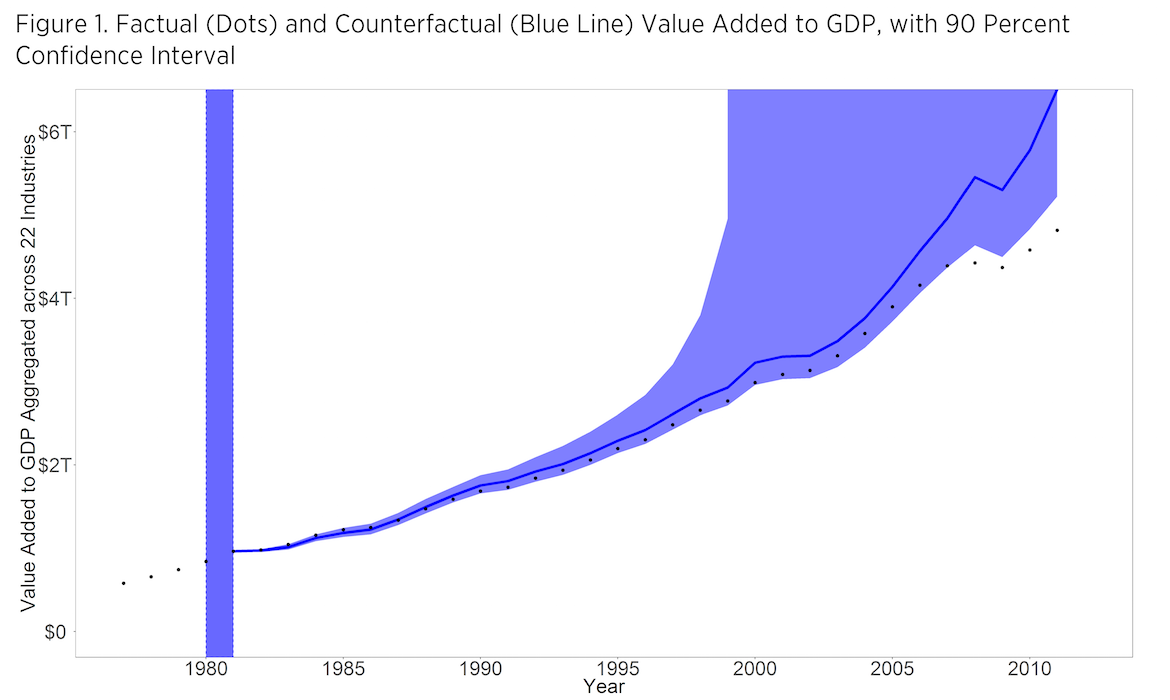
Economic growth in the United States has, on average, been slowed by 0.8 percent per year since 1980 owing to the cumulative effects of regulation:

If regulation had been held constant at levels observed in 1980, the US economy would have been about 25 percent larger than it actually was as of 2012.

This means that in 2012, the economy was $4 trillion smaller than it would have been in the absence of regulatory growth since 1980. This amounts to a loss of approximately $13,000 per capita,...
 A graphical summary:


(It's interesting that the standard errors are so weighted to the up side. I checked with the authors, this is indeed how the distributions of uncertainty work out in their estimation.)

I also found this nice graph from Chad Jones,


Chad's graph differs from mine for a few reasons. First, his index of "social infrastructure" from the world bank is more comprehensive, including Accountability of politicians, Political stability, Government effectiveness, Regulatory quality, Rule of law, Control of corruption. Second, he has total factor productivity on the Y axis. The vertical axis is a log scale, so read carefully. 1.6 (Singapore) is a lot more than 1.0, though they are compressed on the graph.

Monday, May 9, 2016

Bond Swap

The U.S. Treasury debates new-for-old bond swap, reports FT. The Treasury will issue more of the popular 10 year bonds, and then buy them back at some point before they mature.

The idea is to make treasury markets more uniform and liquid. Once bonds get several years old, they tend to sit in proverbial sock drawers, and they're harder to buy and sell (they are "off the run.") To the extent that this illiquidity lowers their value, the Treasury can buy them back cheaper.
“By buying cheap issues and funding the buybacks with issuance of rich on-the-run securities, the Treasury could enhance liquidity in these issues, while decreasing its borrowing costs,”
There is a lot of writing about "safe" and "liquid" asset shortages, so issuing more of a few popular issues and leaving less outstanding otherwise is beneficial to markets.

Comment.  I like the idea, but I think the Treasury should go further. Coincidentally, I just happen to have recently written an article called "A new structure for U.S. Federal Debt" that explains it all in detail.

When you think about it, the treasury ends up in a strange place. Why would you constantly issue 10 year debt, and then buy it all back when it's (say) 8 year debt? What is the question that this structure solves? (Other than the desire of dealer banks to double their earnings on buying and selling treasury securities!)  

My proposal is simpler: Issue perpetuities. These securities pay $1 coupon forever. Buy these back, not on a regular schedule, but when (!) the day of surpluses comes that the government wants to pay down the debt. Then there is one issue, with market depth in the trillions, and the whole on the run vs. off the run phenomenon disappears. I hope the Treasury will someday at least try selling some perpetuities.


Friday, May 6, 2016

Global Imbalances

I gave some comments on “Global Imbalances and Currency Wars at the ZLB,” by Ricardo J. Caballero, Emmanuel Farhi, and Pierre-Olivier Gourinchas at the conference, “International Monetary Stability: Past, Present and Future”, Hoover Institution, May 5 2016. My comments are here, the paper is here 

The paper is a very clever and detailed model of "Global Imbalances," "Safe asset shortages" and the zero bound. A country's inability to "produce safe assets" spills, at the zero bound, across to output fluctuations around the world. I disagree with just about everything, and outline an alternative world view.

A quick overview:

Why are interest rates so low? Pierre-Olivier & Co.: countries can't  “produce safe stores of value”
This is entirely a financial friction. Real investment opportunities are unchanged. Economies can’t “produce” enough pieces of paper. Me: Productivity is low, so marginal product of capital is low.

Why is growth so low? Pierre-Olivier: The Zero Lower Bound is a "tipping point." Above the ZLB, things are fine. Below ZLB, the extra saving from above drives output gaps. It's all gaps, demand. Me: Productivity is low, interest rates are low, so output and output growth are low.

Data: I Don't see a big change in dynamics at and before the ZLB. If anything, things are more stable now that central banks are stuck at zero. Too slow, but stable.  Gaps and unemployment are down. It's not "demand" anymore.


Exchange rates. Pierre-Olivier  "indeterminacy when at the ZLB” induces extra volatility. Central banks can try to "coordinate expectations." Me: FTPL gives determinacy, but volatility in exchange rates. There is no big difference at the ZLB.

Safe asset Shortages. Pierre-Olivier: driven by a large mass of infinitely risk averse agents. Risk premia are therefore just as high as in the crisis. Me: Risk premia seem low. And doesn't everyone complain about "reach for yield" and low risk premia?

Observation. These ingredients are plausible about fall 2008. But that's nearly 8 years ago! At some point we have to get past financial crisis theory to not-enough-growth theory.

But, finally, praise. This is a great paper. It clearly articulates a world view, and you can look at the assumptions and mechanisms and decide if you think they make sense. I am in awe that Pierre-Olivier & Co. were able to make a coherent model of these buzzwords.

But great theory is great theory. To a critic, the assumptions are necessary as well as sufficient. I  read it as a brilliant negative paper, almost a parody: Here are the extreme assumptions that it takes to justify all the policy blather about "savings gluts" "global imbalances" "safe asset shortages" and so on. To me, it shows just how empty the idea is, that our policy-makers understand any of this stuff at a scientific, empirically-tested level, and should take strong actions to offset the supposed problems these buzzwords allude to.

I hope this taste gets you to read  my comments and the paper. 


Wednesday, May 4, 2016

Central Bank Governance and Oversight Reform

The Hoover Institution Press just published "Central Bank Governance and Oversight Reform," the collected volume of papers, comments, and discussion from last May's conference here by the same name. You can get the  book or e-book here at the Hoover press or here at amazon.com. The individual chapter pdfs are available here.  Press release here.

(My modest contributions are in the preface and a discussion of Paul Tucker's Chapter 1. I agree it would be nice to have a more rule-based approach to lender of last resort and bailout functions, but wouldn't lots of equity so you don't have to mop up so often be even better?)

This is part of an emerging series of monetary policy conferences at Hoover. Tomorrow we will have a conference on international monetary policy. Stay tuned...


The blurb:
How can we balance the central bank’s authority, including independence, with accountability and constraints? Drawn from a 2015 Hoover Institution conference, this book features distinguished scholars and policy makers’ discussing this and other key questions about the Fed. Going beyond the simple decision of whether to raise interest rates, they focus on a deeper set of questions, including, among others, How should the Fed make decisions? How should the Fed govern its internal decision-making processes? What is the trade-off between greater Fed power and less Fed independence? And how should Congress, from which the Fed ultimately receives its authority, oversee the Fed?

The contributors discuss, for instance, whether central banks can both follow rule-based policy in normal times but then take a discretionary, do-what-it-takes approach to stopping financial crises. They evaluate legislation, recently proposed in the U.S. House and Senate, that would require the Fed to describe its monetary policy rule and, if and when the Fed changed or deviated from its rule, explain the reasons. And they discuss to best ways to structure a committee—like the Federal Open Market Committee, which sets interest rates—to make good decisions, as well as offer historical reflections on the governance of the Fed and much more. They conclude with an important reminder: how important it is to have a “healthy separation between government officials who are in charge of spending and those who are in charge of printing money,” the most essential part of good governance.
The contents:

Preface
By John H. Cochrane and John B. Taylor

Chapter 1: How Can Central Banks Deliver Credible Commitment and Be “Emergency Institutions”?
By Paul Tucker

Chapter 2: Policy Rule Legislation in Practice
By David H. Papell, Alex Nikolsko-Rzhevskyy and Ruxandra Prodan

Chapter 3: Goals versus Rules as Central Bank Performance Measures
By Carl E. Walsh

Chapter 4: Institutional Design: Deliberations, Decisions, and Committee Dynamics
By Kevin M. Warsh

Chapter 5: Some Historical Reflections on the Governance of the Federal Reserve
By Michael D. Bordo

Chapter 6: Panel on Independence, Accountability, and Transparency in Central Bank Governance
By Charles I. Plosser, George P. Shultz, and John C. Williams

Tuesday, April 26, 2016

Macro Musing Podcast

I did a podcast with David Beckworth, in his "macro musings" series, on the Fiscal Theory of the Price Level, blogging, and a few other things.


(you should see the link above, if not click here to return to the original).

You can also get the podcast at Sound Cloud, along with all the other ones he has done so far, or on itunes here.  For more information, see David's post on the podcast.

Saturday, April 23, 2016

Lessons Learned I

I spent last week traveling and giving talks. I always learn a lot from this. One insight I got:  Real interest rates are really important in making sense of fiscal policy and inflation.

Harald Uhlig got me thinking again about fiscal policy and inflation, in his skeptical comments on the fiscal theory discussion, available here. At left, two of his graphs, asking pointedly one of the standard questions about the fiscal theory: Ok, then, what about Japan? (And Europe and the US, too, in similar situations. If you don't see the graphs or equations, come to the original.) This question came up several times and I had the benefit of several creative seminar participants views.

The fiscal theory says
 \[ \frac{B_{t-1}}{P_t} = E_t \sum_{j=0}^{\infty} \frac{1}{R_{t,t+j}} s_{t+j} \]
 where \(B\) is nominal debt, \(P\) is the price level, \(R_{t,t+j}\) is the discount rate or real return on government bonds between \( t\) and \(t+j\) and \(s\) are real primary (excluding interest payments) government surpluses. Nominal debt \(B_{t-1}\) is exploding. Surpluses \(s_{t+j}\) are nonexistent -- all our governments are running eternal deficits, and forecasts for long-term fiscal policy are equally dire, with aging populations, slow growth, and exploding social welfare promises. So, asks Harald, where is the huge inflation?

I've sputtered on this one before. Of course the equation holds in any model; it's an identity with \(R\) equal to the real return on government debt; fiscal theory is about the mechanism rather than the equation itself. Sure, markets seem to have faith that rather than a grand global sovereign default via inflation, bondholders seem to have faith that eventually governments will wake up and do the right thing about primary surpluses \(s\). And so forth. But that's not very convincing.

This all leaves out the remaining letter: \(R\). We live in a time of extraordinarily low real interest rates. Lower real rates raise the real value surpluses s. So in the fiscal theory, other things the same, lower real rates are a deflationary force.

The effect is quite powerful. For a simple back of the envelope approach, we can apply the Gordon growth formula to steady states. Surpluses \(s\) grow at the rate \(g\) of the overall economy. So, in steady state terms,
 \[ \frac{B_{t-1}}{P_t s_t} = E_t \sum_{j=0}^{\infty} \frac{(1+g)^j}{(1+r)^j} \approx \frac{1}{ r - g} \]
\[ \frac{P_t s_t}{B_{t-1}}  \approx  r - g \; \; (1) \]
(and exact in continuous time). The left hand side is the steady state ratio of surpluses to debt. The right hand side is the difference between the real interest rate and the long-run growth rate.

So, with (say) a 2% growth rate g, and a 4% long-run interest rate r, surpluses need to be 2% of the real value of debt. But suppose interest rates decline to 3%. This change cuts in half the needed long-run surpluses! Or, holding surpluses constant, if long-run interest rates fall to 3%, the price level falls by half.

You can see the punchline coming. Long term real interest rates are really low right now. If anything, we're flirting with \(r \lt g\), the magic point at which governments can borrow all they want and never repay the debt.

With this insight, Harald should have been asking of the fiscal theory, where is the huge deflation? And the answer is, well, we're sort of there. The puzzle of the moment is declining inflation and even slight deflation despite all our central bankers' best efforts.

Pursuing this idea, there is a larger novel story here about growth, interest rates, and inflation.

Obviously, there is an opposite prediction for what happens when real interest rates rise. Higher real rates, unless accompanied by higher surpluses, will drive inflation upwards.

In conventional terms, looking at flows rather than present values, suppose a government that is $20 Trillion in debt faces interest rates that rise from 2% to 5%. Well, then it has to increase surpluses by $600 billion per year; and if it cannot do so inflation will result.

A similar story makes sense for the cyclical falls in inflation. What happened to our equation in 2008?  Surpluses fell -- deficits exploded -- and future surpluses fell even more. Debt rose sharply. Why did we see deflation? Well, real interest rates on government debt fell to unprecedentedly low levels. This really isn't even economics, it's just accounting. The equation holds, ex-post, as an identity!

To think a bit more about real rates, growth, and inflation, remember the standard relation that the real interest rate equals the subjective discount rate (how much people prefer current to future consumption) plus a constant times the per capita growth rate
\[ r = \delta + \gamma (g-n) \]
The constant \(\gamma\) is usually thought to be a bit above one.

With \(\gamma=1\) (log utility), then we have \(r-g = \delta-n\). The magic land of unbounded government debt can occur because government surpluses can grow at the population growth rate, while interest rates are determined by the individual growth rate. But population growth is tapering off, and must eventually cease, and bondholders prefer their money now. With \(\gamma \gt 1 \) ,
\[ r-g = \delta - n + (\gamma-1)(g-n) \; \; (2)\]
The new term is the per capita growth rate, which is positive, further distancing us from the land of magic.

More to the point, though, we now have before us the central determinant of long run real interest rates. Real interest rates are higher when economic growth is higher. And \(r-g\) rises when economic growth \(g\) rises.

So, going back to my equation (1), we actually had a puzzle before us. Higher real interest rates would mean lower values of the debt, and would thus be inflationary if not accompanied by austerity to pay more to bondholders. But higher real interest rates must come with higher economic growth, and higher economic growth would raise surpluses, helping the situation out. Which force wins? Well, equation (2) answers that question: With \(\gamma \gt 1\), the usual case (a 1% rise in consumption growth comes with a more than 1% rise in real interest rates), higher growth g comes with higher still interest rates r, and thus remains an inflationary force, again holding surpluses constant.

All in all then, we have the hint of a fiscal theory Phillips curve: Inflation should be procyclical. In good times, interest rates rise and the real value of government debt falls, producing more inflation. In bad times, interest rates fall and the real value of government debt rises, producing less inflation.

Central banks have been absent in all this. The natural next question is, does this provide another reinforcing channel by which central banks might raise inflation if they raise interest rates? I don't think so, but one needs more equations to really answer the question.

What matters here are very long-term real interest rates, the kind that discount expectations of surpluses -- yes, we need some surpluses! -- 20 to 30 years from now to establish bondholder's willingness to hold debt today.

In no model I have played with can central banks affect real interest rates for that long. I think a quick look out the window convinces us that central banks cannot substantially raise interest rates in a slump, with supply of global savings so strong compared to demand for global investment. Long-term interest rates really must come from supply and demand, not monetary machination. Higher real interest rates require higher marginal products of capital, and thus higher economic growth, not louder promises, more speeches, or more energetic attempts to avoid the logic of a liquidity trap.