Sunday, June 22, 2014
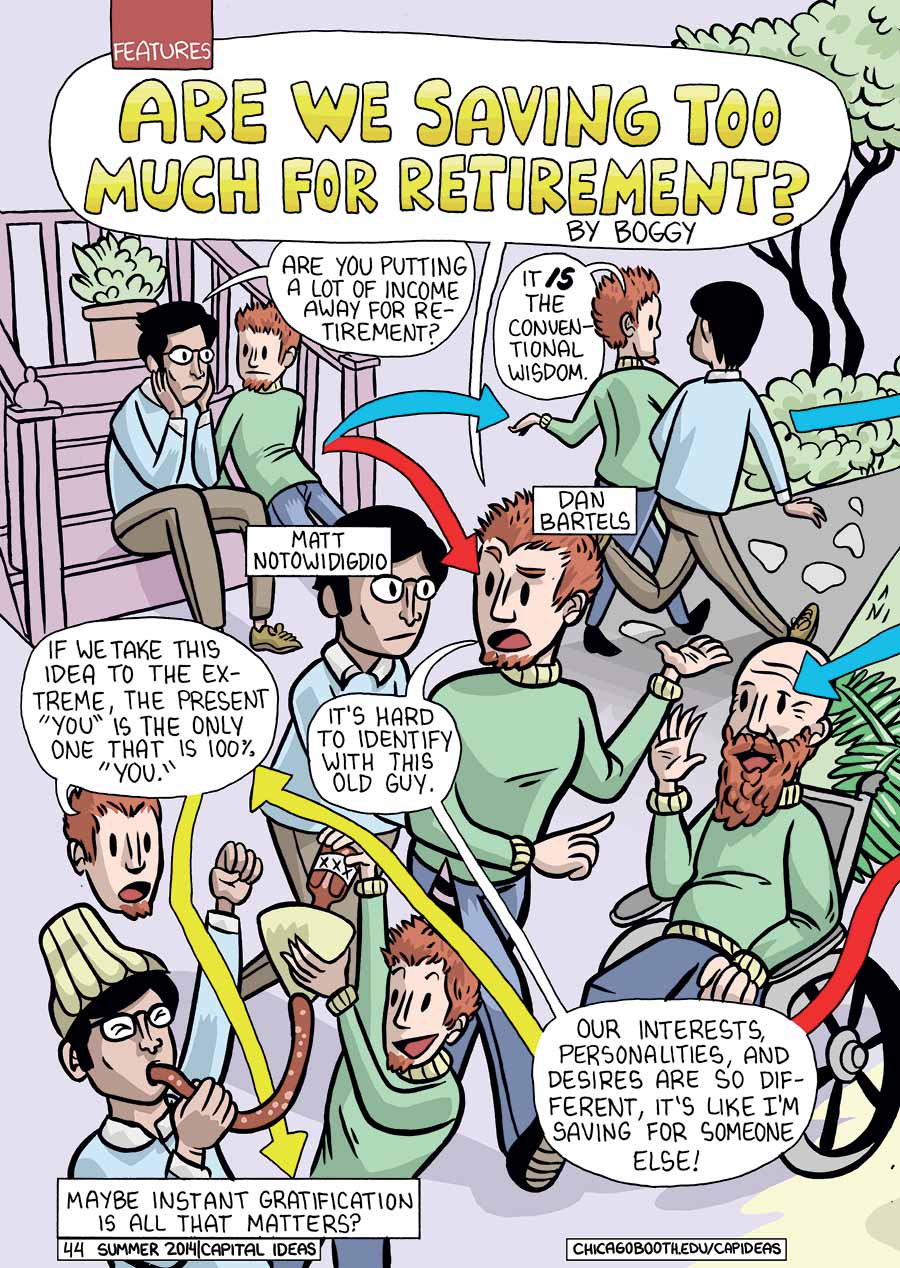
Are we saving too much for retirement?
Another graphic novel in the Booth Capital Ideas magazine. This is just page one, click on the link to see all four pages. It's an interesting conversation between an economist (Matt), who thinks about intertemporal choice, and a psychologist (Dan), who thinks about how you imagine your future self. It really works best as a four page spread so you can follow all the arrows as they jump around.


Saturday, June 7, 2014
Geithner Review
I found quite interesting Matt Stoller's review of Treasury Secretary Tim Geithner's book at vice.com. Matt read between the lines of the personal part of the book, and the glimpse it offers into the lives and career paths of well-connected people in our Eastern finance-government-academia establishment. There still is such a thing.
I haven't read the book, as I find Geithner's all-bailout, all-the-time view of finance rather simplistic. And I don't endorse all the review's contrary economic ideas either. The review is also bit personal, a tone I don't endorse. Cronyism is a disease of a government and polity which elects it, not supposed moral failings of specific individuals. We will not build a better government by hoping that good-looking well-mannered Dartmouth grads will voluntarily turn down opportunities for power, priviledege and wealth that land in their laps through family and school connections.
The review points to a very nice multi-authored article, "The Value of Connections In Turbulent Times" by Daron Acemoglu, Simon Johnson, Amir Kermani, James Kwak, and Todd Mitton, using stock price reactions to measure the value of insider connections.

This tale has a strong lesson for how "resolution authority" will work out. Better keep your private cell phone contact list up to date.
This reinforces a larger point, which my colleagues Luigi Zingales and Raghu Rajan have been making for a while (here and here), among many other voices. The antagonist to free markets in our time is not state control or bureaucratic socialism. It is crony-capitalism, a system that relies on large private companies, but under detailed government control, government favors dispensed in return for political support and buckets of money, arbitrary prosecutions and regulatory "crucifixion" (to borrow a term from an infamous EPA staffer) awaiting those who speak out or don't play along.
One last point on Tim Geithner's career. We lost a wonderful opportunity. If the Treasury Secretary can't fill out Turbo-Tax correctly, surely it is time to simplify our tax code. Alas, the crony state demands an absurd tax system, so that brief moment vanished.
I haven't read the book, as I find Geithner's all-bailout, all-the-time view of finance rather simplistic. And I don't endorse all the review's contrary economic ideas either. The review is also bit personal, a tone I don't endorse. Cronyism is a disease of a government and polity which elects it, not supposed moral failings of specific individuals. We will not build a better government by hoping that good-looking well-mannered Dartmouth grads will voluntarily turn down opportunities for power, priviledege and wealth that land in their laps through family and school connections.
The review points to a very nice multi-authored article, "The Value of Connections In Turbulent Times" by Daron Acemoglu, Simon Johnson, Amir Kermani, James Kwak, and Todd Mitton, using stock price reactions to measure the value of insider connections.
The announcement of Tim Geithner as President-elect Obama’s nominee for Treasury Secretary in November 2008 produced a cumulative abnormal return for …nancial …firms with which he had a personal connection. This return was around 15 percent from day 0 through day 10, relative to other comparable …financial fi…rms. ... Roughly in line with market expectations, the Obama administration hired people from Geithner-connected fi…rms into top level fi…nancial policy positions.... We argue that this value of connections refl‡ects the perceived impact of relying on the advice of a small network of …financial sector executives during a time of acute crisis and heightened policy discretion.
This tale has a strong lesson for how "resolution authority" will work out. Better keep your private cell phone contact list up to date.
This reinforces a larger point, which my colleagues Luigi Zingales and Raghu Rajan have been making for a while (here and here), among many other voices. The antagonist to free markets in our time is not state control or bureaucratic socialism. It is crony-capitalism, a system that relies on large private companies, but under detailed government control, government favors dispensed in return for political support and buckets of money, arbitrary prosecutions and regulatory "crucifixion" (to borrow a term from an infamous EPA staffer) awaiting those who speak out or don't play along.
One last point on Tim Geithner's career. We lost a wonderful opportunity. If the Treasury Secretary can't fill out Turbo-Tax correctly, surely it is time to simplify our tax code. Alas, the crony state demands an absurd tax system, so that brief moment vanished.
Thursday, June 5, 2014
The Economist on Narrow Banks
The Economists Free Exchange blog covers narrow banks, and parts of my "run free" paper in a post somewhat mean-spiritedly -- or perhaps unintentionally self-descriptively -- titled "Narrow Minded." I always appreciate publicity, but a few parts seem wrong enough to address.
After nicely covering the history of the idea, the Economist writes,
Yes, investors can all try to dump stocks, either held directly or held through funds, and stock prices can go down. There is no failure, no bankruptcy, and no crisis in this. We want a system that allows booms and busts without crises, not the promise that wise regulators will step in to stabilize stock prices!
After nicely covering the history of the idea, the Economist writes,
such a plan raises huge practical questions. The first is implementation: how to get from today’s system of highly indebted banks to one in which they are financed chiefly by equity.That's not hard. We're slowly raising capital requirements, and all we have to do is to keep raising them. My Pigouvian tax on debt would help a lot -- I think banks screaming how hard it is to issue equity or how terrible not to pay dividends for a while would suddenly find it much easier if paying 5 cents for each dollar of debt issued. Announcing that institutions above 50% equity and with less than 20% short-term debt are exempt from Basel and Dodd-Frank asset regulation might cause a rush for the exits.
Politically, there would be formidable opposition from vested interests.And this is, somehow, an argument against the plan rather than for it? There is formidable opposition from vested interests against abolishing agricultural subsidies, trade protection, occupational licensing, and taxicab monopolies. Dear Economist, when did feeding the cronies become an argument for keeping bad policy in place, not a main indicator of needed change?
The first is simply untrue, and the second is deeply misleading. For every dollar of long term debt or equity that must be raised, one dollar of short term debt is paid back. No extra funds from investors are required, and no selling of assets is required. It's just a Modigliani-Miller / Yogi Berra reslicing of the same pizza.
Economically, the transition would require banks to dispose of a vast stock of loans, or raise an equivalent amount of long-term debt and equity.
A second concern is whether a split between narrow banks and wider lending-and-investment firms would actually eliminate runs. If other institutions replace banks in making loans, they could end up creating fragilities of their own. Mutual funds, for example, are financed by shareholders, not creditors; but if such shares are seen as stable and safe, investors will treat them as deposits—and try to withdraw their investment if that safety is threatened.This is just simply wrong, and in the "Economist should know better" camp. You cannot "withdraw your investment" from a floating-value fund. The fund makes no fixed-value promises. It cannot fail. It cannot suffer a run. Look up the definition of run, dear Economist! A floating-value fund, and especially an exchange-traded fund with no one-day NAV promise, is the paradigmatic example of a run-proof institution.
Yes, investors can all try to dump stocks, either held directly or held through funds, and stock prices can go down. There is no failure, no bankruptcy, and no crisis in this. We want a system that allows booms and busts without crises, not the promise that wise regulators will step in to stabilize stock prices!
After this happened even once, people would simply flock to the narrow banks, and there would be no source of lending.” To prevent this, the authors argue, governments would have to intervene to save the “not-so-narrow intermediaries”.Now we're deep into the silly season. The intermediaries do not need any saving. They have not made any promises. A floating value fund cannot go bankrupt! Yes, stock prices can fall, and your fire sale is my buying opportunity. Do we really want Governments and their central banks buying stocks to prop up their values? Do we really want governments allocating credit? Have we so lost sight of what a "crisis" is, and is not?
Third, such a system would still need plenty of regulation.The fact that we need some regulation -- that I don't produce a libertarian-anarchist nirvana solution in which absolutely zero regulation is required -- is somehow a defense of the current monstrous setup? I think we need cops at stoplights. Is this a defense of Dodd-Frank? Come now, it takes about 1/10th the regulation, because we can throw out all regulation of the safety of bank asssets, all the risk weights, all the stress tests, all the "resolution," and so on. The perfect is truly the enemy of the good at the Economist.
But given the growing cost and inefficiency of today’s regulatory regime, the concept of narrow banking surely deserves more serious consideration.I'll take the grudging endorsement and return a grudging gratitude for the mention of the idea!
Hall on Supply vs. Demand
I'm reading Bob Hall's Macro Annual paper (ungated here). The burning question is, how much of our low GDP relative to the pre-2007 trend and forecasts corresponds to "supply" (really "equilibrium") which monetary and fiscal "stimulus" can't help, and how much is "demand" that they might. (I live in a more model-based and equilibrium tradition, so I don't want to fully endorse these words and the concepts behind them, but they'll have to do for now.) Bob's paper is a really nice quantitative exercise aimed at answering the question, rather than just bloviating as us bloggers tend to do.
Bob starts with
From the conclusion
I add that up as 3.4+5.0+2.5 = 10.9% / 13% not particularly amenable to "stimulus," and instead reflecting "supply." Capital stock "mean reversion" means investment which doesn't happen on its own, and I'm dubious of "accelerators." Take your own conclusions.
The paper is good for a detailed search theoretic view of labor markets.
My only big complaint: The title: "Quantifying the lasting harm to the U.S. economy from the financial crisis." I would insist on adding "and policy responses to that crisis." We have had swift recoveries from previous crises.
Bob starts with
The years since 2007 have been a macroeconomic disaster for the United States of a magnitude unprecedented since the Great Depression.He measures our shortfall at 13.3 percent of GDP. Now we add up where it comes from and how much "demand" might help.
From the conclusion
There is no reason to expect that the cumulative shortfall in productivity growth of 3.4 percentage points of output could be reversed by a sudden increase in product demand. That shortfall seems to be the result of a period of reduced innovation, possibly the result of the crisis. ..Whether the return to a normal economy will result in a catchup in productivity growth in the longer term [JC: do inventions proceed on a time trend, and we can quickly implment them] is an unsettled question of growth economics.
...the capital stock is ... responsible for the largest part of the output shortfall, 5.0 percentage points. It can't respond immediately to a boost to product demand, but a boost would probably trigger an accelerator response that would close some part of the shortfall. In the longer run, the strong mean reversion in the historical capital/output ratio should work to close the entire gap.
... Unemployment dropped slowly to 1.3 percentage points above normal in 2013, contributing 0.9 percentage points to the shortfall in output in that year. The return to normal has been slower than in previous post-recession episodes because the crisis shifted the composition of jobseekers toward those with low job- finding rates and low exit rates from unemployment. An increase in product demand would accelerate the remaining move back to normal....
Labor-force participation fell substantially after the crisis, contributing 2.5 percentage points to the shortfall in output. The decline showed no sign of reverting as of 2013. Part is demographic and will stabilize, and part are effects low job-fi nding rates, which should return to normal slowly. But an important part may be related to the large growth in bene ficiaries of disability and food-stamp programs. Bulges in their enrollments appear to be highly persistent. Both programs place high taxes on earnings and so discourage labor-force participation among benefi ciaries. The bulge in program dependence is a state variable arguably resulting from the crisis that may impede output and employment growth for some years into the future.
I add that up as 3.4+5.0+2.5 = 10.9% / 13% not particularly amenable to "stimulus," and instead reflecting "supply." Capital stock "mean reversion" means investment which doesn't happen on its own, and I'm dubious of "accelerators." Take your own conclusions.
The paper is good for a detailed search theoretic view of labor markets.
My only big complaint: The title: "Quantifying the lasting harm to the U.S. economy from the financial crisis." I would insist on adding "and policy responses to that crisis." We have had swift recoveries from previous crises.
Gladstonian Republicans
 |
| Before politicians were telegenic. Source: Wall Street Journal |
"Imagine that the world's superpower reduces the size of government by a quarter over the next 30 years, even as its population grows by 50%. Imagine further that the superpower performs this miracle while dramatically increasing both the quality of public services and the nation's diplomatic clout. And imagine that the Republican Party leads this great revolution while uniting its manifold factions behind one of its favorite words: liberty.
Impossible? That is exactly what Britain, then the world's superpower and pioneer of the new economy, did in the 19th century. Gross revenue from taxation fell from just under £80 million in 1816 to well under £60 million in 1846, even as the population surged and the government helped build schools, hospitals, sewers and the world's first police force. The Victorians paid for these useful new services by getting rid of what they called "Old Corruption" (and we would call cronyism) and by exploiting the new technology of the day, like the railway. For these liberal reformers were the allies of the new commercial classes who were creating the industries that were transforming the world ...
Gladstonian liberalism provides a remarkable template....
First, rip out cronyism. Between 1815 and 1870 British Liberals replaced a government based on patronage, sweeping aside the special privileges for the East India Company, West Indian sugar makers and British landowners. Today the American right's dirty secret is its love of big government, especially tax breaks for business (including sugar). The U.S. tax code has $1.6 trillion of exemptions, most of which go to the well-off....
Having helped dismantle Britain's protectionist Corn Laws in the 1840s, he [Gladstone] would be astonished that America still doles out $30 billion a year in agriculture subsidies and employs 100,000 people in the Agriculture Department....
Gladstone would concentrate money on the poor, targeting the welfare state for the rich. More money goes to the top 5% in mortgage-interest deduction than to the bottom 50% in social housing. ...
Third, simplify government, particularly the numbers. In the early 19th century, British government accounts were incomprehensible, deliberately so. The aristocrats who ran the country wanted to conceal the fact that most government spending went to support their relations in the form of sinecures, church livings, pensions and ceremonial jobs. Gladstone insisted on standing before Parliament and explaining the budget in detail: If he couldn't explain it to a gathering of his peers, then he knew that it was worthless. America's current budget is so full of perks for vested interests that only lobbyists and their lawyers can understand it. ...I think this advice also addresses a sensible middle in the current inequality squabble.
The big "inequality" problem in the US is the situation of the bottom 20% or so, stuck in many ways, outside education, decent jobs, and suffering a lot of social dysfunction. Taxing Larry Ellison and sending them checks is not going to address their problems and everyone knows it.
In the top 1%, aside from Gallic fears of dynastic ambitions among these nouveau-riche, it's hard for serious people to see the problem if formerly middle-class entrepreneurs conjure up wonders that make us all better off and make fortunes doing so.
But there is common ground in 1% riches gained by government favoritism and crony connections. The one halfway sensible argument I have heard for large income or wealth taxation is as rough-and-ready remedy for crony profits.
But people who wangle government contracts and crony protection also know how to wangle exemptions to high tax rates. And higher statutory tax rates just focus their efforts, and focus politician's efforts on extracting political and financial support for offering exemptions. The cure ends up perpetuating the disease.
Even if it could work, I think that approach also gives up too soon. It accepts a horribly inefficient crony-capitalist state, and then tries second set of distortions to offset the first.
How much better to focus on cutting out the cronyism in the first place. Here free market economics, libertarian politcs, and left-wing outrage can meet productively.
How does it happen? I was interested by "the allies of the new commercial classes who were creating the industries that were transforming the world." Sudden new technology can create a class with interest in breaking down the crony system. Uber finally is breaking government imposed taxi monopolies, by suddenly creating a group of happy customers who will bring political pressure to bear, in a way that potential customers of slow-growing new businesses did not.
Alas, half of our tech moguls seem happy to endorse government-centered liberalism, and the other half seem to already be heading to government rent-seeking, as in merger antitrust regulation and big patent wars. Health care and banking are now firmly in the camp of gaming the government for profit rather than innovation. So while the technological underpinnings are similar, the business coalition for liberty may be harder to find.
The left will have to come the realization that the regulatory state breeds cronies, and does not cure them. When you need to ask armies of bureaucrats for permission to run a business, the quid pro quo of protection and subsidy for political support is inevitable, and getting favors from the government is the only way to make money.
I loved "incomprehensible, deliberately so." That's our tax and regulatory code. If us peasants knew what was going on we'd be in the streets.
PS, I don't know much of anything about 19th century British history, so if you think Gladstone really wasn't such a good guy, oh well. The ideas in the article are good in any case.
Wednesday, June 4, 2014
Sugar Mountain
Last Saturday I got to go to the biannual meeting of the Macro-Finance Society. This is a great new effort spearheaded by outstanding young macro-finance researchers.
(The society is limited to people with PhDs after 1990, occasioning the title of this post, a reference to a song about a bar limited to people under 21, a reference you will not get unless your PhD was granted well before 1990.)
I can't blog all the great papers and discussions, so I'll pick one of particular interest, Itamar Drechsler, Alexi Savov, and Philipp Schnabl's "Model of Monetary Policy and Risk Premia"
This paper addresses a very important issue. The policy and commentary community keeps saying that the Federal Reserve has a big effect on risk premiums by its control of short-term rates. Low interest rates are said to spark a "reach for yield," and encourage investors, and too big to fail banks especially, to take on unwise risks. This story has become a central argument for hawkishness at the moment. The causal channel is just stated as fact. But one should not accept an argument just because one likes the policy result.
Nice story. Except there is about zero economic logic to it. The level of nominal interest rates and the risk premium are two totally different phenomena. Borrowing at 5% and making a risky investment at 8%, or borrowing at 1% and making a risky investment at 4% is exactly the same risk-reward tradeoff.
In equations, consider the basic first order condition for investment, \[ 0 = E \left[ \left( \frac{C_{t+1}}{C_t} \right)^{-\gamma} (R_{t+1}-R^f_t) \right] \] \[ 1 = E \left[ \beta \left( \frac{C_{t+1}}{C_t} \right)^{-\gamma} \right] R_t^f \] Risk aversion \(\gamma\) controls the risk premium in the first equation, and impatience \(\beta\) controls the risk free rate in the second equation. The level of risk free rates has nothing to do with the risk premium.
Yes, higher risk aversion or consumption volatility would increase precautionary saving and lower interest rates in the second equation, holding \(\beta\) fixed. But that is the "wrong" sign -- lower interest rates are associated with higher, not lower, risk premiums.

Worse, that "wrong" sign is what we see in the data. Risk premiums are high in the early part of recessions, when interest rates are low. Risk premiums are low in booms, when interest rates are high. OK, I'm a bit defensive because "by force of habit" with John Campbell was all about producing that correlation. But that is the pattern in the data. I made a graph above of the Federal Funds rate (blue) and the spread between BAA bonds and treasuries (green, right scale). You can see the risk premium higher just when rates fall at the early stage of every recession, and premiums low at the peaks of the booms, when rates are at their peaks.
So, if one has this belief about Fed policy, there must be some other effect driving a big negative correlation between risk premiums and rates, yet the Fed can cause premiums to go up or down a bit more by raising or lowering rates.
Every time I ask people -- policy types, central bankers, Fed staff, financial journalists -- about this widely held belief, I get basically psychological and institutional rather than economic answers. Fund managers, insurance companies, pension funds, endowments, have fixed nominal rate of return targets. People have nominal illusions and don't think 8% with 1% short rates is a lot better than 10% with 9% short rates. Maybe. But basing monetary policy on the notion that all investors are total morons seems dicey. For one thing, the minute the Fed starts to exploit rules of thumb, smart investors change the rules of thumb. Segmented markets and institutional constraints are written in sand, not stone, and persist only as long as they are not too costly.
OK, enter Drechsler, Savov, and Schnabl. They have a real, economic model of the phenomenon. That's great. We may disagree, but the only way to understand this issue is to write down a model, not to tell stories.
The model is long and hard, and I won't pretend I have it all right. I think I digest it down to one basic point. Banks had (past tense) to hold non-interest-bearing reserves against deposits. This is a source of nominal illusion. If banks have to hold some non-interest bearing cash for every investment they make, then the effective cost of funds is higher when the nominal rate is higher. We are, in effect, mismeasuring \(R^f\) in my equation.
This makes a lot of sense. Except... Before 2007 non-interest-bearing reserves were really tiny, $50 billion dollars out of $9 trillion of bank credit. Quantitatively, the induced nominal illusion is small. Also, while it's fun to write models in which all funds must channel through intermediaries, there are lots of ways that money goes directly from savers to borrowers, like mortgage-backed securities, without paying the reserve tax. Banks aren't allowed to hold equities, so this channel can't work at all for the idea that low rates fuel stock "bubbles."
And now, reserves will pay interest.
At the conference, Alexi disagreed with this interpretation. He showed the following graph:

Fed funds are typically higher than T bills, and the spread is higher when interest rates are higher. They interpret this quantity (p.3) as the "external finance spread." Fed funds represent a potential use of funds, and the shadow value of lending. Alexi cited another mechanism too: "sticky" deposits generate a relationsip (at least temporary) between interest rate levels and real bank funding costs. So by whatever mechanism, they say, you can see that cost of funds vary with the level of interest rates. In response to my sort of graph, yes, lots of other things push risk premiums around generating the negative correlation, but allowing the causal effect.
Read the paper for more. I have come to praise it not to criticize it. Real, solid, quantiative economic models are just what we need to have a serious discussion. This is a really important and unsolved question, which I will close by restating:
Does monetary policy, by controlling the level of short term rates, substantially affect risk premiums? If so, how?
Of course, maybe the answer is "it doesn't."
(The society is limited to people with PhDs after 1990, occasioning the title of this post, a reference to a song about a bar limited to people under 21, a reference you will not get unless your PhD was granted well before 1990.)
I can't blog all the great papers and discussions, so I'll pick one of particular interest, Itamar Drechsler, Alexi Savov, and Philipp Schnabl's "Model of Monetary Policy and Risk Premia"
This paper addresses a very important issue. The policy and commentary community keeps saying that the Federal Reserve has a big effect on risk premiums by its control of short-term rates. Low interest rates are said to spark a "reach for yield," and encourage investors, and too big to fail banks especially, to take on unwise risks. This story has become a central argument for hawkishness at the moment. The causal channel is just stated as fact. But one should not accept an argument just because one likes the policy result.
Nice story. Except there is about zero economic logic to it. The level of nominal interest rates and the risk premium are two totally different phenomena. Borrowing at 5% and making a risky investment at 8%, or borrowing at 1% and making a risky investment at 4% is exactly the same risk-reward tradeoff.
In equations, consider the basic first order condition for investment, \[ 0 = E \left[ \left( \frac{C_{t+1}}{C_t} \right)^{-\gamma} (R_{t+1}-R^f_t) \right] \] \[ 1 = E \left[ \beta \left( \frac{C_{t+1}}{C_t} \right)^{-\gamma} \right] R_t^f \] Risk aversion \(\gamma\) controls the risk premium in the first equation, and impatience \(\beta\) controls the risk free rate in the second equation. The level of risk free rates has nothing to do with the risk premium.
Yes, higher risk aversion or consumption volatility would increase precautionary saving and lower interest rates in the second equation, holding \(\beta\) fixed. But that is the "wrong" sign -- lower interest rates are associated with higher, not lower, risk premiums.
Worse, that "wrong" sign is what we see in the data. Risk premiums are high in the early part of recessions, when interest rates are low. Risk premiums are low in booms, when interest rates are high. OK, I'm a bit defensive because "by force of habit" with John Campbell was all about producing that correlation. But that is the pattern in the data. I made a graph above of the Federal Funds rate (blue) and the spread between BAA bonds and treasuries (green, right scale). You can see the risk premium higher just when rates fall at the early stage of every recession, and premiums low at the peaks of the booms, when rates are at their peaks.
So, if one has this belief about Fed policy, there must be some other effect driving a big negative correlation between risk premiums and rates, yet the Fed can cause premiums to go up or down a bit more by raising or lowering rates.
Every time I ask people -- policy types, central bankers, Fed staff, financial journalists -- about this widely held belief, I get basically psychological and institutional rather than economic answers. Fund managers, insurance companies, pension funds, endowments, have fixed nominal rate of return targets. People have nominal illusions and don't think 8% with 1% short rates is a lot better than 10% with 9% short rates. Maybe. But basing monetary policy on the notion that all investors are total morons seems dicey. For one thing, the minute the Fed starts to exploit rules of thumb, smart investors change the rules of thumb. Segmented markets and institutional constraints are written in sand, not stone, and persist only as long as they are not too costly.
OK, enter Drechsler, Savov, and Schnabl. They have a real, economic model of the phenomenon. That's great. We may disagree, but the only way to understand this issue is to write down a model, not to tell stories.
The model is long and hard, and I won't pretend I have it all right. I think I digest it down to one basic point. Banks had (past tense) to hold non-interest-bearing reserves against deposits. This is a source of nominal illusion. If banks have to hold some non-interest bearing cash for every investment they make, then the effective cost of funds is higher when the nominal rate is higher. We are, in effect, mismeasuring \(R^f\) in my equation.
This makes a lot of sense. Except... Before 2007 non-interest-bearing reserves were really tiny, $50 billion dollars out of $9 trillion of bank credit. Quantitatively, the induced nominal illusion is small. Also, while it's fun to write models in which all funds must channel through intermediaries, there are lots of ways that money goes directly from savers to borrowers, like mortgage-backed securities, without paying the reserve tax. Banks aren't allowed to hold equities, so this channel can't work at all for the idea that low rates fuel stock "bubbles."
And now, reserves will pay interest.
At the conference, Alexi disagreed with this interpretation. He showed the following graph:
Fed funds are typically higher than T bills, and the spread is higher when interest rates are higher. They interpret this quantity (p.3) as the "external finance spread." Fed funds represent a potential use of funds, and the shadow value of lending. Alexi cited another mechanism too: "sticky" deposits generate a relationsip (at least temporary) between interest rate levels and real bank funding costs. So by whatever mechanism, they say, you can see that cost of funds vary with the level of interest rates. In response to my sort of graph, yes, lots of other things push risk premiums around generating the negative correlation, but allowing the causal effect.
Read the paper for more. I have come to praise it not to criticize it. Real, solid, quantiative economic models are just what we need to have a serious discussion. This is a really important and unsolved question, which I will close by restating:
Does monetary policy, by controlling the level of short term rates, substantially affect risk premiums? If so, how?
Of course, maybe the answer is "it doesn't."
Taylor rules
Last week I attended a conference at Hoover, "Frameworks for Central Banking in the Next Century." It was very interesting for its mix of academics, Fed people, and media. The Wall Street Journal had an interesting article Monday morning, "BOE's Carney may need to play a fourth card" on BOE governor Mark Carney's struggles with rules. I am left with more questions than answers, which is good.
Rules
What do we really mean by "rules?" The clearest version would be mechanical, the Federal Funds rate shall be \[ i_t = 2\% + 1.5 \times (\pi_t - 2\%) + 0.5 \times (y_t-y^*_t ) \] say, with \(i\) = interest rate, \(\pi\) = inflation \(y - y^*\) = output gap. The numbers come in, the Fed mechanically borrows and lends at that rate. This is something like an idealized gold standard.
That is not what anybody has in mind, obviously. So what do we really mean by "rules?"
One of the biggest problems is what goes in to the output gap part. If the Fed is going to respond to economic conditions, how do we measure those conditions? Unemployment? The Fed got in a bit of a mess first saying 6.5%, then rethinking whether maybe employment vs. unemployment matters, and then worrying about long-term unemployed. Once you get to "labor market conditions," the line between rule, judgment, and discretion gets muddy. Output gap? Then relative to whose "potential?" Just how much of current slow growth is "supply" vs. "demand" possibly fixable by monetary policy is at the center of the current policy debate. It's easy to say "we're really following a rule, we just think the output gap is bigger than you think." Athanasios Orphanides famously pointed out that contemporary views of the output gap in the 1970s justified a lot of loose policy that to later eyes looked like violations of a rule. I don't mean to say it's impossible, or that many people haven't thought long and hard about it, just to point that this is a tough question.
Moreover, I think even the ardent rules supporters have in mind some flexibility to deal with temporary exigencies. The rule is sort of a long-run commitment, not something mechanical. After all, much of the point is to "anchor long run expectations." But my diet also seems to have a daily temporary exigency, and once again rule vs. discretion gets muddy.
David Papell's presentation and Monika Piazzesi's comments were very thought-provoking in this regard. David set out to measure the extent of rules-based vs. discretionary policy. This is deep. Fundamentally, if we can't measure something, it becomes a much muddier concept. I don't think David succeeded, but he did the obvious first step and leaves me with a much clearer view of the problem.
David estimated rules with OLS regressions, roughly \[i_t = r^* + \phi_{\pi} (\pi_t - \pi^*) + \phi_y (y - y^*) + \varepsilon_t\] He sensibly measured the amount of rule-following vs. discretion by the volatility of the error term, and correlated that volatility with economic performance to try to measure the contribution of rules-based policy to economic stability.
But the Fed can surely answer, "We're following a rule, but you're using the wrong measure of u. Our measure of u becomes your error term." The Fed can also answer "that's a ridiculously simplified textbook rule. We follow a rule, but it includes a lot of other right hand variables like financial stability, long-term unemployment, housing bubbles and 10 different measures of output gaps. Variation in those omitted right-hand variables is showing up in your error term, not deviations from a rule."
Those replies would also answer the economic performance correlation. The Fed could go on and say "in times of high economic instability, the other components of our rule move around a lot, so there is more omitted-variable volatility. Economic volatility causes estimated Taylor Rule residuals, not the other way around."
More deeply, Mike Woodford's book recommends that the Fed respond directly to shocks to other parts of the economy, or shocks to the "natural rate," and then add Taylor rule responses, \[i_t = r_t^* + \phi_{\pi} (\pi_t - \pi^*) + \phi_y (y_t - y^*) \] (There is now a t subscript on \(r^*\)). So optimal rule-based policy has this character of apparent "discretionary" residuals from regressions.
So really where is the line between rule, a guideline (Captain Barbossa), a general indication of intent, "forward guidance," communication, principled discretion and willy-nilly discretion? Where is the line between law, commitment, promise, pie-crust promise (Mary Poppins, made to be broken), and the golden-retriever approach to life? Is the issue about rules vs. discretion, or is it just about simple and transparent rules vs. complex and obscure rules; about communication rather than commitment?
At a deep level, we social scientists think of the Fed like every other actor as always following "rules," some function from environment to action that describes behavior. Optimization always results in such a rule. Genuine randomness (the quantum mechanics of behavior?) is't really part of the framework; unpredictable behavior is the result of simplified models and agent's better information, not genuine randomness. (There is an exception for mixed strategies of course, but I don't think that's relevant here.) So is there anything but rules based policy? This question has long bugged me in interpreting impulse-response functions. The Fed never says "and we added 25 basis points for the fun of it." They always describe all actions as reactions to the environment -- a rule.
Framed that way, I think one answer is before us. If we go back to Kydland and Prescott rules vs. discretion, or Odysseus, the key to a "rule" is precommitment. You're following a rule (and a rule is beneficial) when you commit to an action ex-ante that you would prefer not to take ex-post, and that commitment has benefits to your overall objective.
"Forward guidance" or "communication" say "here is what we think we will feel like doing in the future." (But we retain the right to change our mind.) A rule says "here is what we will do in the future," maybe describing a state-contingent set of actions, "even if we will not feel like it at the time." ("And here is a set of costs we impose on ourselves so that we will choose to follow through" helps a lot to make it credible.)
It's pretty clear that the Fed has been doing the former, not the latter. The WSJ article on the BOE makes a similar point. Three rules in a year is not a lot of commitment.
This difference is where my scepticism of stimulative promises came from. If the Fed promised to keep rates low in the future, in order to stimulate today, that promise can only have effect if people imagine the Fed chair going to Congress when inflation has hit 5% and saying "no, I promised to keep rates low in order to boost the economy in the recession, and now I have to do that though we all know it's time to raise rates." Nobody believes the Fed chair will do such a thing. The "guidance" is a "forecast of how the Fed will feel," not a commitment, not a promise with a self-imposed cost, some way of binding itself to the mast.
The intricate legal structure surrounding the Fed, and many of its traditions, do constitute a lot of "rules," by the way. The Fed might dearly like to drop money from helicopters, buy Treasury debt directly, or lend directly to under-"stimulated" businesses. Legal restrictions against such actions are regretted ex-post, and admired as producing overall better outcomes. At best, forward guidance amounts to a set of promises that the Fed will feel it somewhat costly to renege on.
Now, I think we are ready to start thinking about measurement. I don't think that can be a purely empirical exercise. We need to write down some sort of objective, and find promised behavior ex ante that is regretted ex post, but nonetheless beneficial overall. I'm not sure how to do it, but at least the concept has some potentially measurable content.
Models
My second thought prompted by the conference overall, and made concrete by thinking about David's paper is: What is the model of the economy in which the rule is supposed to work?
In David's regression, we can ask the question: Embed the rule in a model. Suppose that the Fed follows the rule perfectly, and we generate artificial time series from the model, and run the regression. Does the regression reveal the Taylor rule that the Fed is following?
In the new-Keynesian model, the answer is no. Bob King pointed out long ago that we can write the Taylor rule in such models as \[i_t = i_t^* + \phi_{\pi} (\pi_t - \pi_t^*) + \phi_y (y_t - y^*_t ) \] where we now interpret the * variables as equilibrium values, and the non-starred values as deviations from equilibrium. When the Fed follows such a rule, in that model, we observe \( i_t = i_t^* \) , \( \pi_t = \pi^*_t \) and \( y_t = y_t^* \). There is no variation in the right hand variables on which to estimate the Taylor rule. The Taylor rule is not identified when placed in a new Keynesian model. In a new-Keynesian model, the "Taylor rule" becomes the "Taylor Principle," a set of off-equilibrium threats not seen in equilibrium. The Fed introduces instabilty to gain determinacy, rather than introduce stability as it does in old-Keynesian models. (This is a not so subtle plug for "Determinacy and Identification With Taylor Rules")
More generally, the point of monetary policy is to stabilize output and inflation, so simple regressions of interest rates on output and inflation no more measure the policy rule, than simple regressions of inflation and output on interest rates measure the effect of monetary policy. This is a point James Tobin made about 50 years ago (post hoc ergo propter hoc). Chris Sims got a Nobel Prize for VARs to address the problem.
Most simply, monetary policy shocks affect output and inflation, so the right hand variable is correlated with the error term. The new-Keynesian model is an extreme case of this behavior, in which the right hand variable and error terms are perfectly correlated.
These questions were not really on anyone's mind. They are hard questions, they are old questions, and they don't have easy answers.
The larger question is, what model of the economy do policy people use to think about how monetary policy affects the economy? The clear answer at this conference is, some unwritten mixture of old Keynesianism and old Monetarism. Old Keynesianism: higher rates reduce "demand" which reduce output which through a Philips curve reduces inflation. Old Monetarism: higher interest rates reduce some quantity of money which works its way through to prices. Neither can be written down or spoken aloud without provoking chuckles. But we had a whole conference on "rules" without an explicit mention of "transmission mechanism" (i.e. "model"), and surely the verbal reasoning conformed more to those 40 year old stories than anything written since.
That wide gulf is worth pondering from both sides.
(There were a lot of really interesting papers and discussions. I especially recommend Marvin Goodfriend's paper, which I'll try to blog at some point in the future.)
Rules
What do we really mean by "rules?" The clearest version would be mechanical, the Federal Funds rate shall be \[ i_t = 2\% + 1.5 \times (\pi_t - 2\%) + 0.5 \times (y_t-y^*_t ) \] say, with \(i\) = interest rate, \(\pi\) = inflation \(y - y^*\) = output gap. The numbers come in, the Fed mechanically borrows and lends at that rate. This is something like an idealized gold standard.
That is not what anybody has in mind, obviously. So what do we really mean by "rules?"
One of the biggest problems is what goes in to the output gap part. If the Fed is going to respond to economic conditions, how do we measure those conditions? Unemployment? The Fed got in a bit of a mess first saying 6.5%, then rethinking whether maybe employment vs. unemployment matters, and then worrying about long-term unemployed. Once you get to "labor market conditions," the line between rule, judgment, and discretion gets muddy. Output gap? Then relative to whose "potential?" Just how much of current slow growth is "supply" vs. "demand" possibly fixable by monetary policy is at the center of the current policy debate. It's easy to say "we're really following a rule, we just think the output gap is bigger than you think." Athanasios Orphanides famously pointed out that contemporary views of the output gap in the 1970s justified a lot of loose policy that to later eyes looked like violations of a rule. I don't mean to say it's impossible, or that many people haven't thought long and hard about it, just to point that this is a tough question.
Moreover, I think even the ardent rules supporters have in mind some flexibility to deal with temporary exigencies. The rule is sort of a long-run commitment, not something mechanical. After all, much of the point is to "anchor long run expectations." But my diet also seems to have a daily temporary exigency, and once again rule vs. discretion gets muddy.
David Papell's presentation and Monika Piazzesi's comments were very thought-provoking in this regard. David set out to measure the extent of rules-based vs. discretionary policy. This is deep. Fundamentally, if we can't measure something, it becomes a much muddier concept. I don't think David succeeded, but he did the obvious first step and leaves me with a much clearer view of the problem.
David estimated rules with OLS regressions, roughly \[i_t = r^* + \phi_{\pi} (\pi_t - \pi^*) + \phi_y (y - y^*) + \varepsilon_t\] He sensibly measured the amount of rule-following vs. discretion by the volatility of the error term, and correlated that volatility with economic performance to try to measure the contribution of rules-based policy to economic stability.
But the Fed can surely answer, "We're following a rule, but you're using the wrong measure of u. Our measure of u becomes your error term." The Fed can also answer "that's a ridiculously simplified textbook rule. We follow a rule, but it includes a lot of other right hand variables like financial stability, long-term unemployment, housing bubbles and 10 different measures of output gaps. Variation in those omitted right-hand variables is showing up in your error term, not deviations from a rule."
Those replies would also answer the economic performance correlation. The Fed could go on and say "in times of high economic instability, the other components of our rule move around a lot, so there is more omitted-variable volatility. Economic volatility causes estimated Taylor Rule residuals, not the other way around."
More deeply, Mike Woodford's book recommends that the Fed respond directly to shocks to other parts of the economy, or shocks to the "natural rate," and then add Taylor rule responses, \[i_t = r_t^* + \phi_{\pi} (\pi_t - \pi^*) + \phi_y (y_t - y^*) \] (There is now a t subscript on \(r^*\)). So optimal rule-based policy has this character of apparent "discretionary" residuals from regressions.
So really where is the line between rule, a guideline (Captain Barbossa), a general indication of intent, "forward guidance," communication, principled discretion and willy-nilly discretion? Where is the line between law, commitment, promise, pie-crust promise (Mary Poppins, made to be broken), and the golden-retriever approach to life? Is the issue about rules vs. discretion, or is it just about simple and transparent rules vs. complex and obscure rules; about communication rather than commitment?
At a deep level, we social scientists think of the Fed like every other actor as always following "rules," some function from environment to action that describes behavior. Optimization always results in such a rule. Genuine randomness (the quantum mechanics of behavior?) is't really part of the framework; unpredictable behavior is the result of simplified models and agent's better information, not genuine randomness. (There is an exception for mixed strategies of course, but I don't think that's relevant here.) So is there anything but rules based policy? This question has long bugged me in interpreting impulse-response functions. The Fed never says "and we added 25 basis points for the fun of it." They always describe all actions as reactions to the environment -- a rule.
Framed that way, I think one answer is before us. If we go back to Kydland and Prescott rules vs. discretion, or Odysseus, the key to a "rule" is precommitment. You're following a rule (and a rule is beneficial) when you commit to an action ex-ante that you would prefer not to take ex-post, and that commitment has benefits to your overall objective.
"Forward guidance" or "communication" say "here is what we think we will feel like doing in the future." (But we retain the right to change our mind.) A rule says "here is what we will do in the future," maybe describing a state-contingent set of actions, "even if we will not feel like it at the time." ("And here is a set of costs we impose on ourselves so that we will choose to follow through" helps a lot to make it credible.)
It's pretty clear that the Fed has been doing the former, not the latter. The WSJ article on the BOE makes a similar point. Three rules in a year is not a lot of commitment.
This difference is where my scepticism of stimulative promises came from. If the Fed promised to keep rates low in the future, in order to stimulate today, that promise can only have effect if people imagine the Fed chair going to Congress when inflation has hit 5% and saying "no, I promised to keep rates low in order to boost the economy in the recession, and now I have to do that though we all know it's time to raise rates." Nobody believes the Fed chair will do such a thing. The "guidance" is a "forecast of how the Fed will feel," not a commitment, not a promise with a self-imposed cost, some way of binding itself to the mast.
The intricate legal structure surrounding the Fed, and many of its traditions, do constitute a lot of "rules," by the way. The Fed might dearly like to drop money from helicopters, buy Treasury debt directly, or lend directly to under-"stimulated" businesses. Legal restrictions against such actions are regretted ex-post, and admired as producing overall better outcomes. At best, forward guidance amounts to a set of promises that the Fed will feel it somewhat costly to renege on.
Now, I think we are ready to start thinking about measurement. I don't think that can be a purely empirical exercise. We need to write down some sort of objective, and find promised behavior ex ante that is regretted ex post, but nonetheless beneficial overall. I'm not sure how to do it, but at least the concept has some potentially measurable content.
Models
My second thought prompted by the conference overall, and made concrete by thinking about David's paper is: What is the model of the economy in which the rule is supposed to work?
In David's regression, we can ask the question: Embed the rule in a model. Suppose that the Fed follows the rule perfectly, and we generate artificial time series from the model, and run the regression. Does the regression reveal the Taylor rule that the Fed is following?
In the new-Keynesian model, the answer is no. Bob King pointed out long ago that we can write the Taylor rule in such models as \[i_t = i_t^* + \phi_{\pi} (\pi_t - \pi_t^*) + \phi_y (y_t - y^*_t ) \] where we now interpret the * variables as equilibrium values, and the non-starred values as deviations from equilibrium. When the Fed follows such a rule, in that model, we observe \( i_t = i_t^* \) , \( \pi_t = \pi^*_t \) and \( y_t = y_t^* \). There is no variation in the right hand variables on which to estimate the Taylor rule. The Taylor rule is not identified when placed in a new Keynesian model. In a new-Keynesian model, the "Taylor rule" becomes the "Taylor Principle," a set of off-equilibrium threats not seen in equilibrium. The Fed introduces instabilty to gain determinacy, rather than introduce stability as it does in old-Keynesian models. (This is a not so subtle plug for "Determinacy and Identification With Taylor Rules")
More generally, the point of monetary policy is to stabilize output and inflation, so simple regressions of interest rates on output and inflation no more measure the policy rule, than simple regressions of inflation and output on interest rates measure the effect of monetary policy. This is a point James Tobin made about 50 years ago (post hoc ergo propter hoc). Chris Sims got a Nobel Prize for VARs to address the problem.
Most simply, monetary policy shocks affect output and inflation, so the right hand variable is correlated with the error term. The new-Keynesian model is an extreme case of this behavior, in which the right hand variable and error terms are perfectly correlated.
These questions were not really on anyone's mind. They are hard questions, they are old questions, and they don't have easy answers.
The larger question is, what model of the economy do policy people use to think about how monetary policy affects the economy? The clear answer at this conference is, some unwritten mixture of old Keynesianism and old Monetarism. Old Keynesianism: higher rates reduce "demand" which reduce output which through a Philips curve reduces inflation. Old Monetarism: higher interest rates reduce some quantity of money which works its way through to prices. Neither can be written down or spoken aloud without provoking chuckles. But we had a whole conference on "rules" without an explicit mention of "transmission mechanism" (i.e. "model"), and surely the verbal reasoning conformed more to those 40 year old stories than anything written since.
That wide gulf is worth pondering from both sides.
(There were a lot of really interesting papers and discussions. I especially recommend Marvin Goodfriend's paper, which I'll try to blog at some point in the future.)
Subscribe to:
Posts (Atom)