Sunday, August 10, 2014

Anat Admati profile in the New York Times

Source: New York Times
When she talks, banks shudder. A very nice profile of Anat Admati by Binyamin Applebaum in the New York Times.

The article got most of the big points right. Banks don't "hold" capital, they issue it.
“The industry has benefited from, and sometimes encouraged, public confusion. Banks are often described as “holding” capital, and capital is often described as a cushion or a rainy-day fund. “Every dollar of capital is one less dollar working in the economy,” the Financial Services Roundtable, a trade association representing big banks and financial firms, said in 2011. But capital, like debt, is just a kind of funding. It does the same work as borrowed money. The special value of capital is that companies are under no obligation to repay their shareholders, whereas a company that cannot repay its creditors is out of business."
Look for the usage "banks hold capital" in the vast majority of financial press, including newspapers that should know better, for a sense of how pervasive this fallacy is.

The article mentioned the argument that equity costs more than debt, got right that much of that is due to debt subsidies and the difference between private and social cost:

A 2010 analysis funded by the Clearing House Association, a trade group, concluded that an increase of 10 percentage points in capital requirements would raise interest rates by 0.25 to 0.45 percentage points. 
This, in the view of Ms. Admati, is a small price to pay for fewer crises. She notes that debt is cheaper than equity largely because of government subsidies — not just deposit insurance but also tax deductions for interest payments on other kinds of debt — so more equity would basically transfer costs from taxpayers to banks. Even in the short term, she says, the economic impact may well be positive. A study last year by Benjamin H. Cohen, an economist at the Bank for International Settlements, found that banks with more capital tended to make more loans. 
The article couldn't quite get to the Modigliani-Miller point that the cost of equity declines if banks issue more of it. Still, for newspaper coverage of tough issues, this was really good.

***

I'm a big fan of Anat's courageous crusade for capital. (For example, my review "The banker's new clothes," and "Toward a run free financial system" also arguing for more capital.)  Anat doesn't just sit around and write essays, opeds, and occasional snarky (or "polemical") blog posts. Anat has taken on the hard work of "dogg[ing] from the West Coast to the East Coast to Europe and back again and over again.” She testifies in Congress, she goes to endlessly boring bank regulation conferences, she dukes it out with Vikram Pandit (then Citigroup CEO) on the pages of the FT. When bank apologists write self-serving balderdash, I shrug my shoulders and move on. Anat gets on a plane.

The last sentence:
she said she was glad that policy makers finally seemed to be listening. But, she said, she was frustrated by the lack of progress and not sure about how to press ahead.
To the contrary, this has been one of the most successful campaigns to change ideas in economic policy, in a short time, that I have ever seen. If you want to study how an academic economist can have a major influence on public policy, this is it.  My capsule history (from "Challenges for cost-benefit analysis in financial regulation")
In the Dodd-Frank act, higher capital requirements are a small element in a sea of regulation. But in the subsequent policy discussion, simple and very high capital requirements have come to the fore as probably the best idea that has a realistic chance of success.

As a concrete example, the French et al. (2010) Squam Lake Report written by a team of academic financial economists (including myself) included a short chapter on “reforming capital requirements.” It includes a speculative list of “costs” of capital requirements, including management “discipline” by the threat of a run, and potential “economies of scale.”... 
But this isn’t really the focus of the book’s recommendations to prevent financial crises. Chapters on “systemic regulator,” “new information infrastructure,” “regulation of executive compensation,” “improving resolution options,” two chapters on derivatives and prime brokers, and a clever proposal for “regulatory hybrid securities” really draw the author’s passions.
 In the following years, my own thinking, and I think that of many economists and agencies especially including the Fed, shifted... The larger consensus has shifted away from clever schemes for convertible debt, farsighted benevolent regulators, and any faith in resolution, to capital, just more capital.

Admati and Hellwig (2013) ... argue straightforwardly for more simple equity capital... 
And now, much higher simple capital ratios are the only component of Dodd-Frank that most observers put much faith in. Where 5% was once radical, the idea that 20%, 30% or more capital has very little social cost is now commonplace.
Anat's dogged persistence is a big part of this story.

Interestingly, it is, I think, the simple unimpeachable logic of her position that is carrying the day. Usually policy debates are fought out with complex "studies" with tables of numbers that nobody really understands, and "theory" is disparaged. And plenty of "studies" with big numbers have been written opposing her.

An interesting personal note:
Admati decided to enter the public square because she felt that academics and policy makers weren’t listening. ... She was not sure how to reach a popular audience, so in 2010 she enrolled in a program [http://theopedproject.org] that teaches prominent women to write opinion articles. 
Writing is hard, communicating is hard, and investing in that skill is worthwhile and a worthy example.


Thursday, August 7, 2014

S&P economists and inequality


The article starts with interesting comments about business economists
...you have to know a little bit about the many tribes within the world of economics. There are the academic economists...many labor in the halls of academia for decades writing carefully vetted articles for academic journals that are rigorous as can be but are read by, to a first approximation, no one. 
Ouch!


Then there are the economists in what can broadly be called the business forecasting community. They wear nicer suits than the academics, and are better at offering a glib, confident analysis of the latest jobs numbers delivered on CNBC or in front of a room full of executives who are their clients. They work for ratings firms like S.&P., forecasting firms like Macroeconomic Advisers and the economics research departments of all the big banks.

The key difference, though, is that rather than trying to produce cutting-edge theory, they are trying to do the practical work of explaining to clients — companies trying to forecast future demand, investors trying to allocate assets — how the economy is likely to evolve.  
They’re not really driven by ideology, or by models that are rigorous enough in their theoretical underpinnings to pass academic peer review. Rather, their success or failure hinges on whether they’re successful at giving those clients an accurate picture of where the economy is heading.
The latter part really isn't true. Few business economists are measured or rewarded for the accuracy of their forecasts. They are rewarded for, well, doing a good job offering glib comments on CNBC and entertaining rooms-full of executives. As, I readily admit, academic economists are rewarded for "influence" among other academics and increasingly in the media, rather than accuracy.  Nor is this a criticism -- offering supply to meet demand is always a noble calling to a free-market economist.

Read that again
They’re not really driven by... models that are rigorous enough in their theoretical underpinnings to pass academic peer review.
This is damning with strong praise. Irwin is saying that business economists are happy to make predictions based on models that are completely internally incoherent and illogical, so much so that the graduate student assigned to referee a paper at a second-rate journal would spot the logical holes, if those models forecast well.

Well, that's what forecasting is about. "The weather forecaster causes rain" is a model that forecasts well. Until you try to kidnap the forecaster and make a sunny day.  Unconditional forecasting and cause-and-effect are separate businesses in economics, and being good at one does not make you good at the other. Just as the guy who can tell you if it will rain tomorrow may not be that good at tornado thermodynamics.

***

But back to inequality and growth. Just how does inequality hurt growth? That should be the central thing we learn from such a report, no? That is, after all, its title!

Conventional wisdom says that often the opposite occurs, that in times of great opportunity and technical change -- railroads 1880, radio 1920, internet 1990 -- fortunes are made while stoking growth.  That might be called "good inequality."

There is also "bad inequality" in which politically powerful interests make great fortunes rent-seeking and drive the economy to stagnation.  (A conundrum not yet faced on the left: if rent-seeking is driving inequality, just how is giving the government more power to redistribute incomes, increasing the incentives to rent-seeking, going to help? High tax rates are catnip for tax lawyers,  lobbyists, and rent-seekers.)

Welcome to economics, there is always supply and demand, and it's hard to tell which is moving.
And since inequality is so popular (welcome to the rewards of getting on MSNBC, or the New York Times), economists of all "tribes" are busy concocting stories about how inequality might lower growth.

Well, business economists do have a lot better contact with the real world than academics. The ones I know are really sharp, and very well informed. We should expect a lot of "real-world" insights on this crucial mechanism from the S&P economists, right?

Irwin's article offers only
Because the affluent tend to save more of what they earn rather than spend it, as more and more of the nation’s income goes to people at the top income brackets, there isn’t enough demand for goods and services to maintain strong growth, and attempts to bridge that gap with debt feed a boom-bust cycle of crises, the report argues...  Those ideas go back to John Maynard Keynes,
Oh please. Yes, the problem with America is... our darn national thriftiness?

Anyway, can't we do better than spewing some half-remembered undergraduate course from the mid 1970s in which a sleepy professor with long hair and bell bottoms pushed around IS LM curves and talked about "demand" and "marginal propensity to consume" a lot? Didn't Milton Friedman demolish the whole concept of "marginal propensity to consume" 70 years ago? Is this it for the connection between inequality and growth?

Most of all, if the reason that inequality is bad is that it is bad for growth, and if the reason it is bad for growth is that it leads to insufficient consumption and lack of demand, then that can easily be addressed in the same Keynesian framework with lots of stimulus spending. If you play the Keynesian game, it seems to me you have to play by the Keynesian rules. Even if you accept the diagnosis, then you do not accept the conclusion that very high -- and very distorting -- taxes and transfers are the best remedy. Unless... you really don't believe the mechanism, or the connection to growth, and this is all rhetoric in favor of taxation for other reasons. It is interesting how the diagnoses seem to follow the prescription, and redistributive taxation is a perennial answer in search of a question.

 Another example. If the reason inequality is bad is that it is bad for growth, and if the reason it is bad for growth is that it leads to insufficient consumption, and if the remedy is going to be to take money from people with low marginal propensity to consume and give it to those with high marginal propensity to consume, well, do it. Income is only weakly correlated with "mpc."

My wife's relatives are mostly in the thrifty poor category -- they unplug toasters when not in use just to be sure, and slowly save for retirement. When Michael Jackson died, he had borrowed  about $100 million bucks all for consumption -- a private amusement park and petting zoo. If you want to transfer money from low mpc to high mpc people, then you tax my wife's thrifty relatives and give it to people like Jackson, who will surely do a better job of consuming it. Transfer based on mpc, not income. What, you think it would be awful to tax thrifty poor people and give it to spendthrift rich people? Well, then this is about redistribution, isn't it. You don't really believe it's about raising the aggreagte mpc to stimulate growth. So let's stop obfuscating and get to the point.

Well, maybe Irwin is summarizing a bit too much. I read the report looking for something deeper. I did not find it.

Here's what I did find.
  • "Is inequality increasing?" Boilerplate numbers, no need for more comment.
  • "When ends don't meet." Boilerplate summary of speculation about causes -- gloabalization, technology, superstars, etc. All curiously "good inequality." Curiously little on rapacious cronies, the one good mechanism I can think of for "bad inequality."
  • "Not just the fruits of our labor." Capital income accounts for a lot of measured income inequality.
  • "The impact of government policy." Back of the envelope on how changes in (highly progressive) social programs and taxes affect inequality.
  • "Undereducated workers." A nice long section on how bad education lowers GDP and makes inequality worse. But that's not inequality lowering growth, that's bad education causing both more inequality and lower growth. Let's not repeat the classic third cause fallacy

Finally, in "Catching up with the Joneses" some hints of the point, mechanisms by which inequality might hurt growth.
As income inequality increased before the crisis, less affluent households took on more and more debt to keep up--or, in this case, catch up--with the Joneses, first by purchasing a new home. Further, when home prices climbed, these households were willing to borrow against their newfound equity--and financial institutions were increasingly willing to help them do so, despite slow income growth. A number of economists have pointed to ways in which this trend may have harmed the U.S. economy.
This is incoherent -- this is how poor people spent more, not spent less. Inequality - growth is supposed to be about long run trends, not boom and slow recovery.
Professor of Public Policy at U.S. Berkeley Robert Reich argues that increased inequality has reduced overall aggregate demand. He observes that high-income households have a lower marginal propensity to consume (MPC) out of income than other households
Here we go again. So the deep analysis was passing on Reich's "argues" which is more accurately "speculates."

A brief review of Mian and Sufi --- good data on housing and debt but little to add on inequality leading to growth, and also mired in "marginal propensities to consume."  A sentence summarizing Rajan
Raghuram Rajan claims that, while high-income individuals saved, low-income individuals borrowed beyond their means in order to sustain their consumption, and that this overleveraging, as a result of increased inequality, was a significant cause of the financial crisis in 2008. 
(Actually Rajan's story is political -- politicians, noticing inequality, handed out mortgage subsidies to pacify the peasants. But that's for another day)

OK, so the idea in this report is that somehow, truck drivers in Las Vegas found out that hedge fund managers in Greenwich CT were upgrading from Gulfstreams to 737s. This made them feel bad, so they went out and took out huge mortgages that they had no chance of repaying. When house prices went up, they refinanced and bought TVs giving them even less chance of paying off their mortgages. Now they're broke and not spending a lot. And "spending," not productivity is the key to long-run growth. If you want to do your bit for growth this afternoon, don't learn Python, don't write a new app, don't invest in a startup -- head down to the mall and grab some stuff you don't need.

At best this is a theory of boom and slow recovery. But growth and inequality is about the long run. Why were we growing too slowly in the 2000s?
An IMF paper by Michael Kumhof and Romain Ranciere also details the mechanisms that may have linked income distribution and financial excess and have suggested that these same factors were likely at play in both the Great Depression and Great Recession (43).
May have. Suggested. Likely. And whatever they were, this report can't even coherently summarize them.
...former Secretary of the Treasury Lawrence Summers has said that the U.S. may be mired in a period of slow growth...what he called "secular stagnation" (48). This refers to an economic era of persistently insufficient economic demand relative to the aggregate saving of households and corporations....While specific causes of secular stagnation are still uncertain, possible reasons include slower population growth, an aging population, globalization, and technological changes. An increasingly unequal distribution of income and wealth is also cited as a contributing factor. 
Summers is smart and clever, but these are speeches, opinions, not models or facts. And income distribution isn't even central in Summer's speeches. He sort of throws it in a laundry list because he knows it's popular these days.
In his influential 1975 book "Equality and Efficiency: The Big Tradeoff," economist Arthur Okun argued that pursuing equality can reduce efficiency. He claimed that not only would more equal income distribution reduce work and investment incentives, but the efforts to redistribute wealth--through, for example, taxes and minimum wages--can themselves be costly (54).
Argued. Claimed. Where or where did models, logic, and data go? Well, if you're going to be Paleo-Keynesian, you might as well quote opinions from the heyday.

At last some faintly sensible speculation:
Income inequality can contribute to economic growth, and a degree of inequality is a necessary part of what keeps any market economic engine operating on all cylinders. Indeed, a degree of inequality is to be expected in any market economy, given differences in "initial endowments" (of wealth and ability), the differential market returns to investments in human capital and entrepreneurial activities, and the effect of luck.
Yeah, but how much? We seem to have gotten nowhere on diagnosing "good inequality" from "bad inequality"
However, too much of the focus in the debate about inequality has been on the top earners, rather than on how to lift a significant portion of the population out of poverty--which would be a good thing for the economy. And though extreme inequality can impair economic growth, badly designed and implemented efforts to reverse this trend could also undermine growth, hurting the very people such policies are meant to help (57).
Well there's some nice one hand-other hand economics.  So, it would seem we really have no idea where we are on the good or bad spectrum.  But then
There is no shortage of proposals for tackling extreme income inequality.
Excuse me, we just went through a long review that got nowhere documenting that our inequality was even of the bad vs. good type, no causal mechanism for inequality to hurt growth as economists understand growth -- just rich people invest, poor people consume and IS/LM lasts forever -- and suddenly it's "extreme" and needing "tackling?"

So, Irwin's paragraph did accurately reflect what's in the report. There just wasn't any there there.

***

Well, at the end, what did we learn from our "business" economists at the S&P, which Irwin praised for their practicality and remoteness from academic angel on head of pin counting?

Nothing. Despite Irwin's distaste for academia, it tuns out that the best this report can do is collect opinions from the softer writings of... academics! And the best these opinions can do is to speculate that "lack of demand" from excessive aggregate thriftiness lasts forever. The practical opinions of people with clients to please and ears to the ground is  completely absent in this report. Or any other independent thought or analysis.

Well, at least it is nice to know that to a second approximation, someone is reading academic writing -- the authors of the S&P report.

(Again, I mean nothing ill here about the actual merits of business economists in general, as the ones I know are very well informed and insightful. I'm just complaining about Irwin's marketing and this report.)

What is going on here? Why would the S&P put out such an awful report, collecting second-hand opinions and speculations from popular books and speeches, doing no serious independent analysis, and then endorsing as settled fact that "inequality" -- of all stripes, no distinction made between kinds -- is bad for "growth" -- completely confusing business cycle and long run? Why is it so important for the S&P -- and the IMF -- to go out on a limb to declare themselves for measures to address "extreme" inequality, by endorsing cocktail party stories about their connection to growth?


Wednesday, August 6, 2014

QE and interest rates

Source: Wall Street Journal
In an August 3 article, the Wall Street Journal made the graph at left.

The US and UK have done a lot of "Quantitative easing," buying up long-term government bonds and mortgage-backed securities, to the end of driving down long-term interest rates. Europe, not so much, and the WSJ article quotes lots of people imploring the ECB to get on the bandwagon.

It's a curious experiment, as standard theory makes a pretty clear prediction about its effects: zero.  OK, then we dream up "frictions," and "segmentation," and "price pressure" or other stories. Empirical work seems to show that the announcement of QE lowers rates a bit.  But those theories only give transitory effects, and there is no correlation between actual purchases and interest rates. (p.2 here for example.)

So back to the graph.


Here is the current US Treasury yield curve, from the really snazzy website provided by the Treasury. (It's nice to get something useful for our tax dollars!)  Yields rise from zero out to 3% at the 30 year horizon.


Here is the same graph from the European Central Bank. I'm too lazy to download the data and put them on the same graph, so you'll have to squint a bit. The US graph compresses the x axis. Overall though, you see Euro rates rising from the same zero to about 2.2%.

Hmm. If massive QE is supposed to lower long rates, why are Europe's long rates a full percentage point below ours?

OK, I admit this isn't serious.  It's got a "thesis topics" label on it for a reason. As always one can bring up other things that are not held constant. The WSJ article mentions the ECB's commitment to "do what it takes," meaning a threat to buy a lot of southern sovereign debt in the future. Though, if all it took was more promises from central bankers -- say to "do what it takes" to keep state pensions afloat -- to lower rates another percentage point, it would be strange that Fed officials haven't provided the needed hot air.

So I'll leave it as a suggestion, or maybe a request to let me know if the paper is already written and I just don't know about it. The large difference in QE across US/UK and EU seems like a fruitful way to measure its effects, and especially to get past announcements and measure its permanent effects. If any.

(Thanks to an anonymous correspondent for pointing out the WSJ graph and making the interest rate point.)

Update

A correspondent put a US and Euro yield cure on the same graph for me. (I only use people's names if they say it's ok. You don't need my hate mail. Thanks though!)

Tuesday, August 5, 2014

Renewing Prosperity, The Op-Ed

For its 125th anniversary issue, the WSJ asked "If you could propose one change in American policy, society or culture to revive prosperity and self-confidence, what would it be and why?" Oh, and you have 250 words. I asked my son what to do. He answered quickly, "wish for more wishes." That's pretty much what I did.

My answer, along with some great other essays here at the WSJ. (WSJ asks us to hold off reposting for 30 days, which is why it's here now.)

Limit Government and Restore the Rule of Law

America doesn't need big new economic ideas to get going again. We need to address the hundreds of little common-sense economic problems that everyone agrees need to be fixed. Achieving that goal requires the revival of an old political idea: limited government and the rule of law.

Our tax code is a mess. The budget is a mess. Immigration is a mess. Energy policy is a mess. Much law is a mess. The schools are awful. Boondoggles abound. We still pay farmers not to grow crops. Social programs make work unproductive for many. ObamaCare and Dodd-Frank are monstrous messes. These are self-inflicted wounds, not external problems.

Why are we so stuck? To blame "gridlock," "partisanship" or "obstructionism" for political immobility is as pointless as blaming "greed" for economic problems.

Washington is stuck because that serves its interests. Long laws and vague regulations amount to arbitrary power. The administration uses this power to buy off allies and to silence opponents. Big businesses, public-employee unions and the well-connected get subsidies and protection, in return for political support. And silence: No insurance company will speak out against ObamaCare or the Department of Health and Human Services. No bank will speak out against Dodd-Frank or the Securities and Exchange Commission. Agencies from the Environmental Protection Agency to the Internal Revenue Service wait in the wings to punish the unwary.

This is crony capitalism, far worse than bureaucratic socialism in many ways, and far more effective for generating money and political power. But it suffocates innovation and competition, the wellsprings of growth.

Not just our robust economy, but 250 years of hard-won liberty are at stake. Yes, courts, media and a few brave politicians can fight it. But in the end, only an outraged electorate will bring change—and growth.

Macro debates, the oped


This is a a Wall Street Journal Op-Ed, on supply vs, demand in understanding slow growth. WSJ asks that I don't re-post the oped for a month; a month has passed so here it is for those of you who don't subscribe to WSJ.

The underlying paper is The New Keynesian Liquidity Trap, for those wanting more substance to some of the claims about New Keynesian models.

They didn't want the graph, but I think it illustrates the point well.

The Op-Ed, [with a few cuts restored and one typo fixed]:

Output per capita fell almost 10 percentage points below trend in the 2008 recession. It has since grown at less than 1.5%, and lost more ground relative to trend. Cumulative losses are many trillions of dollars, and growing. And the latest GDP report disappoints again, declining in the first quarter.

Sclerotic growth trumps every other economic problem. Without strong growth, our children and grandchildren will not see the great rise in health and living standards that we enjoy relative to our parents and grandparents. Without growth, our government's already questionable ability to pay for health care, retirement and its debt evaporate. Without growth, the lot of the unfortunate will not improve. Without growth, U.S. military strength and our influence abroad must fade.


Prominent macroeconomists of all stripes bemoan our slow growth. Stanford's Robert Hall calls the years since 2007 "a macroeconomic disaster for the United States of a magnitude unprecedented since the Great Depression." Describing our current situation, Harvard's Larry Summers (an Obama adviser) or Princeton's Paul Krugman sound a lot like Mr. Hall, Stanford's Ed Lazear and John Taylor (both of whom served in the George W. Bush administration) or Arizona State's Ed Prescott.

Where macroeconomists differ, sharply, is on the causes of the post-recession slump and which policies might cure it. Broadly speaking, is the slump a lack of "demand," which monetary or fiscal stimulus can address, or one of structural sand-in-the gears that stimulus won't fix?

The "demand" side initially cited New Keynesian macroeconomic models. In this view, the economy requires a sharply negative real (after inflation) rate of interest. But inflation is only 2%, and the Federal Reserve cannot lower interest rates below zero. Thus the current negative 2% real rate is too high, inducing people to save too much and spend too little.

New Keynesian models have also produced attractively magical policy predictions. Government purchases, even if financed by taxes, and even if completely wasted, raise GDP. Larry Summers and Berkeley's Brad DeLong write of a multiplier so large that spending generates enough taxes to pay for itself. Paul Krugman writes that even the "broken windows fallacy ceases to be a fallacy," because replacing windows "can stimulate spending and raise employment."

[ The full Krugman quote, which got cut for space, is delightful, and accurate about how the models work: “many of the usual rules of economics cease to hold,” so the world is “topsy-turvy.” “Thrift leads to lower investment; wage cuts reduce employment,…. the broken windows fallacy ceases to be a fallacy,” because replacing windows “can stimulate spending and raise employment.”]

If you look hard at New-Keynesian models, however, this diagnosis and these policy predictions are fragile. There are many ways to generate the models' predictions for GDP, employment and inflation from their underlying assumptions about how people behave. Some predict outsize multipliers and revive the broken-window fallacy. Others generate normal policy predictions—small multipliers and costly broken windows. None produces our steady low-inflation slump as a "demand" failure. [Documentation in The New Keynesian Liquidity Trap.]

These problems are recognized, and now academics such as Brown University's Gauti Eggertsson and Neil Mehrotra are busy tweaking the models to address them. Good. But models that someone might get to work in the future are not ready to drive trillions of dollars of public expenditure.

The reaction in policy circles to these problems is instead a full-on retreat, not just from the admirable rigor of New Keynesian modeling, but from the attempt to make economics scientific at all.

Messrs. DeLong and Summers and Johns Hopkins's Laurence Ball capture this feeling well, writing in a recent paper that "the appropriate new thinking is largely old thinking: traditional Keynesian ideas of the 1930s to 1960s." That is, from before the 1960s when Keynesian thinking was quantified, fed into computers and checked against data; and before the 1970s, when that check failed, and other economists built new and more coherent models. [, models that put time, people, and economics in to macroeconomics.]  Paul Krugman likewise rails against "generations of economists" who are "viewing the world through a haze of equations."

Well, maybe they're right. Social sciences can go off the rails for 50 years. I think Keynesian economics did just that. But if economics is as ephemeral as philosophy or literature, [if it returns to rejected ideas, as physics does not] then it cannot don the mantle of scientific expertise to demand trillions of public expenditure.

The climate policy establishment also wants to spend trillions of dollars, and cites scientific literature, imperfect and contentious as that literature may be. Imagine how much less persuasive they would be if they instead denied published climate science since 1975 and bemoaned climate models' "haze of equations"; if they told us to go back to the complex writings of a weather guru from the 1930s Dustbowl, as they interpret his writings. That's the current argument for fiscal stimulus.

In the alternative view, a lack of "demand" is no longer the problem. Financial observers now worry about "reach for yield" and "asset bubbles." House prices are up. Inflation is steady. The Federal Reserve evidently agrees, since it is talking about taper and exit, not more stimulus. Even super-Keynesians note that five years of slump have let physical and human capital decay, which "demand" will not quickly reverse. But we are stuck in low gear. Though unemployment rates are returning to normal, many people are not even looking for work.

Where, instead, are the problems? John Taylor, Stanford's Nick Bloom and Chicago Booth's Steve Davis see the uncertainty induced by seat-of-the-pants policy at fault. Who wants to hire, lend or invest when the next stroke of the presidential pen or Justice Department witch hunt can undo all the hard work? Ed Prescott emphasizes large distorting taxes and intrusive regulations. The University of Chicago's Casey Mulligan deconstructs the unintended disincentives of social programs. And so forth. These problems did not cause the recession. But they are worse now, and they can impede recovery and retard growth.

These views are a lot less sexy than a unicausal "demand," fixable by simple, magic-bullet policies. They require us to do the hard work of fixing the things we all agree need fixing: our tax code, our cronyist regulatory state, our welter of anticompetitive and anti-innovative protections, education, immigration, social program disincentives, and so on. They require "structural reform," not "stimulus," in policy lingo.

But congratulate all sides for emphasizing that slow growth is the burning problem—though Washington seems to have forgotten about it—and that slow growth represents a self-inflicted wound, not an inevitability to be suffered.

Hedge Funds

I recently stumbled across the FT Alphaville collection on hedge fund performance.

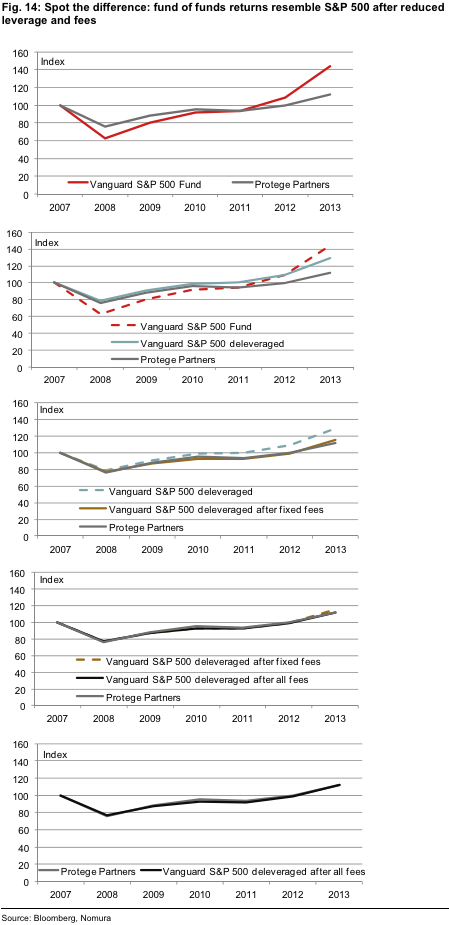
The latest, "The hare gets rich while you don't: back the passive tortoise" reviews a Nomura report covering the performance of "alternative investments," private equity and hedge funds. (The report is here, alas behind the FT's very confusing paywall.) A while ago I put together a class and talk covering hedge fund literature, but haven't updated it in a few years so reviews with updates are particularly interesting.

The fact that hedge funds and private equity have a lot of beta -- often hidden by infrequent or inaccurate marking to market -- remains true:


Source: Nomura via FT alphaville
"To achieve the returns of hedge fund portfolios:
1) start with basic market exposure using the S&P 500 index or a rolling short VIX position,
2) reduce leverage to achieve an exposure of somewhere between 30% to 60% of standard, and
3) deduct fees.

To achieve the returns of private equity:
1) start with a basic market exposure like the S&P 500, but more particularly the S&P Midcap 400, 2) increase leverage to achieve an exposure of somewhere between 120% to 150% of standard, and
3) deduct fees.

Which prompts a game of spot the difference.
Starting with the Vanguard S&P 500 fund, we de-leverage it (to achieve a 57% exposure, which is the beta of Protege Partners to the Vanguard S&P 500) and then deduct both fixed and performance fees. What we are left with is virtually indistinguishable from the performance of the Protege Partners fund of funds."

To me, the private equity results are novel -- though I suspect Steve Kaplan will disagree

I'm interested  by their finding that hedge funds do earn just enough alpha before fees to pay their fees. This fits the Berk and Green model in which investors get exactly the same return as in passive investments, more than the Fama and French view that there isn't any alpha in the first place and active investors are just being morons. Extending the Berk Green vs. Fama French debate to hedge fund data is low-hanging dissertation fruit.

Your favorite hedge fund manager will respond, "those results show the average hedge fund doesn't deliver anything to investors. But that's an average of good and bad funds. We're a good fund." Ah, but how to tell good from bad ex-ante, since they all say that? FT reminds us how little past performance tells us with a memorable anecdote:
Day to day, reporting spectacular bets that have paid off for individual hedge fund managers still makes for good stories about the hedge fund industry. But John Paulson did everyone a favour by being the genius of the financial crisis who made several fortunes betting agains mortgage backed securities only to then look like an idiot in 2011 when his flagship fund halved in value.
Selection bias is alive and well in private equity, or at least its marketing
To a large extent, private equity promoters are aware that there is some kind of performance problem in their industry. For this reason, marketing documents that we have seen describe the returns investors can achieve in private equity by referring to return data from the top quartile of private equity managers. This is done because the returns from a sample that included all private equity managers would not look impressive. 
For the statistically-minded, this practice is a whopper.
The rest of the series looks interesting too

Two-thirds of all hedge funds ever to report to a database are dead and defunct, yet their investment record lives on and the industry is hungry for fees...

Saturday, August 2, 2014

Work and Jail

I have run in to some interesting recent readings on the nexus between work, or the lack thereof, jail and drugs.  In case you didn't know, the numbers are staggering.

The table below, from The Prison Boom and the Lack of Black Progress since Smith and Welch by Derek Neal and Armin Rick, gives the fraction of black male high school dropouts employed, and below that the fraction that are institutionalized -- mostly in jail.

So, bottom left, in the last census, 19.2% of 20-24 year olds were employed, and 26.4 (!) percent were in jail. Read up, and it was not always thus. Of the cohort born in the 1930s, at the same age, 68% were employed and 6.7% were in jail -- in a society and criminal justice system that was, whatever our current faults, much more overtly racist. The numbers for older men are just as shocking if you haven't see these before.
Source: Derek Neal and Armin Rick
And really, that's just the surface.  Neal and Rick's numbers don't count the numbers on parole or otherwise under the supervision of the criminal justice system. And their numbers miss one of the biggest effects: In America, once you have a criminal record -- often even just an arrest record -- getting a job becomes next to impossible. So the flow through the criminal justice system, as much as the numbers currently in jail, is an important measure of its effect.

Becky Petit's Invisible Men: Mass Incarceration and the Myth of Black Progress calculates the cumulative risk of imprisonment, which gives a sense of how many people are in this quandary.
Source: Becky Petit
The less than high school black number rose from 14.7% in 1979 to an astounding 68% in the latest numbers. Nearly 70 percent of black high school dropouts will spend time in jail. And pretty much end their hopes for conventional employment as a result. (Things aren't great for white high school dropouts either, and 21% for black high school graduates is pretty shocking too.)


The main point of Petit's book, and echoed by Neal and Rick, is that institutionalized people don't show up in standard statistics. Employment to all population is, for minority men, even worse than the standard ratio of employment to non-institutionalized population. Which was already amazingly low.

What happened? That's the main point of Neal and Rick's paper. Crime got a lot better. Arrests are down. Neal and Rick's  main answer is that the criminal justice system got a lot harsher: arrests turned in to jail more often, and jail sentences got a lot longer.
A move toward more punitive treatment of arrested offenders drove prison growth in recent decades, and this trend is evident among arrested offenders in every major crime category. Changes in the severity of corrections policies have had a much larger impact on black communities than white communities because arrest rates have historically been much greater for blacks than whites.
But while this explains a larger number in jail, it doesn't square with Petit's finding of the much larger numbers that flow through jail. If the same number get arrested and spend more time in jail, then we would not see larger numbers with lifetime experience of jail.

The other suspect is the war on drugs. Neal and Rick do find that the rise in Federal incarceration is mostly about drugs:
Between 1989 and 2010, the stock of federal prisoners increased by more than 250 percent....The Federal prison population increased by about 150,000 persons over this period, [that's at any one time, so the total number of people flowing through the system is much larger] and increases for only three offense categories account for almost 90 percent of this growth...  drug offenses...81,000, weapons and immigration offenses...29,000 and 21,000 respectively...The stock of prisoners serving time for traditional violent and property crimes remained roughly constant..
 And overall, it is the one category where arrests rose:

Source: Neal and Rick 
So, perhaps the war on drugs disproportionately affects less-educated minorities, reconciling Petit with Neal and Rick.

What is life like for people in this situation? How do they even get by with so few working?  I've been reading the reviews, both positive and negative, of Alice Goffman's On the Run. (The book itself is still on the in pile alas.) But it seems like it gives us a useful sense of the broader impact of the war on drugs and the intense association with the criminal justice system.

Interesting observations fro the New York Times Review:
The war on drugs mangled, if not destroyed, any trust between residents of distressed urban communities and the authorities. 
Young men like Mike often avoid girlfriends for fear that the women, for their own reasons, might turn their paramours in
Yes, if the cops are looking for you, the first thing they'll do is ask a girlfriend, or if there was one, a wife, and the cops can be pretty persuasive. Then we wonder why marriage is rare and men are absent in their children's lives.

As you can see, I'm attracted to the view that a lot of this disaster is one more awful consequence of the pointless war on drugs.

The New York Times has come out in an excellent series of editorials for Marijuana legalization. The column on this prohibition's effects on minorities "The injustice of Marijuana Arrests"
America’s four-decade war on drugs is responsible for many casualties, but the criminalization of marijuana has been perhaps the most destructive part of that war. The toll can be measured in dollars — billions of which are thrown away each year in the aggressive enforcement of pointless laws. It can be measured in years — whether wasted behind bars or stolen from a child who grows up fatherless. And it can be measured in lives — those damaged if not destroyed by the shockingly harsh consequences that can follow even the most minor offenses.
Sometimes, unintended consequences reach farther than one would imagine.

Update: 

Some of the comments speculated that the high school dropout rate decreased, so we're just seeing a smaller sample of really pathological people.  Here's Petit's graph of the dropout rate. It is smaller, but that doesn't strike me as enough to account for the rather dramatic changes in employment, incarceration, or flow through the criminal justice system.

Source: Becky Petit