Monday, November 23, 2015

Hounded out of business

The Wall Street Journal had a nice oped, "Hounded out of business by regulators" by Dan Epstein who was, well, hounded out of business by regulators. Excerpts:
Last Friday, the FTC’s chief administrative-law judge dismissed the agency’s complaint. But it was too late. The reputational damage and expense of a six-year federal investigation forced LabMD to close last year.

...the commission opened an investigation into LabMD in January 2010. ...the FTC refused to detail LabMD’s data-security deficiencies.... Eventually, the FTC demanded that LabMD sign an onerous consent order admitting wrongdoing and agreeing to 20 years of compliance reporting.

Unlike many other companies in similar situations, however, LabMD refused to cave and in 2012 went public with the ordeal. In what appeared to be retaliation, the FTC sued LabMD in 2013, alleging that the company engaged in “unreasonable” data-security practices that amounted to an “unfair” trade practice.... FTC officials publicly attacked LabMD and imposed arduous demands on the doctors who used the company’s diagnostic services. In just one example, the FTC subpoenaed a Florida oncology lab to produce documents and appear for depositions before government lawyers—all at the doctors’ expense.
Yet after years of investigation and enforcement action, the FTC never produced a single patient or doctor who suffered or who alleged identity theft or harm because of LabMD’s data-security practices. The FTC never claimed that LabMD violated HIPAA regulations, and until 2014—four years after its investigation began—never offered any data-security standards with which LabMD failed to comply.

...the case illustrates the injustice of the federal system that allows agencies to cow companies into submission rather than seek a day in court. During its three years of pre-suit investigation against LabMD, the FTC demanded thousands of documents, confidential employee depositions and several meetings with management. LabMD—which at its apex employed 30 people—spent hundreds of thousands of dollars meeting demands. No federal court would ever allow such abusive tactics. But this isn’t federal court—it’s a federal agency.

Furthermore, the FTC is likely to simply disregard the 92-page decision—which weighed witness credibility and the law—and side with commission staff. That’s the still greater injustice: The FTC is not bound by administrative-law judge rulings. In fact, the agency has disregarded every adverse ruling over the past two decades, according to a February analysis by former FTC Commissioner Joshua Wright. Defendants’ only recourse is appealing in federal court, a fresh burden in legal fees.

That’s what happens when a federal agency serves as its own detective, prosecutor, judge, jury and executioner.
The anecdote has two larger implications, in my view. First, many people including myself have a sense that this kind of regulatory persecution is harming economic growth. But there are no good estimates of the total number of companies put out of business, jobs destroyed, investment made worthless by regulatory persecution, or, even harder, projects not started from fear of such persecution. For the moment, we can only collect anecdotes, which is why I pass this one on.  But the measurement question is vital. Inequality is only a big policy issue because we have statistics on it.

Second, note the pretty clear charge that the FTC retaliated against LabMD for challenging the FTC. In "The rule of law in the regulatory state" (pdf, blog version here; excerpt at the insider here)  I started thinking about the political and free-speech implications of this kind of persecution.

With exceptions such as Lois Lerner at there IRS, the agencies are still first and foremost interested in protecting the agencies.

But it's easy enough these days to figure out who donates to what campaign, or who blogs about what.  To imagine that this kind of persecution will not be used for partisan political purposes -- or that fear of such persecution will not drive company owners to make political friends, make abundant contributions, pay for expensive speeches, and so forth -- is to imagine that a plate full of cookies at a children's birthday party will stay untouched when mom and dad say eat your vegetables first.  LabMD clearly needed a friend in high places to call and say "make this problem go away." Its successors will not make that mistake.

Inflation Drumbeat

Noah Smith has an interesting Bloomberg View piece on Japanese inflation. Three crucial paragraph struck me
... Japanese unemployment is very low, and the economy is expanding at or above its long-term potential growth rate of around 0.5 percent to 1 percent. So according to mainstream theory, inflation would be an unnecessary and pointless negative for Japan’s economy. Why, then, are there always voices calling for Japan to raise its inflation rate?
Actually, there are several reasons. The main one is that inflation reduces the burden of debt. Japan’s enormous government debt represents the government’s promise to transfer resources from young people (who work and pay taxes) to old people (who own government bonds). Since Japan is an aging society, there are more old people than young people. That makes the burden especially difficult to bear. Young people also tend to have mortgages, the repayment of which is another burden.
Sustained higher inflation would represent a net transfer of resources from the old to the young. That would increase optimism, and hopefully raise the fertility rate, helping with demographic stabilization. It would also decrease the risk that the Japanese government will eventually have to take extreme measures to stabilize the debt.
I like these paragraphs because they so neatly distill the language used by the standard policy establishment to advocate inflation. Noah clearly separates the usual "stimulus" arguments from the new "debt" argument, which helps greatly.

Debt is a "burden." Sort of like snow on your roof, debt appears from the sky somehow and then represents a "burden" requiring "lifting," which would be beneficial to all.

Debt "represents the government’s promise to transfer resources from young people ... to old people.." Apparently, the government woke up one morning, and said "we promise to grab about two and a half years worth of income from young people and give it to old people." Undoing such an ill-advised promise does indeed sound worthy.

But, lest these soothing words lull you into idiocy, let us remember where debt actually comes from. The Japanese government borrowed a lot of money from people who are now old, when they were young. Those people consumed less -- they lived in small houses, made do with fewer and smaller cars, ate simply, lived frugally -- to give the government this money. The promise they received was that their money would be returned, with interest, to fund their retirements, and to fund their estates which young people will inherit.

Noah is advocating nothing more or less than a massive government default on this promise, engineered by inflation. The words "default,"  "theft," "seizure of life savings," apply as well as the anodyne "transfer." I guess Stalin just "transferred resources."


Amazingly, to Noah (and the views he ably summarizes here) this "transfer" will "increase optimism." Hmm. Let's look at the evidence for that. We have seen many large inflations, which wiped out middle-class savings along with government debts. Those events have generally been regarded as economically, politically, and psychologically destabilizing tragedies, not FDR-fireside-chat "optimism"-raising sessions. No surprise that few societies have voluntarily signed up for such treatment as Noah recommends. I would be curious to hear of a single happy historical antecedent. (I mean that. Perhaps I am mistaken in my understanding of Noah's proposal. A successful example might correct me.)

How does a government default benefit young people anyway? It does so if a large amount of tax revenue is being used to pay interest or principal on the debt, and the default is accompanied by a large tax cut for young families. Not by the same level of taxes and increased government spending on more railway-to-nowhere stimulus projects.  Without tax cut, there is no transfer. Noah is strangely silent on the essential big tax cut aspect of his plan.

Quiz: Find in Japanese (or American) government finances the actual "promise to transfer resources from young people (who work and pay taxes) to old people." If you say "government bonds," you (like Noah) got the wrong answer. The right answer is Social Security, Medicare, and public employee pensions. If Noah wishes to reduce the "burden" of intergenerational transfers, no matter that governments have promised to make those transfers and people have planned their lives around them, the silence on these promises is deafening.

If the purpose is default, why not just advocate default? A massive inflation also destroys private savings and wipes out private contracts. Oh wait, that's the point:
Young people also tend to have mortgages, the repayment of which is another burden.
Like the government, young people too I guess woke up one day and this "burden" parachuted down on top of their surprisingly big house.

So, according to Noah, a self-induced hyperinflation to generate an economy-wide debt default is necessary... to "decrease the risk that the Japanese government will eventually have to take extreme measures to stabilize the debt." I find it hard to imagine what more extreme measures he has in mind.

One practical difficulty: Like most governments, Japan rolls over debt fairly frequently. So inflation must come really quickly if it is to wipe out debt. A second practical difficulty: The BOJ, like our own Fed, seems completely unable to induce any inflation. With advice like this, thank goodness.

Another puzzle: What exactly is the "burden" of Japan's debt? Japan's interest rates have been zero for 20 years. Japan's growth rate g, as low as it is, is larger than its interest rate r. Japan pays next to nothing in debt service.  Is Noah joining the despised ranks of worrywarts like me that this can't last? But if it comes to an end, in a run on Japanese government debt and consequent inflation, then Noah gets what he wants. If it does not come to an end, Japan pays no debt service and gradually grows out of the debt. Where's the fire?

Again, this is not a post about Noah. One writes columns quickly, and space often prevents a full development of arguments.  I am resolved not to discuss or even imply criticism of a writer's motives, so if you infer that, undo the inference now.

Rather, let us appreciate and dissect Noah's language, logical loose ends, insouciant willingness to upend the lives of millions, and answers in search of questions, for how well they summarize so much policy blather; and therefore not to be lulled by that blather's repetition.  

Wednesday, November 18, 2015

Open Letter on Economic Data

I joined a large number of economists signing an open letter supporting funding for economic data. The letter is here, twitter #SaveTheData, Financial Times story here, press release here.

Few public goods are as cheap or important as good economic data.  Much of our national policy discussion is based on government-collected data. Changes in inequality, wage growth or stagnation, employment and unemployment, growth, inflation... none of these are readily visible walking down the street.

Free, openly accessible, well-documented data, allowing comparisons over long periods of time, such as provided by the Bureau of Labor Statistics, is especially valuable.

Already, much of the data we get is based on decades-old measurement concepts. Perhaps someday internet big data will bring us alternatives. But that day is a long way away. Let's not fly blind in the meantime.

Thursday, November 12, 2015

Permazero

St. Louis Fed President Jim Bullard gave a very interesting paper at the Cato monetary conference, with this great title.

Jim starts with this great picture. It's a simulation of the standard three equation new Keynesian model as we go from 2% interest rate to zero. This is an upside down version of the first graph in my "Do higher interest rates raise or lower inflation." (Blog post) But Jim makes a new and insightful point with it, that had not occurred to me.

Jim reads this as an account of what happened in 2008, not (my) tentative prediction for what might happen in 2016 in the other direction. It's compelling: The Fed lowers rates. This boosts output (black line) over what it would otherwise be, overcoming the horrendous negative shocks to the economy from a financial crisis. Inflation gently declines, which is also what inflation did after a one time shock in 2009, related to the output shock which the Fed was offsetting.


Jim then ties that together with my Figure 3 in an artful way. The same model that accounts well for slow disinflation in the recovery suggests that raising rates now, in the absence of other shocks, would just raise inflation and lower output.


Jim goes on to present some data averaged across a variety of countries. Here you see a pattern quite similar to the model's prediction. After recovering from the severe shock, inflation starts its gentle decline.

Like me, Jim is nervous about these conclusions. The data seem to be telling us that interest rate pegs are not unstable. The standard model turns out to have that prediction, but also predicts that raising interest rates, while lowering output as we have long been told, will just smoothly raise inflation. It's very hard to turn around decades of contrary doctrine -- that pegs are unstable, and raising rates lowers inflation. One should be nervous about such conclusions. Maybe inflation is, finally, just around the corner. So Jim makes very clear he's not yet recommending a rate rise to cause more inflation!

But one should also start thinking about what these conclusions mean if they are right, and Jim summarizes with a number of such implications. A few that seem especially important, with comment:
Third, longer‐run economic growth would still be driven by human capital accumulation and technological progress, as always, but without the accompanying stabilization policy as conventionally practiced from 1984‐2007. In principle, the economy would still be expected to grow at a pace dictated by fundamentals.
A little more bluntly, Japan-bashers cannot blame 20 years of poor growth on the zero bound. Nor should we worry that permazero will cause lower growth. (The other way around is much more likely: low marginal product of capital leads to low rates.) Japan's growth and inflation, like our own for the last seven years, has also been quite stable, raising the next question of just how much stabilization this policy was doing.
Fourth, the celebrated Friedman rule would arguably be achieved, so that household and business cash needs are satiated. In many monetary models this is a desirable state of affairs.
Yes!! Shout it from the rooftops.

Just what is so terrible about zero rates and very low inflation? Zero rates are the optimum quantity of money. They have financial stability benefits too. Banks sitting on huge piles of cash don't go under.

Conventional modeling has been treating the zero bound as a "trap," or a terrible outcome to be avoided. But it's a honey trap, at least in these models. The main complaint one could make is that they don't last, that they lead to spiraling deflation or hyperinflation. But the models said "trap" -- they last -- and the data seem to agree.
Fifth, the risk of asset price fluctuations may be high. In the New Keynesian model, the near‐zero interest rate policy with little or no response to incoming shocks is associated with equilibrium indeterminacy. This means there are many possible equilibria, all of which are consistent with rational expectations and market clearing. In a nutshell, a lot of things can happen. Many of the possible equilibria are exceptionally volatile. One could interpret this theoretical situation as consistent with the idea that excessive asset price volatility is a risk.
This is spot on. In the models, the trouble with the zero bound "trap" is not high unemployment, low growth, or spiraling inflation or deflation -- it has none of these. The problem is "indeterminacy," the possibility that inflation can bounce around a bit, each time returning stably back again. That's also what we seem to see, and it hasn't been a huge problem: We don't see any more inflation, output, or asset market volatility in the last 7 years than in the period before the crisis.

And this is a simple problem to solve in the theory. Add back the missing fiscal theory of the price level -- deliberately thrown out in the theory -- and you have determinacy again. In words, a jump to an alternative equilibrium requires that fiscal policy expectations also jump. If people's expectations of long-term fiscal policy are stable, then we have determinacy and no more volatility at the zero bound too.
Sixth, and finally, the limits on operating monetary policy through ordinary short‐term nominal interest rate adjustment in this situation would surely continue to fire a search for alternative ways to conduct monetary stabilization policy. The favored approach during the past five years within the G‐7 economies has been quantitative easing, and there would surely be pressure to use this or related tools.
I.e. in permazero, eventually markets get tired of reacting to whispers that the Fed might someday raise rates. Monetary policy overall becomes ineffective, leading central banks to try other levers. Which may not be such a great idea!

Tuesday, November 10, 2015

Taylor Truman Medal Speech

John Taylor's speech  on receiving the Truman medal for economic policy is noteworthy. John thinks about the institutions that govern monetary and financial policy. We spend too much time on the will-she-raise-rates-or-won't-she sort of decisions that we forget how important this institutional structure is to good, predictable and (as John might put it) rule-based policy.

John reflects on the institutions of postwar policy:
Seventy years ago Harry Truman signed the Bretton Woods Agreements Act of 1945. It officially created two new economic institutions: the International Monetary Fund and the World Bank. A year later he signed the Employment Act of 1946. It created two more new institutions: the President’s Council of Economic Advisers (CEA) and the Congress’s Joint Economic Committee (JEC). And in 1947 came the General Agreement on Tariffs and Trade (GATT) and the Truman Doctrine, and in 1948 the Marshall Plan.

Prewar problems:
... One serious economic evil leading up to World War II arose from competitive devaluations and currency wars...
A second economic evil stemmed from extensive “exchange controls,” in which importers of goods were forced to make payments to a government monopoly in foreign exchange. The government would determine what types of goods could be imported and how much to pay exporters. Exchange controls also involved multiple exchange rates, government licenses to export and import, and even officially conducted barter trade. They deviated from the principles of economic freedom, and caused all sorts of distortions and injustices...
Bretton Woods:
Each country—each party to the agreement—would commit to two basic monetary rules... First, they would swear off competitive devaluations by agreeing that any exchange rate change over 10% from certain values, or pegs, would have to be approved by a newly-created IMF. ... It was called an adjustable peg system.
Second, countries agreed to remove their exchange controls, with a transition period because many had extensive controls in place. The countries, however, did not agree to remove capital controls, which include restrictions on making loans, buying or selling bonds, and equity investments.
John's judgement:
In important respects the blueprint succeeded. Exchange controls were removed, though it took more than a decade, and the currency wars ended, though the adjustable peg system itself fell apart in the 1970s and gave way to a flexible exchange rate system. The 1970s were difficult because monetary policy lost its rules-based footing and both inflation and unemployment rose. 
But in the 1980s and 1990s policy became more focused and rules-based and economic performance improved greatly. Though not part of the blueprint, virtually all the developed countries that signed the original agreement—and others like Germany and Japan—also abandoned capital controls. By the late 1990s, many emerging market countries were adopting rules-based monetary policies, usually in the form of inflation targeting, and entered into a period of stability. Some emerging market countries, such as Brazil, began to remove capital controls, and the IMF recommended adding their removal to the articles of agreement.
I'm a bit skeptical of this judgement. (And I think I've persuaded John, so we'll see what happens in later writings.) Bretton Woods featured pegged exchange rates, something of a gold standard to the dollar, and capital controls to lessen exchange rate pressures. All three blew up by 1970. The basic structure of Bretton Woods failed.

The restoration of order in the 1980s featured important reforms to monetary and fiscal policies internationally, and the Bretton Woods institutions (IMF, CEA, etc.) may have had something to do with it. But Bretton Woods was gone.

Bretton Woods did, however, help to keep the chaos of the 1930s from returning. John's point may be that bad rules are better than no rules.

On to the present:
Unfortunately this benign situation has not held, and today the challenges facing the international monetary system eerily resemble those at the time of the creation...
Consider currency movements. Quantitative easing (QE) started in earnest in 2009 in the United States. It was followed by a period where the dollar was low relative yen. It was followed by QE in Japan in 2013 which depreciated the yen, as was the expressed intent of Japan governor Haruhiko Kuroda. That was followed by QE in the Eurozone in 2014 which depreciated the euro, as was the expressed intent of ECB president Mario Draghi. The dollar- yen-euro story from 2009 to 2014 looks a lot like the pound-dollar-lira story from 1931 to 1936, even though U.S policy makers today consider the exchange rate effect to be by-products of their actions, not the direct intent. So QE begets QE, which begets QE, and so on.
There is a big challenge understanding just how QE affects currencies. Notice John says "followed by." But if you regard QE as signals of future interest rates, it is easier to understand. Exchange rates are a sort of present value of future interest differentials.  Continuing
Interest rate decisions at central banks around the world also resemble currency wars. Whether you ask them or watch them, you can tell that central bankers are following each other. Extra low U.S. interest rates were followed by extra low interest rates in many other countries, in an effort to prevent sharp currency appreciations. Those low interest rates appear to have resulted in a boom-bust pattern in emerging market countries evident in the recent commodity cycle...
Capital also flows in response to interest rate differentials—even if attenuated by policy reactions. .. A host of government interventions and restrictions on housing markets have been used to prevent the low interest rates from causing bubbles. Macro-prudential regulations, which have legitimate purposes, are also being used to counter the effects of the low interest rates.
Worse,
There’s also been a revival of capital controls. Even the IMF has endorsed capital controls, calling them “capital flow management” or CFM for short.
John's conclusion
In my view we need a new strategy to deal with these problems.
So as in the 1940s we should forge an agreement where each country commits to certain rules... 
. A second reform would set up rules for eventually removing capital controls. Currently, 36 countries now have open capital accounts, but 48 are classified as “gate” countries and 16 as “wall” countries with varying degrees of capital controls.
John rethinks the role of the 40s institutions.
.. recreating the ‘40s founded institutions for today’s global economy must go beyond the IMF. The World Bank was originally created to supplement private capital flows for reconstruction and development. But today capital flows and savings to finance investment are abundant—some even see a glut.
He goes on to rethink the roles of CEA, JEC, GATT, WTO, and so forth.

Last but not least, international economic policy and foreign policy are intertwined. The Bretton Woods generation understood that.
...we see the same international cross-border encroachment on freedom, including economic freedom. In my view the United States should commit to promoting economic freedom as part of its foreign policy strategy. It should also strongly support economic leaders who are committed to economic freedom in their own countries. This is the lesson learned from the transitions from government control to market economies two decades ago, especially in Poland. The U.S. government strongly supported Polish economic reforms—the removal of price controls, of barriers to new businesses, and of subsidies of old state enterprises, along with a restoration of the rule of law and property rights. Today international support packages tend to do just the opposite: encourage more government subsidies and controls.
It is amazing just how much of the international financial and monetary architecture resides in institutions set up in the 1940s. Good rules need good institutions. But institutions need rethinking on occasion.

Sunday, November 8, 2015

The 13 Trillion Dollar Question

On Tuesday Nov 10 there will be a conference in Chicago on "The $13 Trillion Question: Managing the U.S. Government’s Debt" hosted by the Initiative on Global Markets at Chicago Booth, and the Hutchins Center on Fiscal and Monetary Policy at Brookings. (The Brookings announcement here.)

Robin Greenwood will present "The Optimal Maturity of Government Debt and Debt Management Conflicts between the U.S. Treasury and the Federal Reserve" arguing that the Fed and Treasury are working to cross-purposes -- the Fed buys what the Treasury sells -- and that the government  should go after low rates on long term bonds rather than the budget insurance of issuing long term bonds.

(The government faces the same decision a homeowner does: borrow at near-zero floating rates,  but maybe rates shoot up and so do your payments, or borrow long at 2% rates, and pay more if rates don't go up. Robin and Larry favor the former. I'm more risk averse. Maybe living in California has sensitized me  that just because you haven't seen an earthquake recently doesn't mean you shouldn't buy earthquake insurance. But it's a good argument to have qualitatively -- what's the risk, and what's the reward.)

I will present "A new structure for Federal Debt," arguing for an overhaul of which instruments the Treasury issues, to make them more useful for financial markets and financial stability as well as for government borrowing and risk management. (Earlier blog post about this paper here.)

There will be extensive discussion and broader issues, and (the big draw) a panel of Seth  Carpenter, Charles Evans, and Sara Sprung, moderated by David Wessel.

The conference is by invitation, but you can still sign up here until they run out of room, or email Jennifer (dot) Williams at chicagobooth (dot) edu. It will also be viewable by live webcast, link here, starting 1:30 central.

Update: Video of the event here.


Program

Session I - The Optimal Maturity of Government Debt and Debt Management Conflicts between the U.S. Treasury and the Federal Reserve

Speakers

Robin Greenwood, George Gund Professor of Finance and Banking, Harvard Business School
Samuel G. Hanson, Assistant Professor of Business Administration, Harvard Business School

Discussant

Guido Lorenzoni, Breen Family Professor, Northwestern University

Moderator

Austan Goolsbee, Robert P. Gwinn Professor of Economics, University of Chicago Booth School of Business

Session II - A New Structure for U.S. Federal Debt

Speaker

John H. Cochrane, Senior Fellow, Hoover Institution and Distinguished Senior Fellow, University of Chicago Booth School of Business

Discussant

James J. McAndrews, Executive Vice President, Federal Reserve Bank of New York

Moderator

Anil K Kashyap, Edward Eagle Brown Professor of Economics and Finance, University of Chicago Booth School of Business

Session III - Panel Discussion

Panelists

Seth B. Carpenter, Assistant Secretary for Financial Markets, Department of the Treasury
Charles Evans, President and Chief Executive Officer, Federal Reserve Bank of Chicago
Sara Sprung, Managing Director, Neuberger Berman

Moderator

David Wessel, Director, The Hutchins Center on Fiscal and Monetary Policy, Brookings Institution

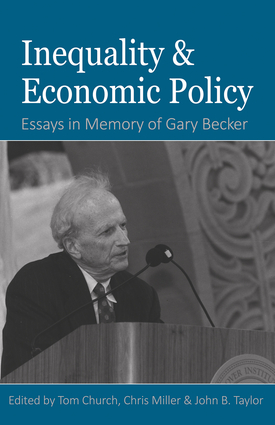
Inequality and Economic Policy Published

The Hoover Press put up for free the chapters of Inequality and Economic Policy: Essays In Memory of Gary Becker, edited by Tom Church, John Taylor, and Christopher Miller. You can of course still buy the book for a reasonable $14.95.

This includes the published version of my essay Why and How We Care about Inequality, also available on my webpage.  Bryan Caplan was kind enough to cover it positively last week, now you can read the original. I put a draft up on this blog last year, so I won't repeat it all today. As usual, the published version is better.

The rest of the contents:

Chapter 1: Background Facts By James Piereson

Chapter 2: The Broad-Based Rise in the Return to Top Talent By Joshua D. Rauh

Chapter 3: The Economic Determinants of Top Income Inequality By Charles I. Jones

Chapter 4: Intergenerational Mobility and Income Inequality By Jörg L. Spenkuch

Chapter 5: The Effects of Redistribution Policies on Growth and Employment By Casey B. Mulligan

Chapter 6: Income and Wealth in America By Kevin M. Murphy and Emmanuel Saez

Chapter 7: Conclusions and Solutions By John H. Cochrane, Lee E. Ohanian, and George P. Shultz

Chapter 8: Contents by Edward P. Lazear adn George P. Shultz