Friday, May 6, 2016

Global Imbalances

I gave some comments on “Global Imbalances and Currency Wars at the ZLB,” by Ricardo J. Caballero, Emmanuel Farhi, and Pierre-Olivier Gourinchas at the conference, “International Monetary Stability: Past, Present and Future”, Hoover Institution, May 5 2016. My comments are here, the paper is here 

The paper is a very clever and detailed model of "Global Imbalances," "Safe asset shortages" and the zero bound. A country's inability to "produce safe assets" spills, at the zero bound, across to output fluctuations around the world. I disagree with just about everything, and outline an alternative world view.

A quick overview:

Why are interest rates so low? Pierre-Olivier & Co.: countries can't  “produce safe stores of value”
This is entirely a financial friction. Real investment opportunities are unchanged. Economies can’t “produce” enough pieces of paper. Me: Productivity is low, so marginal product of capital is low.

Why is growth so low? Pierre-Olivier: The Zero Lower Bound is a "tipping point." Above the ZLB, things are fine. Below ZLB, the extra saving from above drives output gaps. It's all gaps, demand. Me: Productivity is low, interest rates are low, so output and output growth are low.

Data: I Don't see a big change in dynamics at and before the ZLB. If anything, things are more stable now that central banks are stuck at zero. Too slow, but stable.  Gaps and unemployment are down. It's not "demand" anymore.


Exchange rates. Pierre-Olivier  "indeterminacy when at the ZLB” induces extra volatility. Central banks can try to "coordinate expectations." Me: FTPL gives determinacy, but volatility in exchange rates. There is no big difference at the ZLB.

Safe asset Shortages. Pierre-Olivier: driven by a large mass of infinitely risk averse agents. Risk premia are therefore just as high as in the crisis. Me: Risk premia seem low. And doesn't everyone complain about "reach for yield" and low risk premia?

Observation. These ingredients are plausible about fall 2008. But that's nearly 8 years ago! At some point we have to get past financial crisis theory to not-enough-growth theory.

But, finally, praise. This is a great paper. It clearly articulates a world view, and you can look at the assumptions and mechanisms and decide if you think they make sense. I am in awe that Pierre-Olivier & Co. were able to make a coherent model of these buzzwords.

But great theory is great theory. To a critic, the assumptions are necessary as well as sufficient. I  read it as a brilliant negative paper, almost a parody: Here are the extreme assumptions that it takes to justify all the policy blather about "savings gluts" "global imbalances" "safe asset shortages" and so on. To me, it shows just how empty the idea is, that our policy-makers understand any of this stuff at a scientific, empirically-tested level, and should take strong actions to offset the supposed problems these buzzwords allude to.

I hope this taste gets you to read  my comments and the paper. 


Delong and Logarithms

Brad Delong posted a response to my oped on growth  in the Wall Street Journal. He took issue with my graph, reproduced here,


by making his own graph, here


He characterizes the difference between our graphs with his usual gentlemanly restraint,

"Extraordinarily Unprofessional!!:" "total idiocy" The University of Chicago and the Wall Street Journal Have Very Serious Intellectual Quality Control Problems

and so forth.

If you read Brad, you may wonder what skulduggery I used to make the plot. I will now reveal the dark secret. It's a clever Chicago-school mathematical trick:

Logarithms.

Yes, I plotted log income vs. ease of doing business index.

Now just how much of a sin is this? Well, growth theory is about growth, so it's pretty hard to do without logarithms. If thinking about percentage growth and running regressions with log income on the left hand side is a devious right-wing trick, I'm afraid we're going to have to throw out about 99% of growth theory and empirical economics, including much done by Brad's colleagues at Berkeley.

Furthermore, just look at the graph.  I invite anybody who has sat through a first-year econometrics class where they teach this devious technique to ponder my and Brad's plot, and think whether a level or a log fit is appropriate.

Brad raises one valid concern with all of empirical economics: Endogeneity. The graph is a correlation. How do we know that better ease of doing business causes better business, and not the other way around? In Brad's view, it is equally likely, I guess, that first a contry gets rich, and then it improves its laws and regulations.

I didn't mention this in the Journal, simply for lack of space (try to write anything in 950 words). In a previous blog post, here, I wrote a little bit about it.
One might dismiss the correlation a bit as reverse causation. But look at North vs. South Korea, East vs. West Germany, and the rise of China and India. It seems bad policies really can do a lot of damage. And the US and UK had pretty good institutions when their GDPs were much lower. (Hall and Jones 1999 control for endogeneity in this sort of regression by using instrumental variables.)
(This post isn't hard to find. I linked to from my growth oped post. And if one is curious about "what does John have to say about endogeneity?" -- a rather obvious question, which I ask about twice at every seminar -- it is also possible to email me. )

That post goes on to survey a lot of academic literature on just how important good institutions are to economic growth.

But just think about it. Did North Korea or East Germany first get poor and then get bad institutions? Did the UK and US first get rich, and then develop our rule-of-law and property rights traditions? Is reverse causality at all a plausible explanation for the correlation? Just about every historical episode you can think of goes the other way.

Endogeneity is always an issue in economics, but Brad's case that I am too dumb to have even thought about it, or that this correlation obviously goes the other way,  does not hold up.

But apparently, Brad doesn't know about google, fact checking, or emailing for simple clarifications either. Otherwise he would know that I don't work at Chicago anymore, hardly a secret.

The notion that universities should practice "intellectual quality control" is interesting in this era of declining free speech. Brad, be careful what you wish for.  "Controlling" basic professional ethics may come first.

If anyone is still curious, I posted my data and program to my website, and this post describes it some more. I didn't clean it up well, as I never thought this would be controversial, but at least it documents what I did. Feel free to play with it as you wish.

Update: It's clear from many comments and the twitter storm that many readers, even trained economists, missed this basic point. My graph is an illustration of a conclusion reached by hundreds, if not more, papers in the academic literature. It is not The Evidence, or even particularly novel evidence. Were it so, standard errors, specification search, endogeneity, much better measures of institutions, etc. would be appropriate, as many suggest. My graph is just a quick graphical illustration of the conclusions of much growth economics, including much work by Jones, Acemoglu, Barro, Klenow, and many many others. Institutions matter to economic growth; bad governments have amazing power to ruin economies.  As always in writing, I should have made that clearer; but I thought this literature was familiar to the average economist-blogger.

Update 2: There is, I think, an important mis-specification in a regression of log income on the ease-of-doing business index, which Evan Soltas implicitly points out.  I referred to the index as "simple" and "crude" for this reason, but again it looks like this seemingly obvious point needs expanding.

The World bank's measure is mostly focused on the ease of starting small businesses. When we look at the regulatory sclerosis in the US, it is a much wider phenomenon, encompassing the tax code, social program disincentives, the  recent huge expansion of federal involvement in health and finance, general spread of cronyism, reduction in rule of law, and so forth. These affect large businesses as much or more than small businesses.

Clearly, as we look across countries, the ease of doing business is correlated with these wider legal and regulatory problems. Countries with bad institutions overall also have bad ease of doing business scores. But just as obviously, only fixing the ease of doing business indicators without fixing the larger legal and institutional failures that correlate with those indicators, won't do a whole lot of good, which is what Evan seems to find.

The regulatory program I outlined there and in the longer essay on growth (blog post herehtml here,   pdf here) went far beyond ease of doing business indicators, for just this reason.

Update 3: Or, seemingly obvious point #3 that seems to need an answer. A few commenters have questioned  how far "out of sample" one can go. At some point, yes, institutions are perfect and more income will not result from improving them. Where is that? 90? 100? 110? I don't know. But the local derivative is still high, no matter how you fit the "out of sample" points. If you don't think you can draw the line out to 100, going from 82 to 83 still has very large effects.

Wednesday, May 4, 2016

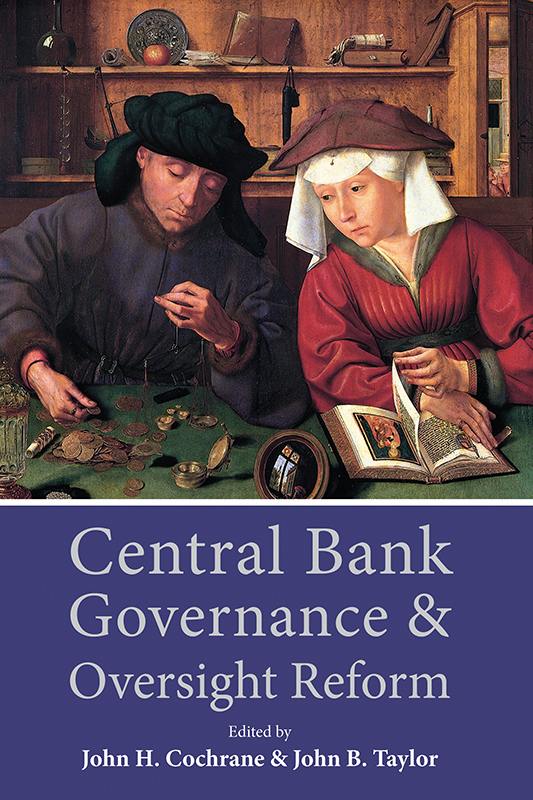
Central Bank Governance and Oversight Reform

The Hoover Institution Press just published "Central Bank Governance and Oversight Reform," the collected volume of papers, comments, and discussion from last May's conference here by the same name. You can get the  book or e-book here at the Hoover press or here at amazon.com. The individual chapter pdfs are available here.  Press release here.

(My modest contributions are in the preface and a discussion of Paul Tucker's Chapter 1. I agree it would be nice to have a more rule-based approach to lender of last resort and bailout functions, but wouldn't lots of equity so you don't have to mop up so often be even better?)

This is part of an emerging series of monetary policy conferences at Hoover. Tomorrow we will have a conference on international monetary policy. Stay tuned...


The blurb:
How can we balance the central bank’s authority, including independence, with accountability and constraints? Drawn from a 2015 Hoover Institution conference, this book features distinguished scholars and policy makers’ discussing this and other key questions about the Fed. Going beyond the simple decision of whether to raise interest rates, they focus on a deeper set of questions, including, among others, How should the Fed make decisions? How should the Fed govern its internal decision-making processes? What is the trade-off between greater Fed power and less Fed independence? And how should Congress, from which the Fed ultimately receives its authority, oversee the Fed?

The contributors discuss, for instance, whether central banks can both follow rule-based policy in normal times but then take a discretionary, do-what-it-takes approach to stopping financial crises. They evaluate legislation, recently proposed in the U.S. House and Senate, that would require the Fed to describe its monetary policy rule and, if and when the Fed changed or deviated from its rule, explain the reasons. And they discuss to best ways to structure a committee—like the Federal Open Market Committee, which sets interest rates—to make good decisions, as well as offer historical reflections on the governance of the Fed and much more. They conclude with an important reminder: how important it is to have a “healthy separation between government officials who are in charge of spending and those who are in charge of printing money,” the most essential part of good governance.
The contents:

Preface
By John H. Cochrane and John B. Taylor

Chapter 1: How Can Central Banks Deliver Credible Commitment and Be “Emergency Institutions”?
By Paul Tucker

Chapter 2: Policy Rule Legislation in Practice
By David H. Papell, Alex Nikolsko-Rzhevskyy and Ruxandra Prodan

Chapter 3: Goals versus Rules as Central Bank Performance Measures
By Carl E. Walsh

Chapter 4: Institutional Design: Deliberations, Decisions, and Committee Dynamics
By Kevin M. Warsh

Chapter 5: Some Historical Reflections on the Governance of the Federal Reserve
By Michael D. Bordo

Chapter 6: Panel on Independence, Accountability, and Transparency in Central Bank Governance
By Charles I. Plosser, George P. Shultz, and John C. Williams

Tuesday, May 3, 2016

Growth Interview


I did a short interview with the WSJ's Mary Kissel about my growth oped. If you can't see the embed above, try this direct link or this one

WSJ Growth Oped

I did an oped on growth in the Wall Street Journal, titled "Ending America’s Slow-Growth Tailspin." I'll post the full thing here in 30 days.

Blog readers will recognize a distilled version of my longer essay on growth (blog post herehtml here,   pdf here), and the graph from Smith v. Jones blog post. I think out loud. The growth essay is much more detailed on diagnosis and especially on policy.

There are three basic ideas (two too many for a good oped).

1) Growth is everything. Increasing growth will do way more for every problem you can name than anything else on the economic agenda. Even if workers in 1910 could have taken all of Rockefeller's wealth, they would have been disastrously poor compared to today.

2) Can policies actually improve growth? The tut-tutters mocked Jeb Bush's 4% aspiration. I outline the "we've run out of ideas" school of thought, most recently in Bob Gordon's thoughtful book; the "everything is right but the zero bound" secular-staglation school, and the view that the growth giant is being held back by a liliputian army of politicized regulators.

As evidence,  I improved on the graph from an earlier post of the World Bank's ease of doing business score vs. GDP per capita,


(if you can't see the graph, click here)

This graph adds a few things relative to the one in WSJ. I added some outliers. Libya and Venzuela seem like countries with good reasons to have temporarily more GDP than their institutions can long support, Rwanda and Georgia the opposite. So the correlation is even better than it looks. Given how crude the world bank measure is, it's surprising it works so well. It's mostly about the difficulties of starting small businesses. I added Greece too to gives some sense of variation within the Euro-US world.

The point: Bad policies can do dramatic harm. Ipso facto, good policies must be able to do a lot of good. The US is not perfect!

A famous economist challenged my view that regulation is causing a lot of problems, noting that all of the big business types he talks to don't complain that much. But I think that's a horrendous selection bias. If you talk to the people still in business, you are talking to the ones that have figured out the political and regulatory game. Go talk to the ones whose businesses are closed, or not even started.

Another point, regulation has been getting worse for decades. Why the slump now? I think that a lot of the government onslaught's effect has been to make the economy less resilient. For example, social security disability is not a problem as long as you have a job. When you lose a job, and go on disability, now the huge disincentive to work, study, move, kicks in.  Recovering from a recession needs new jobs, new businesses, new innovations.

3) A very brief outline of policies to get growth going again. I think the key is to move past the standard rhetoric that defines our current partisan bickering. It's not how much we spend, really, it's how we spend it. Free market economics is not "trickle-down" economics, it's about incentives, simplicity, rule of law, and so forth.


Saturday, April 30, 2016

Equity-financed banking

My dream of equity-financed banking may be coming true under our noses. In "the Uberization of banking" Andy Kessler at the WSJ reports on SoFi, a "fintech" company. The article is mostly about the human-interest story of its co-founder Mike Cagney. But the interspersed economics are interesting.

SoFi started by making student loans to Stanford MBAs, after figuring out that the default rate on such loans is basically zero. It
has since expanded to student loans more generally and added mortgages, personal loans and wealth management. Mr. Cagney says SoFi has done 150,000 loans totaling $10 billion and is currently at a $1 billion monthly loan-origination rate. 
Where does the money come from?
SoFi doesn’t take deposits, so it’s FDIC-free. ... Instead, SoFi raises money for its loans, most recently $1 billion from SoftBank and the hedge fund Third Point, in exchange for about a quarter of the company. SoFi uses this expanded balance sheet to make loans and then securitize many of them to sell them off to investors so it can make more loans
Just to bash the point home, consider what this means:
  • A "bank" (in the economic, not legal sense) can finance loans, raising money essentially all from equity and no conventional debt. And it can offer competitive borrowing rates -- the supposedly too-high "cost of equity" is illusory.
     
  • There is no necessary link between the business of taking and servicing deposits and that of making loans. Banks need not (try to) "transform" maturity or risk.
     
  • To the extent that the bank wants to boost up the risk and return of its equity, it can do so by securitizing loans rather than by borrowing. (Securitized loans are not leverage -- there is no promise of your money back when you want it. Investors bear any losses immediately and without recourse.)
     
  • Equity-financed banking can emerge without new regulations, or a big new Policy Initiative.  It's enough to have relief from old regulations ("FDIC-free").
     
  • Since it makes no fixed-value promises, this structure is essentially run free and can't cause or contribute to a financial crisis. 

More. SoFi does not use the standard methods of evaluating credit risk:
Instead of relying on notoriously inaccurate backward-looking FICO scores, SoFi is “forward-looking.” That means asking basic questions—“Do you make more money than you spend?”—and calibrating where applicants went to college, how long they’ve been employed, how stable their income is likely to be over time.
Why can’t banks do this? Because if you use depositor money for loans, as all banks do, you fall under the jurisdiction of the Federal Deposit Insurance Corp. and the Community Reinvestment Act,...
And Basel and the FSOC and the Fed and so forth. FICO score based mechanical lending standards are also demanded by government-backed securitizers Fannie and Freddie.

Yes, bank "safety" regulations demand that banks purposely lend to people that one can pretty clearly see will not pay it back, and demand that they do not lend money to people that one can pretty clearly see will pay it back.

Now, what will the regulatory response be to this sort of innovation? The right answer, of course, should be hosannas: You have introduced run-free banking, that solves all the financial-crisis worries that 90 years of bank regulation could not solve. Let this spread, and the army of bank regulators, lobbyists, lawyers, and associated politicians can all go, well, drive for Uber.

Somehow I doubt that will be the response from foresaid army. And SoFi might well want to invest in its own lawyers, lobbyists and politicians in today's America.
Rather than by the FDIC, SoFi is monitored by the Consumer Financial Protection Bureau. The overbearing regulator that was Elizabeth Warren’s brainchild thus far hasn’t come down on SoFi—the CFPB is perhaps too preoccupied with using “disparate impact” analysis of old-school auto-loan businesses to focus on a relatively exotic, app-based form of banking. But Mr. Cagney should watch his back.
Indeed he should. In today's rather rule-free environment, the CFPB -- or Department of Justice -- might just discover it doesn't like the demographics of Stanford MBAs as target borrowers.
He’d like to get a national lending license, but that would entail federal-oversight entanglements he’d rather avoid.
If he can.

A little puzzle crops up at the end. For now, I gather SoFi does not issue public equity. The plan for expansion is
insurance companies and sovereign-wealth funds might rent him their balance sheets. 
I'm not sure what "rent a balance sheet" means, but it sounds a lot like private equity or long term debt.  It would be even better for stability and low cost to issue public equity, which is liquid -- investors who need money fast can sell. But public equity comes with its own regulatory scrutiny, and perhaps even that is too much for innovation these days.

Tuesday, April 26, 2016

Macro Musing Podcast

I did a podcast with David Beckworth, in his "macro musings" series, on the Fiscal Theory of the Price Level, blogging, and a few other things.


(you should see the link above, if not click here to return to the original).

You can also get the podcast at Sound Cloud, along with all the other ones he has done so far, or on itunes here.  For more information, see David's post on the podcast.